Saturday, April 05, 2014

Albuquerque to Grand Canyon: Spring Back to Winter

April 3, 2014 -- post delayed due to no wireless internet or time for it while at the Grand Canyon for 2 nights! But now, here it is, as I wrote it down Thursday night.

West of Albuquerque as we drove onward this morning, the mountains were unimaginably beautiful. We came over a pass and I saw spectacular deep red cliffs, deep blue-green trees, and areas of vivid white snow, all illuminated by the rising sun. For a moment, I couldn’t grasp what I was seeing. Then: breathless.

On the highest pass we saw police and tow trucks working to clear a number of vehicles that had obviously slipped off the road earlier in the morning. Luckily, the pavement was quite safe by the time we drove by.


Just past the New Mexico-Arizona border we stopped at a landscaped rest area where all the flowering trees had pink blossoms drooping under deep snow. Bushes and yucca plants were outlined in snow. We definitely regressed from spring back to winter today.


Along the road in the mountains we saw four or five extremely long container trains with containers stacked two high on most of the cars. We also saw a couple of conventional freight trains. Sometimes you can’t see to the end of the train, they are so long.

The tracks parallel highway 40 – old route 66, as one is reminded repeatedly by tourist attractions memorializing the old highway. I don’t miss it at all: four lanes are much better than two!


Thanks to another time change, we arrived at the Grand Canyon by 2 PM and spent the afternoon looking into the canyon and birdwatching in the Kaibab National Forest (without much luck). The area near the visitor center is amazingly crowded despite being off season, though turnoffs along the road east were quite open. Quite a bit of the park is off-limits to private cars – you have to take a shuttle bus. 


We’re staying in the Yavapai Lodge, which consists of a number of single-story buildings like an old motel. The room is quite nice and we’re glad to be right in the park. 

On April 4, we spent the entire day in the park, and now we have made it to Ontario, California. I'll be adding more posts about each of these days and what we have seen, eaten, and done. We've definitely seen winter and spring alternating: our highest temperature on the trip was 80 degrees registered on the car thermometer and 22 degrees reported overnight at Grand Canyon.

Wednesday, April 02, 2014

Spring has come to Albuquerque

Traveling west from Oklahoma City today we enjoyed the changing scenery. Farmland and wind farms in western Oklahoma, the boring and very flat Texas panhandle including feedlots, and the desert and mountains of New Mexico. In Albuquerque, it's spring.

The sun was shining in the Plaza in Old Town.

Historic San Felipe church in the Plaza
Even the Mexican curio shops are full of sunshine!
Real spring flowers in bloom in the courtyards with tourist shops.

Wall paintings and benches in sun-filled courtyards
Around an hour before we made it to Albuquerque we changed drivers at a super-touristy roadside attraction called "Cline's Corners." (If you've read American Gods by Neil Gaiman, it's that kind of place, only bigger.) The copied ceramic story-teller statues and fake Indian pots all made in China, the junky copies of Indian jewelry and cheap imitation Indian blankets were depressing, but this was the worst:
"Medicine Man Speaks -- $1.00"
I really could not believe I was seeing this in the twenty-first century! I thought they got rid of this kind of thing long ago.

Tuesday, April 01, 2014

From Winter to Spring

When we left Ann Arbor, everything was snow-covered.
West Lafayette was cold, but no snow, and the trees were bare.
We were very cold when birdwatching at Celery Bog.
Len and Elaine went down to the Wabash River and saw this eagle
while I was huddling by the fireplace.
As we drove towards St.Louis from Indiana, we started
to see a little bit of light green in the fields and on highway medians.
In St.Louis a few early trees and daffodils were in bloom,
including Jay and Ruby's star magnolia shown here. 
Tonight we are in Oklahoma City. As we left Missouri on highway 44 this morning,
the light greens turned to bright greens and we started to see trees with tiny leaves and
some in full bloom, like this one in a shopping center near where we ate dinner.
Besides birdwatching in West Lafayette, we went to two sanctuaries on
the Mississippi near St.Louis.

We were impressed by the bird blind that looked like a big sculpture.
What you can see from inside the blind.
The blind from outside. The ponds are controlled by levees, and invite both
winter migrants (which left a few weeks ago, alas) and summer resident birds.
We just saw a few, though quite nice ones.
Bridge over the Mississippi from the Riverlands Sanctuary.
Confluence of the Missouri and Mississippi Rivers. I remember going near
here when I was a child, but it was all farmers' fields and you couldn't
get to the actual point from which we observed this. It was great!
Birds in the ponds of the Missouri Bottoms Conservation area,
which includes the south-west point at the confluence.
I also posted this on my food blog. Correction: should be Columbia Bottoms Conservation Area.

Saturday, March 22, 2014

The car is dirty from all that salt

It's been a terrible winter in Michigan. Though the car was washed earlier this week, it's covered with salty splatters again. In a week we are driving back to Santa Barbara. Not such great timing, you might say, since we just suffered through winter and will miss early spring in our own yard, but that's ok with me. I'm really looking forward to the drive out, and all the California fun -- including the world's most beautiful car wash (which I've written about here several times). Some repeat photos just because I'm thinking about it ...

carwashfountain
Fountain in a corner of the carwash
carwash6352
I hope they are still in business

Wednesday, March 19, 2014

Container Ships

Seattle, 2013
Colon, Panama, 2014

Colon, Panama, 2014, where we boarded the Sea Lion.
A vast number of container ships either travel through the Panama Canal or
drop off their cargo to be transported across the isthmus by rail and picked up by others.
Many of the container ships are too large to go through the canal.
Yesterday, I read an article about people who like to watch shipping containers, "Container Spotting," at Edible Geography, a rather strange blog I read occasionally. The article described the challenge of "container spotting" -- that is, identification of containers, where they might have come from, where they might be going, and what their contents might be. Evidently there are two types of spotters: "those who track container ships, and those who track the containers themselves on port and on land."

The blog post described a new book about to be written for those who love this pastime. Though I like looking at the containers on ships or in port, I never even wondered about identification. I guess I'm not going to participate in the Kickstarter campaign for the book -- it's already oversubscribed anyway. But it made me wonder just a little about what was in the containers we saw in Seattle and Panama.

The article also mentioned two other books on containers, Ninety Percent of Everything: Inside Shipping, the Invisible Industry That Puts Clothes on Your Back, Gas in Your Car, and Food on Your Plate by Rose George, and The Box: How the Shipping Container Made the World Smaller and the World Economy Bigger by Marc Levinson. I've already read The Box, which is a wonderful history of shipping containers and the labor issues that accompanied their takeover of worldwide shipping. Maybe I'll read the other book some time.

Monday, March 17, 2014

Souvenirs

Not Mona Lisa: this is a Costa Rican Last Supper.
Original Last Supper -- Wikipedia
Our last bus stop on the way to the airport: a souvenir stand alongside the road, with vast quantities of wood carvings, weavings, pottery, and everyday tchotchkes.

I'm always fascinated by Leonardo parodies like the one above which featured prominently in the souvenir stand. The ewer and towel in the foreground are not present in the original, shown at right. The Central-American embroidery on the tablecloth is more prominent than the faint embroidery in the original. Most interesting: the length of the table is very condensed here, compared to the original, and the dramatic vanishing point effect is completely lost.

A Costa Rican slang expression: "Mae" means something like "Dude"
Who knew? "Pura Vida" is the national slogan. Like "Pure Michigan," I guess.
I bought a very nice woven bag for carrying miscellaneous stuff, and instantly used it as an extra carry-on bag for the plane trip home. I only collect Mona Lisa items, so I didn't buy the Last Supper, just took the photo. And I didn't buy the "Mae" license plate either.

This was also the first place where we had free wireless internet since leaving Miami a week earlier: a record for no-internet living.

Sunday, March 16, 2014

Hammocks

In the afternoon, hammocks cast a long shadow
Private inholdings in Costa Rica's national parks offer a
perfect place for relaxing on the beach
A multi-colored hammock casts an upside-down rainbow reflection
on a still pool near the ocean
When you think of a tropical retreat, maybe you picture a quiet beach hotel to which you bring one suitcase of books and one suitcase of clothes. A friend of mine mentioned that she was planning this sort of trip next month to Saint Martin in the Caribbean. A hammock on the beach, someone to bring you a drink... that's a vacation.

Nothing could be more different than our visit to Costa Rica and Panama. For us: no time to lie down! Each day we had two or three activities on foot or by boat: identifying birds or trees, scanning for monkeys or iguanas, and learning new things about digital SLR settings and framing images effectively. In fact, the rainbow hammock above was pointed out by one of the two photo professionals on our trip. While the ship was moving, we listened to lectures or workshop sessions about photography or learned from the naturalists aboard about the history and background of our visits. One evening, we watched a Nova special about the Panama Canal. No hammocks for us, except as photo subjects.

Friday, March 14, 2014

Beaches


Every day of our trip in Panama and Costa Rica included a visit to a beautiful beach. The photos above show a selection of beaches, including the one with optional horseback riding, which we didn't do.

A tiny island called Granito de Oro in Coiba Island National Park was one of the most impressive. It's so tiny that it's dreamlike.

This was our first look at Granito de Oro, which means little gold nugget.
You can see the wide sand  beach in front of the rocky tip.
On Granito de Oro. We snorkeled around the small rocky point beyond the sand.
Underwater pictures I took while snorkeling are here.
To get from the Sea Bird to the beaches: a zodiac boat (also called a DIB). Life jackets mandatory!
This shows how we got from the Sea Bird into the zodiac -- with help from a crew member.
At the beach, one steps off the boat into the waves. I always got off the boat barefooted.

Tuesday, March 11, 2014

The Panama Canal

canal 8
Looking back towards the boat sharing the locks with us
as we traveled through the Canal. 

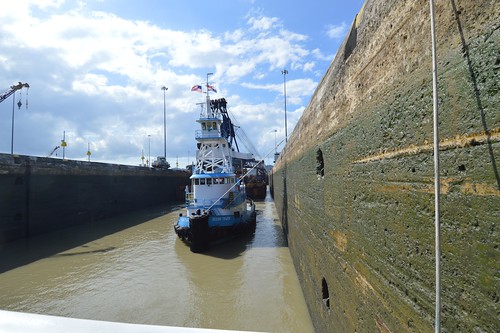
Our trip through the Panama Canal was beautiful. The first night of our trip -- March 1 -- we went through the first set of locks, on the Caribbean (or north) side of the isthmus. Our ship, the Lindblad-National Geographic Sea Lion, was towed by tractor-like "mules" that were designed and built for the canal originally during the construction process, that is around 100 years ago.

We spent the night and the next morning in Gatun Lake, the large artificial lake on the Chagras River. The huge rains of the surrounding rainforest fill the lake and provide the water needed to work all the locks. After a tour of Barra Colorado Island in Gatun Lake, we proceeded through the Culebra Cut, the major engineering achievement of the original designers of the canal.

A modern bridge spans this deep canal, just before the Pacific locks, which step the boat back down to the level of the Pacific Ocean. By dusk, we were sailing around Panama City and towards the Pearl Islands in the Gulf of Panama for our next day's activities.


The entire Flickr set is here: Panama Canal 2014.

Sunday, March 09, 2014

Hello, World! We're back from our trip.

A sloth
Here are a very few highlights of last week's trip to Panama and Costa Rica. I had always wanted to see a sloth. I had always wanted to see the Panama Canal and to see a toucan. We saw them all, and much more.
We started at the dock in a large cargo port in Colon, Panama.
We quickly entered the first set of locks on the Panama Canal, which was as fascinating as we expected.
In Panama and Costa Rica we enjoyed many nature walks, seeing a very large number of species of plants, birds, reptiles, monkeys, fish, whales, dolphins, and little critters.
A false killer whale beside the ship. You can just see the anchor at left.
They love to surf in the ship's bow wave. Later some dolphins did the same thing. 
I'll be adding more posts about the ship, the trip through the canal, and all the wildlife we saw.

Toucans

Wednesday, February 26, 2014

Panama: looking forward and backwards

from Pirates on the West Coast of New Spain 1575-1742

The isthmus of Panama was of great interest to the early Spanish settlers. They found the "Darien Jungle Route" a good way to move silver from the mines on the west coast of South America to ships in the Caribbean and onward to Spain. Cities now at either end of the Panama Canal were founded early in the sixteenth century.

Pirates and buccaneers quickly began to try to take the gold, as described in the book Pirates on the West Coast of New Spain 1575-1742 by Peter Gerhard. Sir Francis Drake raided Nombre de Dios, on the Caribbean side of Panama, in 1572. The next year he crossed the isthmus and raided a mule train carrying Peruvian silver. 

In 1575, Drake and his partner John Oxenham, along with their sailors, hid a ship on the Caribbean (north) side of Panama and recruited a group of runaway slaves who lived in the jungle there. With this local help, the pirates were able to cross to the Pacific side and build a new ship to use in raiding the Spanish. The Spanish had thought shipping on the Pacific side was safe, so their ships were unarmed. Thus Drake and his men quickly took a small ship carrying gold and food (a commodity that was very much needed by all the pirates who ever worked the west coast of New Spain), and then took a huge ship, capturing silver bars and prisoners. Oxenham also fell in love with a Spanish woman, saved her, and somehow arranged for the prisoners' escape, so his expedition did not end well. Drake's many later exploits and explorations in the Golden Hind are much more famous than these early events in Panama. (p. 57-60)

A century later, Henry Morgan, "probably the most unsavory pirate to reach the shores of the Pacific" crossed the isthmus with 1400 men in order to attack the very rich city of Panama, which then had a population of 15,000 to 20,000. Though the Spanish tried to stop them as they came through the jungle in January of 1671, Morgan and his men battled the Spanish defense army, killed 400, and sacked the city of Panama. The pirates tortured the inhabitants, burned buildings, and took prisoners and  large quantities of loot. Morgan betrayed his men but went on to be a pirate-fighting governor of Jamaica. (p. 138-140)

I'm also reading a history of the Panama Canal: The Path Between the Seas: The Creation of the Panama Canal, 1870-1914 by David McCullough. The canal opened almost exactly a century ago.

Panama now, from google maps ... where we plan to be on a Lindblad ship, starting next Saturday


Tuesday, February 25, 2014

Public Accomodations

From Facebook

Saturday, February 22, 2014

The Panama Canal

Photo from my copy of Richard Halliburton's Book of Marvels

From amazon.com

In a week, if all goes as we've planned it, we'll be cruising through the Panama Canal with Lindblad/National Geographic Expeditions, and then on to Costa Rica where we hope to see lots of wildlife. Our ship goes through the canal at night, as the big freighters have daytime priority, but I think it's going to be very exciting. Though not as exciting as swimming through the canal, which has been done exactly once, in 1928, by adventurer Richard Halliburton. He paid 36¢ for his toll, and was accompanied by a rowboat.

My longing to travel began when I was around 12 years old, when a neighbor introduced me to the books of Halliburton, a travel writer who had been active from 1920 until his disappearance in the Pacific Ocean in 1939. She loaned me all of them, beginning with the Book of Marvels, a compendium of his adventures. The swim in the Panama Canal was described in the book New Worlds to Conquer, in which I also recall the descriptions of the fortress in Haiti and the story of the rebellion there in the early 19th century.

One of the copies she let me read was even autographed -- years earlier, when she was in high school, she had gone to a book signing at a bookstore near her home (I think she was from Connecticut). She had been an avid fan, and described what a handsome man he had been, saying how she hung around the bookstore all afternoon just looking at him.

Halliburton still appeals to a surprising number of readers, despite or maybe because his books describe a world that's no longer the same, and describe a sort of adventure-seeking that way too many people have attempted to copy. An article in the Guardian just last year called him "the greatest adventurer in history" -- see "Seven League Boots by Richard Halliburton – review" by David Shariatmadari, published February1, 2013. This reviewer writes that according to Halliburton, "Traditional societies, black ones in particular, are 'primitive'. His retelling of the astonishing story of Henri Christophe, King of Haiti, is polluted with racist condescension and stereotype. But curiosity and a love of the unfamiliar also leap from the pages." I didn't have that kind of sophistication when I was reading the books. I just loved the idea of those adventures.

If you can't resist saying to me "A man, a plan, a canal, Panama," I'll answer "Rats live on no evil star."