From Ann Arbor to Des Moines is neither varied nor very interesting. Beautiful barns and silos, plowed fields (probably going to be corn), baled hay on still-green hillsides. That's about it. Move on, nothing to see here, folks!
Wednesday, May 16, 2012
Day 1: Ann Arbor to Des Moines
From Ann Arbor to Des Moines is neither varied nor very interesting. Beautiful barns and silos, plowed fields (probably going to be corn), baled hay on still-green hillsides. That's about it. Move on, nothing to see here, folks!
Monday, May 14, 2012
The Arboretum
Friday, May 11, 2012
In the Garden
Tuesday, May 08, 2012
Mason Neck Park, Near Fairfax, VA
One weekend activity: a walk along the shore at Mason Neck State Park and the adjacent national wildlife refuge. It's really beautiful. We saw turtles, songbirds, and best of all, we saw the eagles that nest there as they flew above the woods. Wild or maybe semi-wild iris and mountain laurel were blooming in the woods.
Teacher Appreciation
Today was Teacher Appreciation Day. This morning (just before we left Fairfax) Miriam and Alice picked some iris and peonies to bring to several teachers. When we were children, we also had iris and peonies in the yard and brought them to our teachers. I not only remember what they look like, and what it's like to cut them, but also the powerful perfume from both flowers.
Monday, April 23, 2012
Thursday, April 19, 2012
New Canoe Channel in Huron River

The old spillway was in trouble, so they built this beautiful channel next to the river, eliminating the need to portage a canoe into the river below the dam. Some of the narrow places look a bit rough -- we'll wait and see how it is when canoe season really starts. This is going to also be a great path for bikes or walking: both wonderful sports in Ann Arbor.
Saturday, March 31, 2012
Sunday, March 25, 2012
The rabbit eats sticker bushes
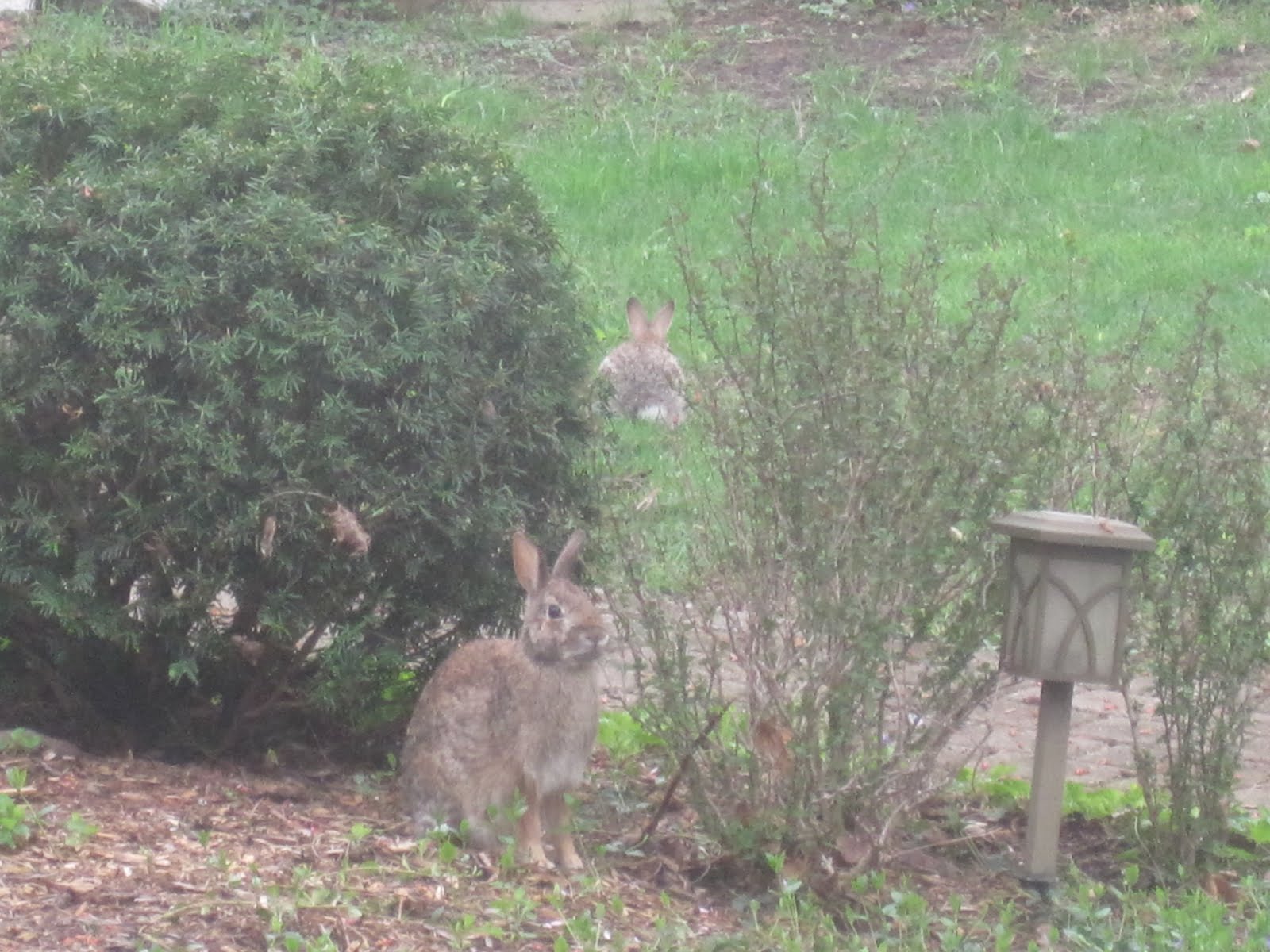
Yesterday I noticed Peter Rabbit chewing on my little bayberry bushes. He was rearing up on his hind legs to reach the tasty little leaves that are just emerging. These aren't very nice bushes, so he's welcome to them. A bit behind him I could see Flopsy or Mopsy or maybe Cottontail -- just up from his ears you can make out her little tail. (Of course I have no idea of whether these are girl or boy rabbits. And I didn't capture a photo of him in the act of eating the bush.)More interesting wildlife was nearby after dark. We heard an owl's trilling hoot -- familiar, now, as I've been hearing it before dawn quite frequently this spring. We also got a look at its silhouette on a branch, showing up against the cloudy sky. When the owl moved from tree to tree, I could just make out the shadowy form as it flew. The moon is almost dark, so it was a very shady perception -- definitely too dark to take photos with any equipment we own.
From the cry we identified it as a screech owl. In the early morning I sometimes thought it was a distant alarm clock, as it makes a repetitive trilling sound, repeated regularly.
Thursday, March 22, 2012
Fluxus Feet

"Painting to be stepped on" is the name of this painting, which is displayed unframed on the floor. So I stepped on it, see? "Fluxus" is the name of an art movement from around 50 years ago. To me, it looks as if it's mainly a copy of the ideas of Marcel Duchamp, with the exception of one or two artists who didn't stay only with Fluxus.
Sunday, March 18, 2012
"The Dervish House"

The Dervish House by Ian McDonald, though mainly a sci-fi story about technology in the near future of 2027, is also a political novel about Turkish history and its imagined future. The uneasy relationship between the remnant of Greek residents and the majority Turkish population is treated in an interesting way through several characters. Ethnic Turks, Greeks, Armenians, Kurds, and Jews all have at least a small role in the story. The city itself -- and the crumbling Dervish House of the title -- have big roles in the story.
The history of Turkish persecutions and population transfers in the 20th century, including the coup of 1980, is key to the personal history of several characters, especially a Greek economist who lives in the Dervish House along with several other main characters. Although at the beginning, he’s an old man who doesn’t go out much, he’s suddenly drawn into a very involved plot involving extremely futuristic nanoscience as well as complexity theory and several other trendy science topics. We learn slowly how his career was ruined years earlier by prejudicial treatment by his professional colleagues and the administration at Istanbul University, and how this one event makes him feel at least somewhat vindicated.
The economist’s understanding of a variety of theories enables him to figure out and help to pin down and stop a dangerous conspiracy. As he acts, we learn of his memories of his experiences in twentieth century Istanbul. Although he and his Greek and Jewish friends and family were extremely Turkish in their sense of identity, they were branded as disloyal, and exiled or worse. Both he and another character, an antiques dealer, also allow the author to present a capsule version of the presence of these minority groups in the longer history of the city.
Istanbul was on my list of cities with secular Jewish populations that I plan to study in the course of this year (so far, I’ve done some work on Odessa and Vienna). Earlier, when I looked into this subject, I didn’t find much about secular Jewish life in Istanbul. Jews seem to have remained relatively observant, or at least not to have called attention to any secular points of view as they did in several other cities. I didn’t expect to find such relevant ideas a Sci-Fi book (or whatever speculative fiction genre this book may belong to).
Overall, I found The Dervish House to be a good read for a number of reasons including the social, political, and science fiction, the careful use of historic detail, the convincing portraits of a wide range of characters, and a suspenseful plot.

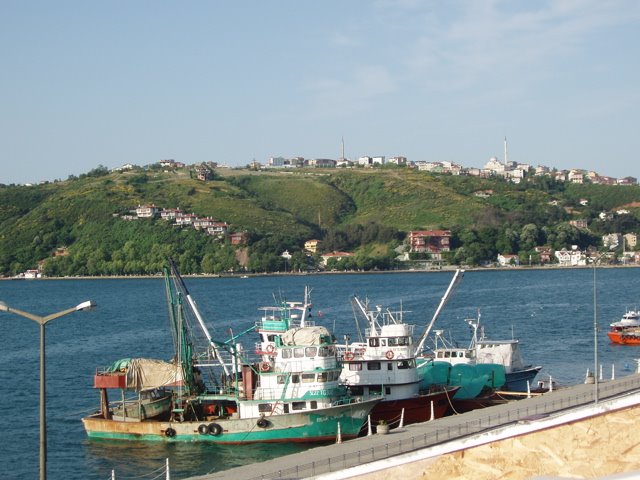
I love the way he describes the city: I could often picture the places where actions occurred, based on my visits to Istanbul. I especially remember watching the ships on the Bosphorous (above) and seeing the bridge where some of the action takes place (top of post).
This post was written for my other blog, Hero or Anti-Hero.
Thursday, March 01, 2012
In the Water
Tuesday, February 28, 2012
Birds on the Shore
Sunday, February 26, 2012
Friday, February 24, 2012
From our lanai ...
From our condo, we have a view of Kahaluu beach park. We snorkeled here this morning, just walking right down the street to get to the water. It's beautiful, though the current is high so there weren't quite as many fish as at real peak times. We also walked to a nearby historic area where two seaside heiaus (buildings from the original Hawaiians' religious rituals) have recently been restored.
Friday, February 17, 2012
Liking E-Books or Not
I have written once or twice about my reaction to e-books, specifically Kindle books, which I now read mainly on my iPad Kindle app. I just read a very satisfying summary of objections I have overcome or problems I have learned to live with. Tim Parks, in a New York Review of Books article titled "E-books Can't Burn," asks why should we dislike e-books? His possible reasons why are insightful:
"Could it be the fact that the e-book thwarts our ability to find particular lines by remembering their position on the page? Or our love of scribbling comments (of praise and disgust) in the margin? ... We can’t so easily flick through the pages to see where the present chapter ends, or whether so and so is going to die now or later. In general, the e-book discourages browsing, and though the bar at the bottom of the screen showing the percentage of the book we’ve completed lets us know more or less where we’re up to, we don’t have the reassuring sense of the physical weight of the thing (how proud children are when they get through their first long tome!), nor the computational pleasures of page numbers (Dad, I read 50 pages today). This can be a problem for academics: it’s hard to give a proper reference if you don’t have page numbers."And the author then asks: "But are these old habits essential?" I think it's a really good question, and for me the answer is, I can do without these old habits and expectations. I make those complaints from time to time, but I've really learned to live with e-books and even to mark up the passages that I want to come back to. Anyway, I never wrote in books, just left sticky notes to myself on the pages.
Monday, February 06, 2012
"The Iron Lady"
Yesterday we saw "The Iron Lady" with Meryl Streep as Margaret Thatcher, both old and (pretty) young. Her performance was amazing, though at one point I couldn't figure out why I was thinking of Julia Child. Oh, yeah, "Julie and Julia" !The recap of British politics of the Thatcher era was interesting, and seemed to bring up the issues that are currently being debated. Do you solve economic downturns and low employment through austerity? Do you tax the poor at an effectively higher rate than the rich? We don't know yet.
In the film, the real drama was in the 24 hour time of the frame story: the life and memories of very elderly Margaret Thatcher on one day in November, 2008, as she sees the Mumbai Massacre events on her TV, and as many similar events of her life, along with other events, flash back in her mind. The memories are vividly and literally recreated as relatively brief onscreen vignettes for the movie viewer. The result is the kind of unity of drama -- the classic kind.
I knew nothing about this film before we went; somehow I hadn't read a single review. So it was all the more impressive. Though I didn't and don't like some of Thatcher's policies and politics, I have a lot of respect for how she led her country, for her determination, and for her success in overcoming prejudice against her (as a woman and a grocer's daughter). The film reinforced that respect. All in all, it's quite worth seeing.
Wednesday, February 01, 2012
Is this serious?

Could this be real news about a copy of Mona Lisa by a student working side-by-side with Leonardo? I guess there will be some discussion. I knew of the copy in the Prado, but now there are big new claims about it! And look: eyebrows.
Tuesday, January 24, 2012
Saturday, January 21, 2012
Samuel F.B. Morse at the Louvre
Last week in Washington, we saw a little-known painting by Samuel F.B. Morse. He's well known for the telegraph and Morse code, little known for his early-life career as a painter. Morse's huge oil painting "Gallery of the Louvre," which he painted during a visit to Europe from 1829-1832, is temporarily on view in the National Gallery of Art. In it he arranged an imaginative view of the works he most valued at the Louvre. He placed them to be of use to students, and painted some of his friends and his daughter in the room where he imagined them.
The National Gallery has hung Morse's work in a large hallway in the center of the museum, along with a very interesting explanation -- and a key to the works. I recognized many of them, but the key is very useful. Above you can see his arrangement of Mona Lisa -- below is Len's photo of the work as we saw it.
Morse based the work on many prior paintings that made a similar collage-like assembly of copies from a single museum's collection. He based his choice of paintings on his own taste and that of his contemporaries. He hoped this work would bring him fame and money, as he planned to exhibit it on a tour of the US. That didn't go as well as he hoped, so he turned to technology and became famous.For more detail about Morse's paintings and the Louvre's collected works he included, see this website.
Monday, January 16, 2012
Skaters at the National Gallery of Art
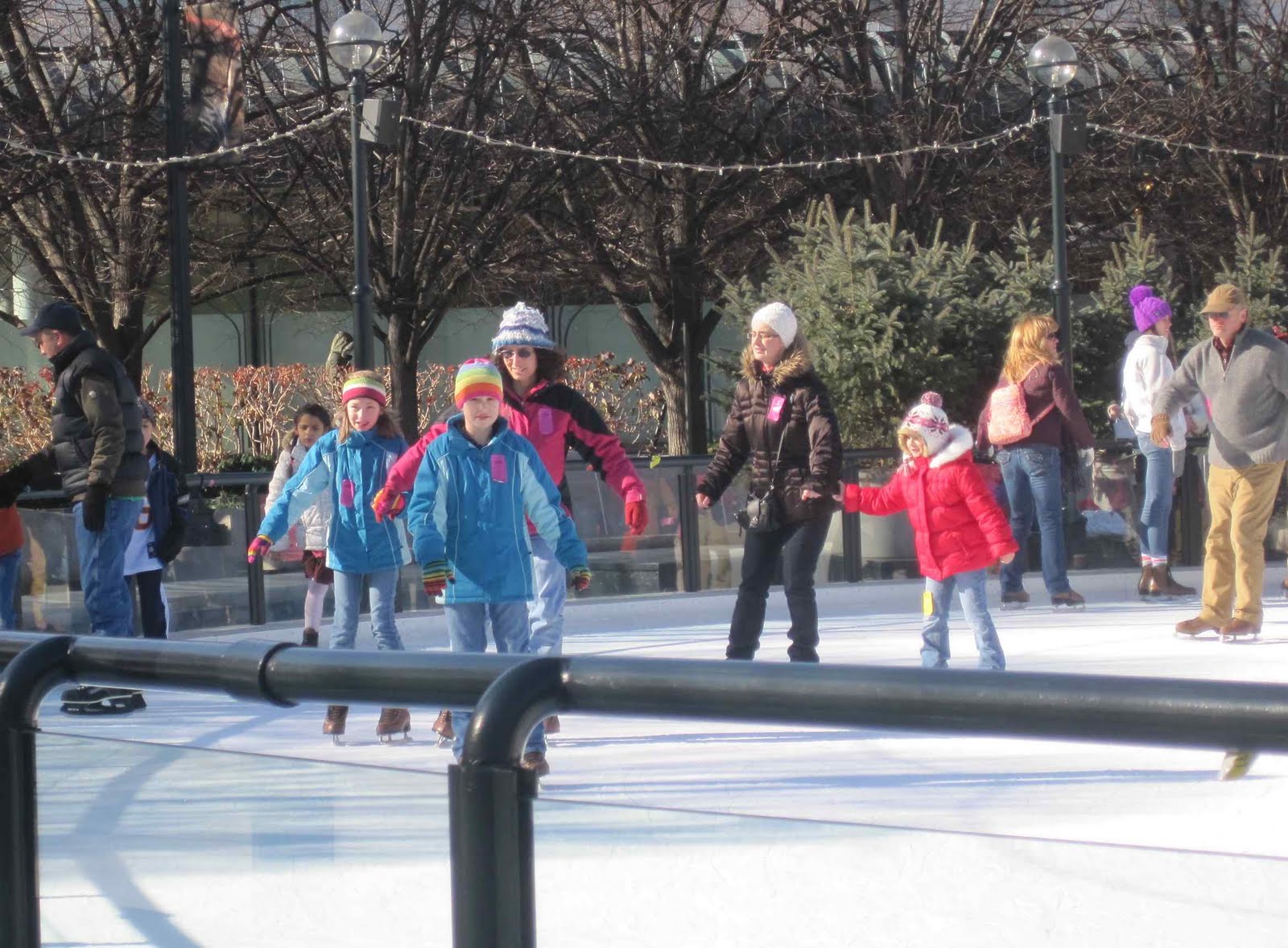
Skating at the National Gallery rink -- Miriam, Alice, and Evelyn, 2012.
"Winter Landscape with Skaters" (detail) by Adam van Breen, 1611.
Inside the National Gallery.
Sunday, January 15, 2012
Morocco, London, and the High Seas
"TinTin" begins in London, where he's a reporter. His exciting adventures take place on the high seas, in an old crumbling English-country manor house, lost in the Sahara, and in a seaside city in Morocco. Quite a bit of travel!
The visuals in "TinTin" were great. Sometimes they closely followed what you see in a cartoon, sometimes departed from that. I thought they very effectively combined realism with parody. Some of the people in the film were nearly caricatures -- an opera singer, a drunken ship captain, an evil villain, a Scotland Yard team, TinTin himself, with his quiff, and most of the minor characters. Some characters at times were quite realistic like TinTin when he's making a plan, the Sultan of Morocco, Snowy the dog or a camel in the port town. Some characters started out realistic and suddenly and enjoyably switched to something unexpected. The net result: an exciting and fun to watch experience.
Saturday, January 14, 2012
Friday, January 13, 2012
Traveling Again
Fairfax, Virginia, on a beautiful sunny day in January: the shadows seem very long for the early afternoon. We walked around a small lake surrounded by houses and apartment buildings, but with just enough woods to be very pleasant.
Here's Alice:
Subscribe to:
Posts (Atom)