![]() |
| Coral mushrooms growing on the path. |
Saturday, July 11, 2015
Mosquito Walk
Wednesday, July 01, 2015
Wrap up on Svalbard: Where were we?
![]() |
-- Map from "Vacations to Go."
|
The only permanent settlement on Svalbard is Longearbyen, a coal-mining town as well as a tourist destination, which is called out on the map. We toured this small town, population around 2000, on the first and last days of the trip. For a week the National Geographic Explorer was our home, as we made our way to a number of landing points and sightseeing points in search of wildlife and beautiful Northern views. The sun never set during this entire voyage.
Here are links to documentation about our wonderful trip:
- For Len's wildlife photos on Flickr, CLICK HERE.
- For all my posts about our Norway trip on this blog, including this one, CLICK HERE.
- For my food blog posts about Norway, CLICK HERE.
- For the Lindblad Expeditions daily trip reports, CLICK HERE. (You will see the first post and can continue to go through them.)
On the National Geographic Explorer: June 18-24, 2015:
![]() |
| The bow of the Explorer. |
![]() |
| The bridge of the Explorer seen from the bow. |
![]() |
| A fogbow, sometimes called a white rainbow. |
![]() |
| Near-midnight sun seen from the bridge. |
![]() |
| The Explorer in port at Longyearbyen before our expedition began. |
Monday, June 29, 2015
The Tundra
![]() |
| This stretch of tundra is especially green because of a nearby bird nesting colony. |
Just a few inches beneath the standing water or water-soaked lichen is hard ice. Unable to soak into the ground, water flows down every slope. At the shoreline are braided streams and rivulets flowing across rocks, gravel, or sand. On the Svalbard islands, much of the terrain slopes very steeply up mountain peaks, ground down by glaciers in various ice ages. From a distance, everything looks like black rock or brownish grass, usually interspersed with snow.
![]() |
| Kittiwakes on a hillside near their nesting colony. |
![]() |
| On a steep slope, our guide showed us a dead gull. |
Cliff-side nesting colonies are occupied by sea-going birds -- kittiwakes, dovekies (aka little awks), guillemots. (I will be doing another post on the nesting colonies.) Ducks, geese, and loons swim in the ponds on the tundra or in the sea.
![]() |
| Long-tailed ducks. |
Small wading birds like phalaropes and sandpipers pick at the vegetation.
![]() |
| Pair of phalaropes beside standing water on the tundra. |
![]() |
| Purple sandpiper. |
![]() |
| A snow bunting. |
Sunday, June 28, 2015
Marine Mammals
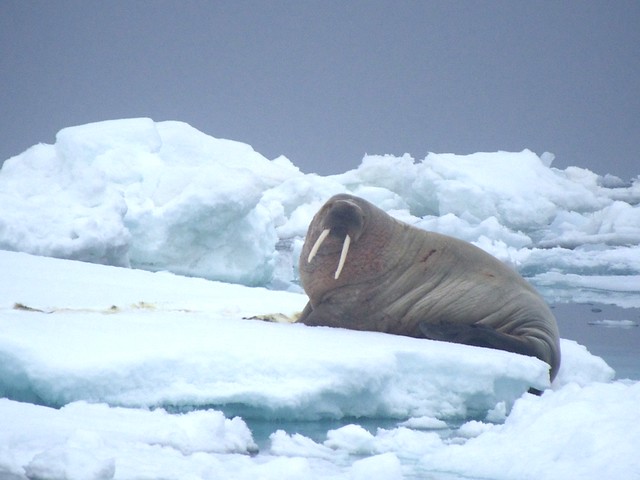
Watching marine mammals from the bow of the ship was one of the most exciting parts of our trip to the Arctic on the National Geographic Explorer. Here are some of Len's photos from his Flickr set:


And one more swimming mammal, as seen from our cabin window on the last day of the voyage:
On the boat in yellow is the ship's doctor, ready for any emergency. On the platform next to the Zodiac boat: the ship's scuba diver Carlos. Unfortunately Carlos had a equipment failure so there were no dives from our ship this trip.
Don't forget that the polar bear is also a marine mammal, as it's a fantastic long distance swimmer. We didn't see any swimming polar bears.
Walking on the tundra near shore we often saw the bones of marine mammals that had been washed up or perhaps dragged by polar bears, which enjoy a rare treat when they find a beached whale.
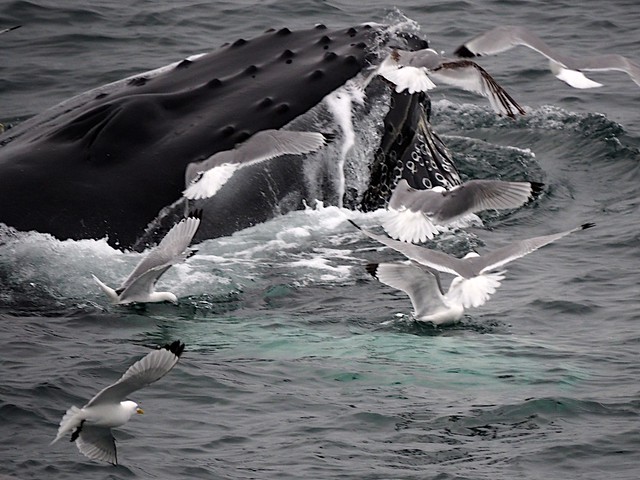
A humpback whale followed by kittiwakes that were sharing the krill brought up as he fed.

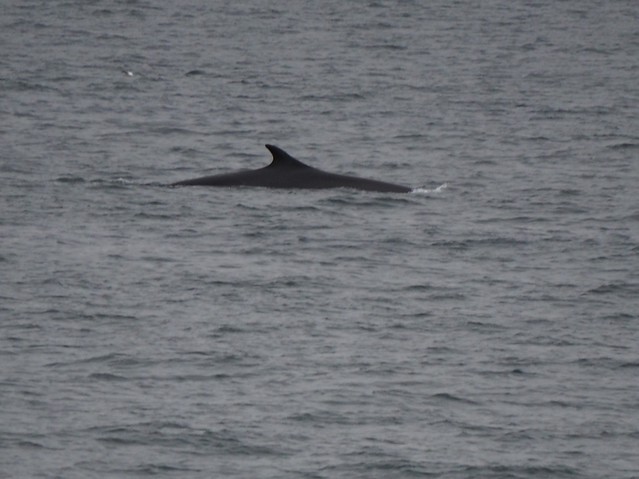
A fin whale.
Fin whales have a larger fin than the blue whales that we also saw. The blue whale is the largest mammal ever known; the fin whale comes in second.

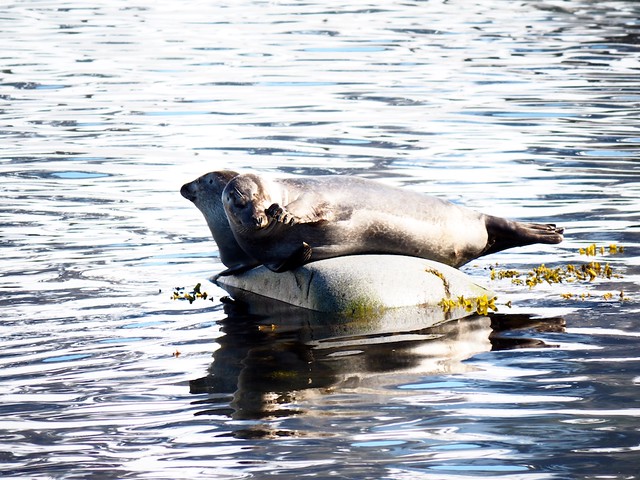
Harbor seals. We also saw bearded seals on the ice.
And one more swimming mammal, as seen from our cabin window on the last day of the voyage:
Three passengers doing the "Polar Plunge."
On the boat in yellow is the ship's doctor, ready for any emergency. On the platform next to the Zodiac boat: the ship's scuba diver Carlos. Unfortunately Carlos had a equipment failure so there were no dives from our ship this trip.
Don't forget that the polar bear is also a marine mammal, as it's a fantastic long distance swimmer. We didn't see any swimming polar bears.Walking on the tundra near shore we often saw the bones of marine mammals that had been washed up or perhaps dragged by polar bears, which enjoy a rare treat when they find a beached whale.
![]() |
| A seal's bones. |
![]() |
| Whale bones with Len for scale. |
Saturday, June 27, 2015
Svalbard Reindeer
Reindeer on the Svalbard islands are a sub-species of the reindeer that live in Greenland and Norway and elsewhere in the Arctic. They are fatter with shorter legs; thus they are adapted to the extreme climate. Svalbard is an arctic desert -- not much snow at all, very dry, few nutrients in the thin layer of soil, much permafrost, quite sparse vegetation. The reindeer live on the few varieties of moss and lichens growing on the permafrost.
We saw at least a few reindeer on almost every hike that we took from the boat, and also some quite near to the town of Longyearbyen. There's a hunting season for people who live there, which is carefully monitored to cull the herds. The hunters who receive a permit and take a reindeer eat the meat and use the hides for warmth. The reindeer meat that we sampled on the boat was from mainland reindeer, which are more numerous.
![]() |
| The reindeer at rest in the first photo above is a tiny spot on the right hillside in this photo. |
Female reindeer have a shovel-like tine on their antlers which they use to scrape away snow and get to lichens in the winter. They thus keep their antlers; the males use the antlers in fights over females and then lose them.
![]() |
| Our guide shows us an antler shed by a reindeer last fall. |
![]() |
| Reindeer grazing near the kittiwake nests. |
![]() |
| On a different walk. At left, antlers that have been shed. At right: a reindeer skull with a full set of antlers attached. |
![]() |
| Reindeer grazing on purple saxifrage. |
![]() |
| Purple saxifrage in bloom on the tundra. |
![]() |
| Reindeer in the snow, seen on a different hike. Because their fur is hollow and fluffy, it's especially good at thermal insulation. |
![]() |
| Baby reindeer belonging to the pair above. |
![]() |
| Reindeer fur that the guide showed us. |
We expected to hear that polar bears to prey on reindeer, but we learned that the reindeer are too fast for them. Though a polar bear can sprint, their heavy fur (also hollow and very effective at insulation) means that they become overheated if they try to do a long run, as they would need to do to take down reindeer.
![]() |
| Reindeer antlers decorating a house in Longyearbyen. |
Friday, June 26, 2015
Svalbard
Here's the iPhone compass reading from the nearly highest point on our trip around Svalbard last week. Highest was 80ยบ 20'. Virtually no satellites cover the arctic -- you see "No Service."
We are now at home where the sun actually sets and it gets dark for several hours a night. We hadn't see a totally dark sky for 2 weeks, until last night! I'll be posting more images and descriptions of our fascinating visit with polar bears, colonies of nesting birds, reindeer, walks on the tundra, and more.
Tuesday, June 16, 2015
Oslo Street Scenes
Saturday, May 30, 2015
Subscribe to:
Posts (Atom)