Monday, July 30, 2007

Ancient Sicily

In The Leopard, Di Lampedusa's prince observes that Sicily was the America of the ancient Greeks: a nearly empty land with some easily vanquished tribes, where they could found major cities and expand their civilization.

Major pre-Greek cities included Selinunte, which eventually became Greek, adopted Greek religion, and developed Greek ways. The Punic wars between Carthage and the ancient Greeks and Romans were fought to dominate Mediterranean ship traffic: Sicily is very close to Europe, and spans the narrowest portion of the Mediterranean; Carthage was close to the point across from Sicily. Until the end of the Middle Ages, ships hugged the shore; this was especially true in ancient times -- look what happened to Odysseus whenever he was blown off course and into the wine-dark sea!

Because Selinunte was destroyed in one of the later Punic wars and then forgotten, it's a magnificent source of archaic Greek and even pre-Greek art and architecture. These friezes from one of the main temples there were collected in the 19th century and brought to the museum in Palermo (a typical 19th century thing to do: take the art work away from the site -- lucky it isn't in Rome or London!) Greek mythological themes are easily recognizeable: I have selected just a few images.

The city itself has a full acropolis, including a theater, marketplace, and many other civic buildings, and a vast, open-roofed temple, which we visited on an earlier trip. The lion-head water spouts from the temple and a vast grotesque face are the most impressive items in the collection. Numerous vases, oil lamps, clay and bronze statues, figures from ancient Greek and pre-Greek graves, and other items from Selinunte and elsewhere are also on display in the museum.


Shipwrecks preserved much evidence of art and technology from ancient times as well: the first helmet, below, obviously spent millenia at the bottom of the sea. The museum also claims the world's largest collection of ancient anchors. These are made from stone and bronze or iron, and are on display all around the courtyard of the museum.


Sunday, July 29, 2007

Mediterranean Views


The above photos show the seascapes seen from the hotel.
Here's one of the several swimming pools -- the water cascades from an elevated pool:


And here is the marina in Palermo, situated in the inner bay called La Calsa.

Palermo Streets

The first photo shows the statues at the Teatro Massimo, just across the square from our hotel in Palermo. The rest of the photos show various street scenes within around a half-hour walk from the hotel.


Friday, July 27, 2007

Palermo Sunday Flea Market

As we walked around Palermo last Sunday we came to a tree-filled square enclosed in a fence, with flea market stalls set up all the way round the fence. One thing we realized: this is the place to see the old cart panels from the classic Sicilian farm carts which once were a predominant tourist attraction. Of course the motor scooter, truck, and automobile have now replaced all horse-drawn transports.


Thursday, July 26, 2007

Sicilian History and Beaches


We just spent a week in Sicily -- without much internet access. We visited several historic monuments in Palermo, and then spent a few days at a beach resort, where Lenny attended a conference. Our arrival was hectic: after an hour of waiting at the carousels, we spent another hour in a long line to report two missing bags. They finally caught up with us at the second hotel. Fortunately our Palermo hotel was in a shopping district -- so we each have a few new clothes. And luckily, a bookstore in the area had a pile of the new Harry Potter, which was released on the second day of our trip. We've now both finished reading it.

During the trip, I also read two relevant books: Roger II of Sicily: A Ruler between East and West by Hubert Houben and The Leopard by Giuseppe di Lampedusa. Roger II, king of Sicily in the 12th century, and his immediate successors built some of the beautiful churches we visited, so it was interesting to learn about that era. The first photo at left shows a mosaic of the coronation of Roger, which we saw in La Martorana church. The book explains the iconic significance of this image, which may not be a portrait in the modern sense, but symbolizes Roger's kingship in several ways. For example, his clothing is the regal garb of a Byzantine emperor. Roger's high official, George of Antioch, a Syrian Christian, built La Martorana.

La Martorana stands beside San Cataldo church, which has Arab-style domes. The second photo shows the exteriors of the two churches. As illustrated by just these two buildings, Sicily was at the intersection of three cultures: Western European Catholic (Roger held his kingship as a vassal of the Pope), Byzantine, and Arab.

The Leopard was especially enjoyable to read in context. In the first scene, the main character (a Sicilian prince living just before the reunification and democratization of Italy) goes from his palace on a hill down into the center of Palermo: just where we had been walking. Throughout the book, I was delighted with descriptions of the environment where I was reading: the rugged landscape, the dry heat, and the blazing sun.

I'll be posting more of my photos of the landscape, the food, the streets of Palermo, and my favorites of ancient Greek artifacts from the archaeology museum.

Wednesday, July 18, 2007

Sunday, July 15, 2007

"Celebrating the Spirit of Innovation in America"


We took a three and a half mile walk along the Huron River and around Argo Pond today. As we walked beside the railroad tracks, approaching the dam, these are some of the images we saw. Most of the route goes through quite pretty woods along the river banks, in contrast to this area, where the junkyard cleanup has not quite worked out yet.

Thursday, July 05, 2007

Quote from "Mountains Beyond Mountains"

"Paul has created technical solutions to help the rest of us get to decency, a road map to decency that we can all follow without trying to imitate him.... Paul is a model of what should be done. He is not a model for how it should be done. Let's celebrate him. Let's make sure people are inspired by him. But we can't say anybody should or could be just like him." (Mountains Beyond Mountains: The quest of Dr. Paul Farmer, a man who would cure the world by Tracy Kidder, p. 244)

This quote is from Paul Farmer's associate Jim Kim, explaining that the poor people in Haiti and elsewhere can't wait until exceptional people like Paul Farmer come along to get good health care. I think this attempt to de-emphasize personal qualities is a key idea in reading the book. The idealism, effectiveness, super intelligence, self-sacrifice, diplomatic skills, persuasiveness, and determination of Paul Farmer can too easily become the focus of the reader, and can prevent focus on Farmer and his associates' actual goals.

When I initially heard of this book, I was reluctant to read it because I expected a sort of myth-making hero worship. It's much broader than I expected, with many well-presented themes. It particularly discusses the rise of drug-resistant TB and struggles against it, the plight of the poor in Haiti and tendency of many people to turn their backs on them, similar reactions to extreme problems in other areas of the world, and bureaucratic tendencies to make big mistakes because they rigidly avoid correcting small mistakes. I think the challenge of the book is to see all the themes, not just the one illuminating figure of Paul Farmer, remarkable though he is.

I'm looking forward to discussing the book at the next meeting of my book club.

Wednesday, July 04, 2007

Fourth of July Parade

No one can remember when the first Fourth of July Burns Park Neighborhood parade took place. The flyers were stapled to telephone poles throughout the neighborhood this year, again by a few informal volunteers, who also drove the one and only car leading the parade. We walked up the parade route, a few blocks from home, and met it coming down Olivia Street.

"Don't let it touch the ground!" said the mother (above) to the baby trying to wave a flag.


The most recent parade I attended before today was around 28 years ago. Evelyn and her friend Becky had a float on a red wagon. Our dog Dolly won a prize that year for wearing a patriotic bandana. The dog in the photo above looks a little like Dolly. Nobody was awarding prizes this year, but watermelon was served to all at Burns Park, the end of the parade route.


Houses along the route -- and all over the neighborhood -- were ready for the Fourth.

Monday, July 02, 2007

Kyoto Temples, 1994


Katsura Detached Villa: Kyoto, Japan, 1994


Reading about sushi inspired me to review some old photos we took on our two trips to Japan. The Emperor's villa is open only to invited visitors, and there's a long waiting list, but Mariko and her parents made sure we were on the list. Every detail of Japanese tradition, including a moon-viewing platform, tea houses, stone pathways, water gardens, and self-consciously rustic buildings are all included and utterly beautiful.

Saturday, June 30, 2007

The World's Navel

......all that fighting over this place. Every real day, thousands of years into the past, and underlying so much of the background of Chabon's alternate history.

Thursday, June 28, 2007

Michael Chabon: The Yiddish Policemen's Union

Jewish history is complicated and full of opportunists, sell-outs, optimists, altruists, realists, and dreamers. Depressing reversals of fortune and betrayals are fundamental to any part of it. It's hard to grasp any big picture of Jewish history or identity. So much is distorted, intentionally or through accidents to the people who might have told their story.

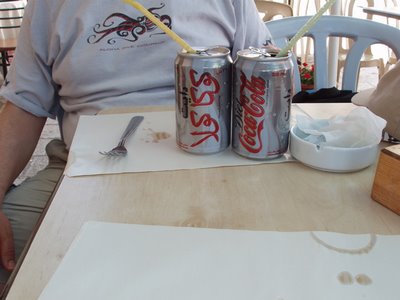
In the modern Jerusalem I've experienced, the views of history vary enormously. Black-hats (a.k.a. Hassids or Haredi) live, work, study, and possess their own view of history. Every person sightseeing or weeping at the Western Wall of the ancient Temple has his own view, I'd say. The Arabs selling tea and Oriental sweets and Falafal and Arab-logo Coke, the Christian tourists -- everybody has a point of view. Any Jew in Jerusalem surely senses the fragile nature of the Israeli success. Seeing Jewish history alive like this is scary.


In The Yiddish Policemen's Union, Chabon has made up a bizarrrely alternate Jewish history. He embeds a huge palate of characters and events in a consistent invented world where Jewish life continues despite its terrible recent past. Using just a few allusions and references, he creates an alternate end to World War II and to the foundation of the State of Israel. The Zionist dream in Chabon's alternate world means something entirely different than it meant before the war, or what it may mean now, retrospectively. The book is so self-contained that I think the reader has no time to ask if the alternate history is at all plausible. That's just not an issue, I'd say.

Comparison with Philip Roth's The Plot against America, another alternate Jewish history, seems inevitable. But Chabon's whole approach differs utterly. Roth gave us ordinary characters faced with an extreme challenge, and his point is to highlight their survival. Chabon gives us extraordinary characters, primarily policemen, murder victims, and criminals. He creates a Chassidic sect that controls organized crime in the temporary Jewish settlement in the wilds of Alaska (Did I mention that the alternate Jewish reality is in Sitka? Well, it is.) He creates a whole society of transplanted Jews who have named their streets and buildings after 19th century Yiddish heros and authors, and have adapted to life in the modern world -- especially guns and cell phones -- without really abolishing the Shtetl.

Above all, unlike Roth, Chabon never really tells us if his imagined Jewish community survives the ordeal he puts them through. Looking forward, his main character at the end of the book considers: "Any kind of wonder seems likely. That the Jews will pick up and set sail for the promised land to feast on giant grapes and toss their beards in the desert wind. That the temple will be rebuilt, speedily and in our day. War will cease, ease and plenty and righteousness will be universal, and humankind will be treated to the regular specacle of lions and lambs cohabiting. Every man will be a rabbi, every woman a holy book, and every suit will come with two pairs of pants." (p. 407) This is hope? Nah.

Characters in The Yiddish Policemen's Union speak Yiddish and curse in American, though there's rarely a word of actual Yiddish in the text. A few remember a version of Hebrew that was emerging in 1948 when disaster befell the nascent state of Israel. Their speech contains all the good humor and pithy idioms of 1920s American Yiddish, remembered with nostalgia, and written with unbeliveable skill. It's worth reading just for the dialog.

This oddball Jewish settlement has made it past the year 2000, and their lease on Alsaka is about to expire. They face an existential challenge: where will they go and what will they do, as their land reverts to the native Americans.

The plot is a police procedural: someone unknown is getting away with murder, and a cover-up is impairing the honest, committed and personally conflicted police officers (two men, one woman, lots of baggage). Love, loyalty, alcoholism, a chess master's puzzle, parents, unborn infants, a possible messiah with a gift for blessing and a curse on his own existence, international political plots, and a miasma of complicated personal stories mingle. Perhaps the most impressive and unlikely portrait is of the wife of the Chassidic rabbi and her role at the rabbi's court, which is located on an Alaskan island. Or perhaps the most impressive character is the half-Indian half-Jewish policeman named Berko. Perhaps it's the failed messiah.

Can we really picture this all happening against a background of midnight sun (like in this photo I stole from some chamber of commerce website, unlike my own original photos of Jerusalem!) Can we see these yids, as they consistently call themselves, in an imaginary Alaska November with snow, sleet, rain and cold? Well, we have to.

Did I mention that I loved every word of this book, and that I'm lost in admiration for its combination of totally improbable choices of topic, style, language, and subject matter? The way it toys with the big issues of Jewish history but doesn't make them burdensome. Or almost doesn't?

My friend Olga brought me the book, and was pleased that she had chosen so perfectly. I'm grateful to her for this choice.