Friday, February 15, 2013

Puako Petroglyph Park


We walked around 1.5 miles today through a tulgey wood to a petroglyph field. (Len thinks the wood wasn't quite damp enough to be really tulgey, but I found it tulgey.)


The petroglyphs were carved by Hawaiians in the early days, around 300 years ago. They walked a long trail parallel to the beach, sleeping in small natural shelters in the rock. Little is known about why they walked and why they carved many images in certain fields of lava rock. Here are a few examples.


Me taking photos of the petroglyph field
The beach nearby has particularly deep blue water, and across the straight you can see Haleakala, which seemed to be producing occasional puffs of steam or sulphur gas. What a magnificent setting!


Saturday, February 09, 2013

Where Ancient Hawaiians Lived

Lapakahi State Historical Park

The northwest tip of the Big Island is called North Kohala district. Prior to Captain Cook's first contact between Europeans and Hawaiians, and for some time after that, this area was home to a number of farming and fishing villages. One village, called Lapakahi, is now a state park including roughly reconstructed buildings and stone foundations illustrating ancient villagers' lives. By the shore are a canoe shelter, shrines to fishing gods, and salt pans. Up the hill are homes, lookout points for watching the ocean, and a burial ground. The lookout point served us as a good place to watch for whales, and we saw a few of them blow and breach.

Around the tip, facing northeast, is the Pololu valley, first in a series of now uninhabited valleys. The path down to the valley is very steep, but the views are spectacular as you climb down the 400 foot drop. It can't be that hard -- we saw some girls walking down the rocky path in bare feet, and saw families with rather small children scrambling quickly down the trail. We carried down some sandwiches and coke and had a picnic. (Yes, we took all our trash back up the hill and put it in a trash can in town!)

From the trail to Pololu Valley:
The first look along the coast always reminds me of the illustrations
for fantasy books about some other planet.

Walking on Pololu beach
Beautiful trees and low ground-level plants are interspersed with volcanic rocks and boulders, making the scenery both eerie and stunning.

The valley -- behind this treed area is a lagoon
The Pololu valley was home to a village for many centuries. Ample water enabled cultivation of large taro plantations. Villagers, who probably lived in houses similar to those we saw in the historic park traveled by outrigger to the other valleys along the coast. There seems to be no remaining trace of this inhabitation.

A water project diverted the stream, and cultivation ended -- the last inhabitants left in the 1940s -- I wonder if the tsunami that wiped out quite a lot of that coast at that time was the reason for the final abandonment. Now there's only a rather rough trail that crosses the ridges of hills. I believe several days are required to walk to the next inhabited area, which is the Waipio valley north of Hilo. (It was definitely abandoned after the tsunami, though a few people have now returned.)

Thursday, February 07, 2013

Diving Feet

On the dive boat today, I noticed these fins that belong to the boat's owner, who is also a dive guide.

For several more photos of fish and dive-boat scenes see this flickr set:
http://www.flickr.com/photos/len2000/sets/72157632715523046/


Sunday, February 03, 2013

African Reading and Art

"Group Photo 1987," wood sculpture by El Anatsui
King Peggy,  recently featured on CNN, leads a village in Ghana
El Anatsui is a multi-media artist from Ghana, who lives in Nigeria. An exhibit of his works titled "When I Last Wrote to You about Africa" at our local art museum includes wooden sculptures, large wall hangings made from the foil caps of whiskey bottles and other found objects, paintings, ceramic sculptures, prints, and installations in various media. Many of the works relate to life in African cities and towns familiar to the artist.

Some of Anatsui's works are representational and some are more abstract; I found all of them beautiful and fascinating. One large work, "Akua's Surviving Children" (which I didn't get an image of) was made from driftwood, and represented the slaves who had left the country. I also enjoyed the wood sculptures of people titled "Group Photo 1987."

The vivid and modern interpretations of life in Ghana and Nigeria, represented in a completely modern and (I think) western European artistic mode, connected in my mind to two things I have read in the past week.

For one thing,  CNN ran a feature on a woman who lives in Washington, D.C., and works as a secretary, but who was chosen by the town Otuam, a fishing village on the coast of her native country Ghana, to be their king. In Otuam, "king" is the traditional title for the ruler, man or woman. The photos and videos with this story showed King Peggy in her vivid robes of office and  crown. In fact, she explained, she owned several crowns!

King Peggy's 7000 people are quite poor, and she has raised money to bring them clean water and an ambulance, and seems to be engaged in other ways of raising their standard of living. They seem to adore her (I hope CNN is telling the truth) and they carry her on a palanquin with a huge umbrella. "In the last few years, she's helped poor families pay school fees for their children and brought computers to classrooms. With the help of other Americans she's also provided Otuam with its first ambulance, as well as access to clean, running water. Her next priority, she says, is to bring state-of-the-art toilets to Otuam."


Amos Tutuola's folk-like tale The Palm-Wine Drinkard has long been one of my favorite African stories. By coincidence, last week I also read a new Kindle edition of some shorter tales that he wrote, "Don't Pay Bad for Bad." The stories take place in Yoruba villages in Nigeria, and are told, according to a preface by Tutuola's son, in an English very much influenced by the idioms of the Yoruba language. His son points out that over his life, Tutuola was both admired and criticized for his fusion of African and English themes and idioms, and that in his later works (which I haven't read) he tried to make his language more conventional.

Village market places, village kings, and relationships among the villagers are central to these stories. Some of them are fables with a moral, like the title story "Don't Pay Bad for Bad," in which a jealous woman tricks another woman, who plots for years to pay her back -- but her revenge is so cruel that she simply gives it up. Famine stalks one village, but an individual finds supernatural beings who will help him on promise of secrecy; of course the secret is discovered by a trickster who is up to no good. The need for food and fear of hunger are very important in these tales, which connects them in my mind to the depictions of market themes in Anatsui.

El Anatsui wall hanging made from bottle caps,
which reminded me of a work by Klimt
I think the artist Anatsui is much more in control of the level of his work, and of his choices to connect to both European (or American) and African visual idioms. Materials like shiny whiskey bottle caps and depictions of slave themes obviously intentionally show the multiple connections in modern village and town life. The artist's creation of beauty from other people's trash speaks to me of a variety of ideas about modern life and village or town life, as well as about the marketplace in a wider sense. Here's an article titled "Art from Bottle Tops" that describes his methods and shows closeups of how he uses them.

Hundreds of metal boxes made by tinkers.
Title "Open(ing) Market"
One large installation of little metal boxes titled "Open(ing) Market" suggests how a market might indicate both local and wide-ranging commerce and connections. Composed of hundreds of brightly-colored little boxes and one or two large ones, and displayed on a wide stretch of the floor, it's quite impressive. Closer up, the boxes are painted with various designs; according to the documentation the metal work was done by local tinkers. Inside each box is a label from a can or package of commodity food like Starkist Tuna. I thought about many markets. An open-air market of an African village far from everywhere, a modern supermarket, or the abstract "market" in which  global trade and commerce take place.
El Anatsui exhibit:
on the floor, a ceramic sculpture
on the far wall, wooden plates carved by artisans and decorated by the artist

Saturday, February 02, 2013

Hill Auditorium at 100 years old

hillaud1963

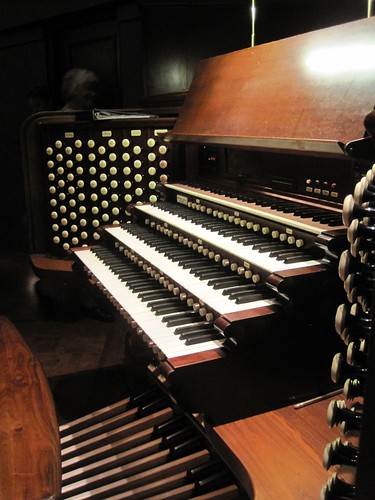
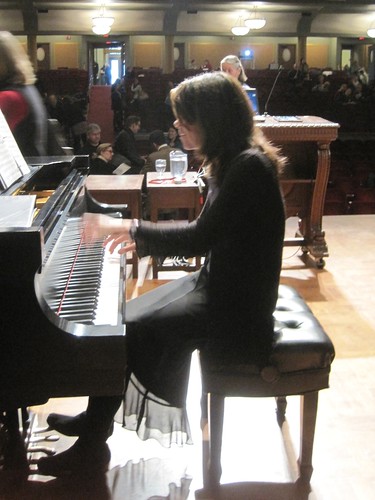
Today we attended a celebration of the 100th anniversary of Hill Auditorium, a famous and acoustically "perfect" space designed by Albert Kahn. We remember many enjoyable concerts there over the years, by many famous music stars who seemed to love performing there. Among our memories: Andres Segovia, Vladimir Horowitz, Leontyne Price, Cecelia Bartoli, and our own daughter who once performed there with Michigan Youth Symphony.

The celebration started with a lecture on the way Hill's acoustics work, sponsored by Saturday Morning Physics. The lecturer was Scott Pfeiffer who served as the lead consulting acoustician on Hill Auditorium’s 2004 renovation. We learned a lot about the original design, as well as about the renovation and its goals. The parabolic shape of the interior was invented for Hill, and has unique results in terms of amplifying the sounds onstage, especially those at the focal point of the parabola. The size of Hill is also exceptional among other acoustically renowned auditoriums -- it seats 3700 people, more than twice the average size of a similar venue. You can hear a dime dropped from a few inches above the floor -- as the lecturer demonstrated.

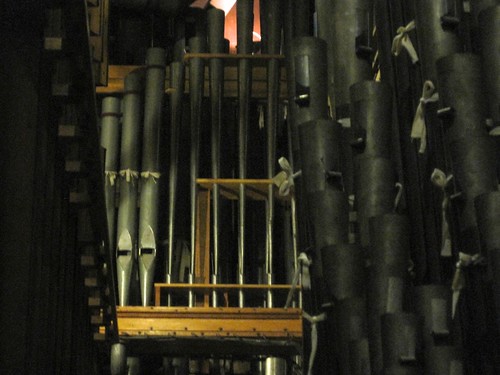
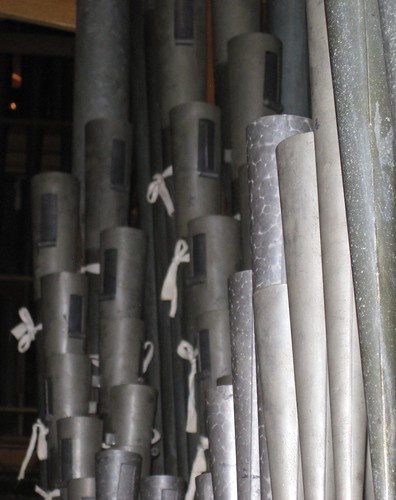
After the lecture the audience was invited to a self-guiding tour as well as to other presentations throughout the day. Above, a photo of the real organ pipes as seen from behind the stage, which one rarely gets to see. They are impressive though the place where they are located is very crowded; we waited in a long line to view them after the lecture. Here are a few more photos from this morning.

hillaud1982

The organ was built for the 1892 Columbia Exposition and purchased shortly thereafter by the University of Michigan. This morning to start the day's events, a music school organist played variations on the Star Spangled Banner -- a popular piece over 100 years ago. The same variations were performed in 1895 when the organ was new at Michigan, obviously before it found its current home in Hill.

hillaud1980

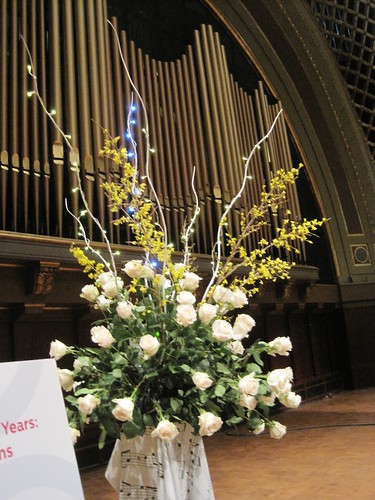
The organ pipes as seen from the stage are just for decoration. The real pipes are behind the decorative ones, and look completely different -- instead of neat rows, they are almost chaotic and very close together.

hillaud1965

The view from the stage is quite different from the view from the audience --

hillaud1976

hillaud1977

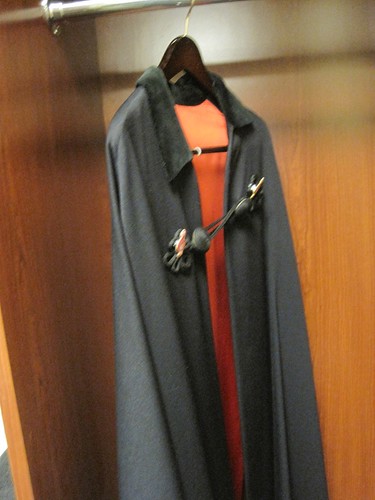
In a dressing room behind the stage they had recreated what might have been there when Leonard Bernstein performed. He gave his cape to the head of University Musical Society as a gift, once, and they had it in the closet --

hillaud1969

Monday, January 07, 2013

A Cultural Evening


Culture! Last night I watched Downton Abbey season 3, part 1 & 2, and also finished the last few pages of J.K. Rowling’s The Casual Vacancy. I’ll start with Rowling. As a long-time Harry Potter fan, having read the books and seen the movies more than once each, I felt at home with Rowling’s style – but I constantly felt that this was a book about muggles. (Surely you know that “muggles” are what the wizards in Harry Potter call non-magical people).

Rowling hates muggles. She sets the scene with the death of a muggle man – a much-beloved citizen and civic leader in the town of Pagford: which I can’t help thinking is an extension of Harry Potter’s awful muggle family on Privet Drive. In the muggle world of Pagford, death is painful, distasteful, and messy. Funerals are boring and uncomfortable. A magical curse administered with a wave of an evil wand is so very preferable – the victim drops, his spirit hovers for a moment, and his body is unchanged and unmoving at least until the end of the description. So dignified. Despite grief and despair, wizards have a sense of purpose which keeps them going as they mourn. Not all the bereaved in Pagford are so lucky.

What mainly motivates good wizards in the Harry Potter books is a desire to propagate the arts of wizardry and defend their world from pure evil in the persona of purely evil Voldmort and in his followers. Bad wizards are simply motivated by this pure evil with maybe a little resentment and hatred left from their childhood. What mainly movates people in Pagford is spite, resentment of authority (or love of being in authority), a sense of class distinctions, anger at how life had treated them, or some combination. Every character has at least a few of these basically banal motives, which drive most of the plot. Despite the concentration on social interactions, I don’t find that The Casual Vacancy works well as a comedy of manners like Jane Austen’s or the kind of book Margaret Atwood or Doris Lessing wrote before they turned to distopian fantasies.

Teenagers quickly become the focus of The Casual Vacancy after the first scene. Their lives are miserable and their bodies are their enemies. There’s nobody like Hagrid to come take them away to any alternate world like the Hogwarts School of Witchcraft and Wizardry. They hate or resent their lives and families, torment and bully one another, and know in their hearts that they will never escape growing up to be just like their parents – or can’t imagine ever being grown up. Writing about teenagers  is definitely Rowling’s strength, and it really comes out in The Casual Vacancy. She skillfully portrays their concerns with how to grow up and become real people or authentic, as Fats, one of the principal characters of the book, puts it.

Along with teenage misery, The Casual Vacancy is a study in contrast between the lives of insiders (pure white British people with a strong work ethic though maybe a lot of hangups) versus the lives of outsiders (Asian doctors; drug-addicted petty criminals and welfare dependents). The only person who ever went from outsider to insider is the man who died at the very beginning of the story, and no one can duplicate his idealism about the future of this society's victims or his pleasure in trying to improve society. The rest of the characters’ pleasures often seem to come from hurting someone else. The only magic they find is hacking into someone’s Facebook page or the town council’s online message board.

Some of the insiders, like teachers or social workers, try to help the less fortunate, but being well-meaning in this story is kind of boring. The Asian doctors treat both the upper and the lower classes, which I guess is because socialized medicine in Britain is a leveler – something I hadn’t thought about much, but found interesting. But the strongest connections between insiders and outsiders arise through hatred, contempt, mean-spiritedness, and efforts by the insiders to increase the misery and marginal nature of the outsiders’ lives. The main plot revolves around the desire of the insiders to cut off government support for a drug-addiction-treatment clinic and to stop poor children from attending Pagford’s good middle-class schools. That’s really mean.

People writing about Harry Potter books have complained because there are no gay characters except Dumbledore, whom Rowling revealed to be gay long after the books were published. (Dumbledore showed no signs of it in anything written down.) Well, in The Casual Vacancy, there’s a gay character who is likeable and has a sense of humor, which distinguishes her from almost all the other characters. But she’s only in one short chapter of the 500+ page book – and the rest of the references to gay people are taunts and cruel name-calling from sadistic fathers and vicious school bullies.

This sole gay character’s remarks provide one of the few humorous moments in the book, as she is able to make rather pointed and insightful quips about her family. But she hates Pagford and quickly gets in her beautiful car and returns to her much more satisfactory life with her partner and her high-paying job. The remainder of the book us unfortunately quite short on humor, as far as I noticed. I hope I’m wrong; I wish someone would tell me what I missed.

In Downton Abbey season 3, the creepy Crawley family are still trying to save their beloved castle, their aristocratic way of life, and their servants’ jobs and downstairs status for future generations. Not much I can say about it except it’s a great escape! All that wealth! All those servants (despite their squabbling)! All those evening gowns! In comparison, in The Casual Vacancy, the muggles who populate the town of Pagford want to save the town from drug addicts and low life welfare cases. Their motives are much uglier than the Crawley’s. They don't even give good parties. Other than that parallel, the two don’t have much in common.


Incidentally: in Downton Abbey I thought Shirley MacLaine was great; a perfect opposite to Maggie Smith. I wish that Mrs. Levinson, her character, hadn’t really gone back to America for the rest of the season, but I know she did. And I hope that in some future novel, J.K. Rowling will go back to imagining an alternate world where unhappy but properly gifted teenagers can find a better life than in the world of their muggle families. Even the world of Downton Abbey has some kind of magic in it, despite taking tons of [American] money to make the magic work.

Saturday, December 29, 2012

African Art: Heads and Masks


I have often written about African masks and why I find them so interesting and appealing. At our recent visit to the St. Louis Art Museum, I made it a point to look at the African collection, and to try to read some of the notes available about the items there. Africa is a huge continent with a wide variety of cultures and peoples, a long history, and much that's been lost, but much more that's preserved in what I see as a rather mysterious state.

The three heads shown above and in detail at left, for example, are 18th or 19th century post-mortem portraits of upper-class individuals from Ashan, Ghana, in a tradition that European visitors observed from the 17th to 20th centuries, according to the accompanying documentation. The heads would be displayed outside the village, where they would be "periodically visited and honored." I wonder what that meant, and what the heads meant to the people in the villages. These little hints never quite present as much as I wish they would.
"Our knowledge of African antiquity is still developing," explains one general-information placard. "The existing material record reveals cultures that produced sophisticated and compelling explorations of the human condition. ... The Sahel, a horizontal band stretching from the Atlantic Ocean to the Red Sea just south of the Sahara, has a long history as a trading nexus of goods, peoples, and ideas. Over the course of the first millenium BC, the region developed rice cultivation, sub-Saharan Africa's earliest cities, and important iron-producing centers."
Each area of Africa, each set of people, each river valley -- all seem to have equally long and complex histories, yet most museums have only a small number of artifacts that represent an entire people's history, and rarely are there really old items -- the St. Louis museum has a few of them, but I didn't photograph them. Below are a few pictures of other masks and sculptures of heads in the museum.

The museum does not have the name of the artists for a single one of these heads and masks, though they do seem to know the names of the rites or the special ceremonial societies for which the masks were used. For example, the Suku mask below was made for initiation ceremonies, during which young boys from a village learned about farming and hunting. The mask personified village ancestors, according to the label.

Mende Mask, Sierra Leone, Early 20th C.
Baule Mask, Je Society, Cote d'Ivoire, Early 20th C.

Suku Mask, Congo, Late 19th C.

Thursday, December 27, 2012

St.Louis Art Museum


Yesterday we spent several hours at the St.Louis Art Museum. I have loved this art museum since I was a child when it was the only one I had ever seen. The statue of St.Louis on his horse has greeted museum goers since the museum was founded, I presume around the time of the St.Louis World's Fair. Here we found him, against the winter sky.


The large entrance hall (not as large as in my memories) displays fewer statues than I remember from the past. Above is one of the most impressive of them, a work by Marcus Lupertz from 1986 -- so it wasn't one that I would have seen as a child.

We began with the temporary exhibit of works by Federico Barocci, borrowed from many world-famous collections, and especially from his native Urbino. I suspect that if I had seen one or two of his paintings in a museum in Italy (as in fact I probably have done) I wouldn't have found him remarkable. However, the exhibit highlighted his method of creating compositions by showing numerous studies and drawings as he did them for each work. The result was captivating. I may write more about this experience later.

Looking across the Entrance Hall Towards the Entrance to the Barocci Exhibit


After lunch in the little museum cafe, we continued with some African art, which I may also describe in greater detail later. The man on a horse (above) is a puppet from Mali, made in the 1960s. As so often happens with tribal works, the museum doesn't know the name of the artist. I have heard that people in cultures that made such objects often did know the names of the artists, but that the collectors never bothered to ask, though of course I know nothing detailed about this example. Ruby is visible behind the puppet through the display case at right. We continued with a brief walk through a few other galleries.

Van Gogh: Factories at Clichy

Van Gogh: Detail of figures in Factories at Clichy


Here are Ruby, Jay, and Len in front of a Monet water lily painting. The museum owns many fabulous masterpieces; of course we had time for not much besides the two exhibits we chose. And now I'm on the way home from St.Louis, and it might be a while before I return to this old favorite museum.

Sunday, December 23, 2012

Lafayette, Indiana Art Museum


Recent pots and weavings from collectors in the Lafayette area


Small Zuni Olla


Weaving by Ruth Yabney


Taos Olla by Pam Luan Hauer


Zuni Lizard Pot by Anderson Peynetsa


We've been shopping in Southwest galleries and at several pueblos near Santa Fe for around 20 years, as have these collectors. However, we haven't bought very many pots (nor any weavings). Seeing this collection brought back the fun of looking. The museum displays were very effective, simple, and well-lit.

Sunday, December 16, 2012

Chanukah Wrap-up


Last night was the eighth night, so it's over for this year. I hope you had a great celebration!

Monday, December 10, 2012

We are prepared

John Hodgman reminds me that we could have had many reasons for having a natural-gas backup generator installed today. We thought we were preparing for brief power failures. Maybe it will help us if the Mayans were right, though Hodgman discouraged me from that hope by mentioning the 1000 foot blood-wave that will obviously flood all of Ann Arbor and surrounding areas, no doubt including our generator. We have not and do not plan to purchase 2 years worth of groceries, either. We just want our pipes to remain non-frozen and our Trader Joe's gyozas and ice cream to remain actually frozen if there's an outage. Just sayin'.

Wednesday, December 05, 2012

Istanbul and The Dervish House

My book club usually reads conventional novels, memoirs, and nonfiction. This year, we decided to choose a science-fiction book, based on the recommendations of friends of some of the members. We picked the highly respected 2010 book The Dervish House by Ian McDonald.*

I volunteered to lead the discussion next Monday -- my discussion questions:

  1. The Dervish House takes place in Istanbul 2027, and involves many futuristic technology innovations, like nanotech pills that change one’s brain and flying transformer robots that can be operated by a child as well as by police spies. McDonald also does a lot with character development and local color.
    How would you compare the characters and atmosphere to those in the novels we more commonly read? Were they convincing/appealing/memorable?


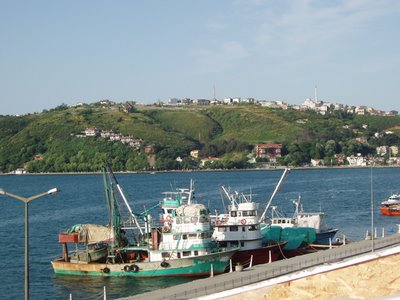
    Local color: view of the Bosphorous from our hotel balcony, 2006.
  2. The novel is structured into five chapters titled MONDAY though FRIDAY. In each chapter is a series of quick events with constantly changing characters. (Characters featured in the sketches include Necdet, Can Durukan, Georgios Ferentinou, Adnan, Ayse, Leyla; also at least 20 minor characters.) Sketches of historic events and flashbacks to the characters’ lives are interspersed. Also, background on the varied ethnic identities, the city, and lots of deal-making.
    Did you find this kaleidoscope of impressions and personalities challenging or enjoyable to read?
    Note: I conclude that this presentation is really complicated since several reviewers I checked got details wrong!
  3. Each character seems to have his or her own trajectory. Ayse’s search for the “Mellified Man” seems to be most central at first, but she achieves her goal around 2/3 of the way through and it turns out to be secondary. Suspense increases a lot after this plot element is finished, as Necdet is kidnapped and the boy Can Durukan and his friend the economist Georgios Ferentinou hone in on what’s really going on.
    Did you find this effective? Did the ending seem well supported by the buildup to it? Or too surprising?
  4. McDonald used a lot of trendy science – nanotech, robotics, neuroscience, non-linear science, economic modeling, statistics, etc. Also politics, religious fanaticism, nationalism, etc.
    Did it intrigue you/get your interest/impress you or did you find it unappealing in some way?
  5. The unifying theme of the book is that every important character lives or works in a 19th century building called the Dervish House.
    How did the author use this, and was it enough to bring together all the disparate elements?


* The Dervish House was nominated for two major SF awards (a Hugo and an Arthur C. Clarke award), and won two other awards (British Science Fiction Award and Campbell award). We usually use prepared questions but I did not find any on the web.