Monday, June 29, 2015

The Tundra

This stretch of tundra is especially green because of a nearby bird nesting colony.
Walking on the tundra is an exceptional experience. Moss and lichens are very spongy and soft underfoot, with rocks and gravel in between the tufts of low vegetation. We always wore knee-high boots because we never knew when we'd sink up to the ankles or deeper in water, or have to cross a snow-covered area or climb over boulders between open stretches. Deeper ponds dot the tundra; these are impassable. Hiking there can be very challenging!


Just a few inches beneath the standing water or water-soaked lichen is hard ice. Unable to soak into the ground, water flows down every slope. At the shoreline are braided streams and rivulets flowing across rocks, gravel, or sand. On the Svalbard islands, much of the terrain slopes very steeply up mountain peaks, ground down by glaciers in various ice ages. From a distance, everything looks like black rock or brownish grass, usually interspersed with snow.

Kittiwakes on a hillside near their nesting colony.
On a steep slope, our guide showed us a dead gull.
Up closer, moss and lichens are sometimes green or greenish, but sometimes they are white, red-orange, chrome yellow, tannish-yellow, rusty red, or dull brown. There is little nitrogen in the sparse soil to nourish the vegetation, though run-off from bird nesting colonies creates a richer environment.


Cliff-side nesting colonies are occupied by sea-going birds -- kittiwakes, dovekies (aka little awks), guillemots. (I will be doing another post on the nesting colonies.) Ducks, geese, and loons swim in the ponds on the tundra or in the sea.
Long-tailed ducks.
Small wading birds like phalaropes and sandpipers pick at the vegetation.
Pair of phalaropes beside standing water on the tundra.
Purple sandpiper.
The only songbird is the snow bunting, which we enjoyed seeing in its white breeding plumage.

A snow bunting.
Small spring flowers bloomed in the vegetation we saw, especially purple saxifrage, which creates a pink carpet in some places. One species of willow, a relative of the full-sized tree, grows to just a few inches high.


Sunday, June 28, 2015

Marine Mammals

Watching marine mammals from the bow of the ship was one of the most exciting parts of our trip to the Arctic on the National Geographic Explorer. Here are some of Len's photos from his Flickr set:

svalbard-wildlife-2 6
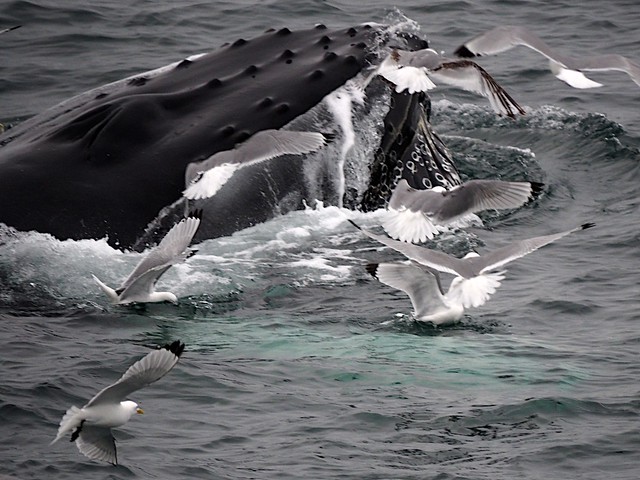
A humpback whale followed by kittiwakes that were sharing the krill brought up as he fed.

svalbard-wildlife-2 7
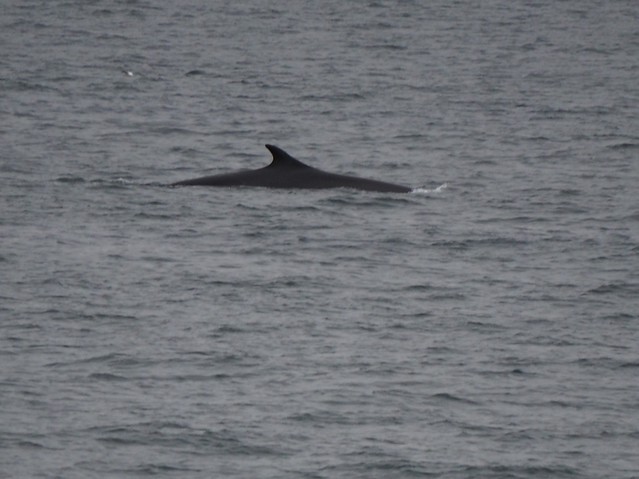
A fin whale.

Fin whales have a larger fin than the blue whales that we also saw. The blue whale is the largest mammal ever known; the fin whale comes in second.

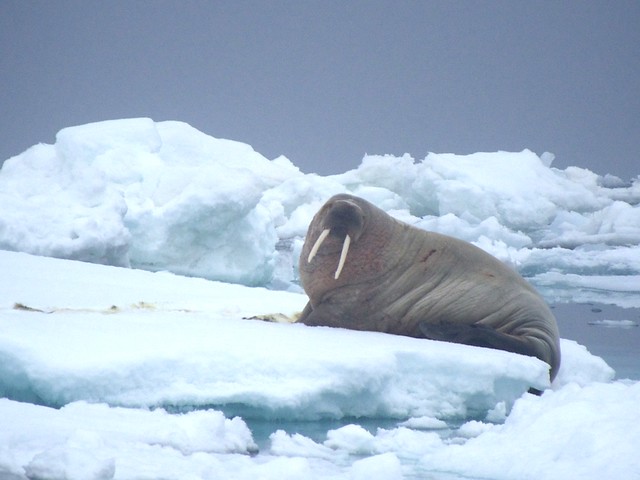
svalbard-wildlife-2 3 A walrus on the ice.
svalbard-wildlife-2 5
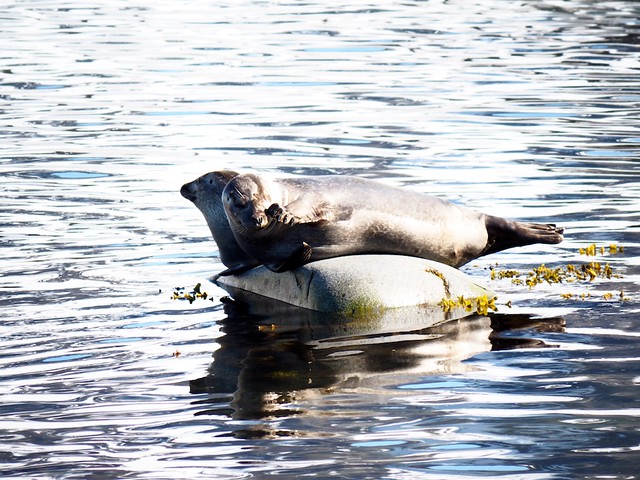
Harbor seals. We also saw bearded seals on the ice.

And one more swimming mammal, as seen from our cabin window on the last day of the voyage:

Three passengers doing the "Polar Plunge." 

On the boat in yellow is the ship's doctor, ready for any emergency. On the platform next to the Zodiac boat: the ship's scuba diver Carlos. Unfortunately Carlos had a equipment failure so there were no dives from our ship this trip.

svalbard-wildlife-2 2Don't forget that the polar bear is also a marine mammal, as it's a fantastic long distance swimmer. We didn't see any swimming polar bears.

Walking on the tundra near shore we often saw the bones of marine mammals that had been washed up or perhaps dragged by polar bears, which enjoy a rare treat when they find a beached whale.

A seal's bones.
Whale bones with Len for scale.

Saturday, June 27, 2015

Svalbard Reindeer


Reindeer on the Svalbard islands are a sub-species of the reindeer that live in Greenland and Norway and elsewhere in the Arctic. They are fatter with shorter legs; thus they are adapted to the extreme climate. Svalbard is an arctic desert -- not much snow at all, very dry, few nutrients in the thin layer of soil, much permafrost, quite sparse vegetation. The reindeer live on the few varieties of moss and lichens growing on the permafrost.

We saw at least a few reindeer on almost every hike that we took from the boat, and also some quite near to the town of Longyearbyen. There's a hunting season for people who live there, which is carefully monitored to cull the herds. The hunters who receive a permit and take a reindeer eat the meat and use the hides for warmth. The reindeer meat that we sampled on the boat was from mainland reindeer, which are more numerous.

The reindeer at rest in the first photo above is a tiny spot on the
right hillside in this photo. 
The cliff in the photo looks greyish. Actually it's very dark rock COVERED with nesting kittiwakes. These tens of thousands of birds feed at sea; thus their droppings are rich in nutrients, and the vegetation below the colonies is much greener than elsewhere. Our hike was headed for this amazing bird colony, but we stopped to observe several reindeer, who obviously love to graze on this comparatively rich vegetation.

Female reindeer have a shovel-like tine on their antlers which they use to scrape away snow and get to lichens in the winter. They thus keep their antlers; the males use the antlers in fights over females and then lose them.

Our guide shows us an antler shed by a reindeer last fall.
Reindeer grazing near the kittiwake nests.
On a different walk. At left, antlers that have been shed.
At right: a reindeer skull with a full set of antlers attached.
Reindeer grazing on purple saxifrage.
Purple saxifrage in bloom on the tundra.
Reindeer in the snow, seen on a different hike. Because their fur is hollow and fluffy, it's especially good at thermal insulation.
Baby reindeer belonging to the pair above.
Reindeer fur that the guide showed us.
We expected to hear that polar bears to prey on reindeer, but we learned that the reindeer are too fast for them. Though a polar bear can sprint, their heavy fur (also hollow and very effective at insulation) means that they become overheated if they try to do a long run, as they would need to do to take down reindeer.
Reindeer antlers decorating a house in Longyearbyen.

Friday, June 26, 2015

Svalbard


Here's the iPhone compass reading from the nearly highest point on our trip around Svalbard last week. Highest was 80º 20'. Virtually no satellites cover the arctic -- you see "No Service."

We are now at home where the sun actually sets and it gets dark for several hours a night. We hadn't see a totally dark sky for 2 weeks, until last night! I'll be posting more images and descriptions of our fascinating visit with polar bears, colonies of nesting birds, reindeer, walks on the tundra, and more.

Tuesday, June 16, 2015

Oslo Street Scenes

Tourists at the fortress facing the harbor.

Hommage to France: these are obviously imported street toilets with all the French signage intact,
painted in French national colors with "liberté, égalité, fraternité" written on them - 


... and now we leave for Svalbard and our cruise in the North.

Saturday, May 30, 2015

Friday, May 29, 2015

The Kirtland's Warbler


Today we met the Audubon tour to see the rare and endangered Kirtland's warbler. The best view we had of the bird was of the above female (above and below left) who was gathering twigs to make a nest. We heard many of the males calling to designate their own territory, where their mate could make a nest.

The tour meets at the Hartfield Pines State Park and proceeds to the managed habitat that's kept perfect for the breeding birds. Unfortunately the tour was crowded and an inconsiderate fat lady elbowed Lenny out of her way when a bird was posing, but we enjoyed most of the trip, and later went to a location where the birds can be seen from the road, which is where we saw the one in the tree. It's a $5000 fine if you enter their territory without the guide!

Kirtland's warbler, male, Len's photo.

Monday, May 25, 2015

Dogma Catmantoo


In the window of the pet store Dogma-Catmantoo -- a poster from the Cat's Gallery of Art.


Monday, May 18, 2015

Magee Marsh

A crowd of birdwatchers looking for one little Connecticut Warbler, May 16, 2015
Magee Marsh is a beautiful preserve in Ohio, where large numbers of migratory birds stop briefly as they migrate from their wintering locations in the south to summer breeding grounds in Canada. They wait in the marsh until just the right moment to fly across Lake Erie.

Connecticut Warbler by
John James Audubon
This weekend was particularly crowded with birders who come especially to see the many species of warblers passing through, as well as those that stop here to nest.

We joined the huge crowd depicted above, all hoping to catch at least a fleeting glimpse of a shy Connecticut warbler that was in the woods. Since we didn't succeed in photographing the poor bird, I included the John James Audubon picture.

Sadly, the crowds of birders appear to be putting enormous pressure on the birds along the boardwalk that allows access to the marsh. We read that a prothonotary warbler and a woodcock that were nesting near the boardwalk have abandoned their nests because of all the people nearby.

Environmental pressure from groups often occurs slowly, so that no single individual realizes that his innocent actions have tiny but real consequences. I've seen the term "future eaters" applied to this situation, where environmental damage accumulated slowly but inevitably. Birdwatching seems to be about as non-destructive as any activity could be. Is it?

A prothonotary warbler (photo from last year at Magee Marsh).
A woodcock we saw from the boardwalk a few weeks ago.
Birders like these who were there on Saturday love Magee Marsh and who can blame them?
I have already posted this on my food blog.

Thursday, May 14, 2015

Birdwatching trip in the Nichols Arboretum

arb-5-14-15 1

While Len and the rest of the members of the Audubon Society who were on the trip were watching the warblers, I mainly enjoyed the beautiful blue sky and the wildflowers lit by bright May sunshine.

arb-5-14-15 6

arb-5-14-15 4

Monday, May 04, 2015

Warblers, Woodcocks, Snakes, and the Blue-Crested Hoopoe

Birdwatching at Magee Marsh. 
It wasn't exactly a coincidence that Carol arrived at Magee Marsh just when we did this morning, but we weren't expecting her.We were very glad to birdwatch with her until it started to rain. Magee Marsh is famous because the birds rest there on the way north for the summer. This morning the wind changed and blew in lots of them from further south in Ohio -- motivating us, Carol, and large crowds of other birdwatchers.

magee_may_04_15 9

Above: a palm warbler, one of many warblers we saw from the boardwalk.

magee_may_04_15 5

Woodcocks are marked to look just like the leafy background. I call this one Waldo Woodcock as in "Where's Waldo?" Obviously since you can hardly see them it's even harder to take their photos. For more bird photos, see Len's Flickr page here.

We also saw this snake. I hope he doesn't eat warblers.
More for birdwatchers: the Midsomer Murders TV show called Rare Bird includes a large number of birdwatchers, some of whom are the victims. They are squabbling over whether one of them has seen a very rare bird -- a blue crested hoopoe. We watched this rather funny episode last night: it's quite wrong about birds in several ways.