Tuesday, May 23, 2006

Markets and other less than usual spots


Natasha and I spent the day walking around an entertaining part of Jerusalem, a mixture of the old and the new. We began at the Italian musuem and synagogue. We continued through small pedestrian streets to the Anna Ticho House, looked around the museum and ate lunch there, walked around more, and ended the day at the large central market and the Ben Yehuda shopping area.

Many buildings in the area are old, some new, some a mixture. In front of a dull and poorly maintained high-rise office and housing building was the gate that once led into the Alliance Internationale Israelite -- the ironwork still had the date 1883, but the stone gates and ironwork were all that remained. The Italian Synagogue
building originally was a church belonging to the German Colony, which stands next to a Russian cultural center. The Anna Ticho house was one of the first outside the city wall. Run-down buildings stand next to the offices of important foundations or law firms. In one courtyard is a small stone ampitheater, where a Russian furniture refinishing shop has its activity.

Anna Ticho
(1894 - 1981) was originally from Moravia. She joined her husband-to-be, an opthalmologist, in Jerusalem before World War I. For much of her life, she helped him in running an eye clinic, treating problem diseases that troubled residents in the then-primitive city. Trained as an artist, she made many sketches of the trees and hills of Jerusalem. Those on display interested me because she had a way of outlining a whole tree and then detailing only a part such as the trunk.

The New Bezalel school was another of Anna Ticho's interests. The clinic and their home were in one of the oldest houses outside the Old City walls. She left all to the public, so the house now serves as a museum and pleasant place to sit in a garden in the middle of a busy city. A prior inhabitant was named Shapira: a small area in the museum described his career as a forger of antiquities.

We walked around the picturesque streets of the neighborhood, going as far as the sign warning us that we were entering Mea Shearim. The sign told us we would be unwelcome unless dressed to their ultra-orthodox standard, which I think we would never meet. Among the crowds of people on the streets, many conformed to this. Some men wore white shirts, black slacks, visible fringes, and dark skullcaps. Some also wore long black coats. (The temperature is probably well over 80 degrees.) A few wore striped silk coats, kneepants, black porkpie hats, and long black socks. Women wore a variety of hats or snoods, long skirts (some dark, some bright-colored), and long-sleeved blouses.

We looked into two churches: the Russian church, in a busy area near the police station, and the Ethiopian church, surrounded by very expensive homes with gates and gardens. The latter is dramatic: a circular building. Inside, a central area beneath the round dome is inaccessible.


A chained-off door leads into a dark sanctuary. Nearby are benches where there are many, many wooden staffs topped with a short handle, like bishop's crooks.
A dark-robed barefoot monk welcomed us. We were also shoeless, as requested by the sign outside the entry.

On the walls of the circular outer aisle are numerous icons, many depicting Ethiopian saints or madonnas with Ethiopian features. Oriental rugs of all colors and types, mostly cheap ones, layer the floors. Plaster walls and pilasters are varied, brightly painted, adorned with cheap metal vases full of artificial flowers and similar decorative objects. Most of the massive doors are painted pale pink. You can look up obliquely towards the deep blue dome painted with disembodied angels in little clouds. Vivid sunlight enters the church from various windows, so it's well lit.

The central market is busy and full of smells: spice, fish, ripe fruit, and frying food. Vivid colors and shapes: piles of dried figs, dates, raisins, prunes, almonds, pecans, walnuts. Burlap bags of spice and fruit-nut mixtures. Fresh green almonds, fresh plums, apricots, tomatoes, cherry tomatoes, apples, pears, cucumbers, onions, squash, beets, kolrabi, green grapes. Dried lentils, peas, fava beans, soup mixes with dried peppers and tomatoes, chili peppers. The whining sound of men at prayers in a stall that serves as a synagogue. A few stall owners call out that you should buy or look at their wares. Refrigerator cases display beef parts, chicken parts, or bowls of condiments and cooked salads. Men and women stand in front of stalls selecting produce to be weighed and packaged.

The jewelry shops along Ben Yehuda street are far less colorful and intriuging than the market. We circled back thorough pedestrian streets to the parking garage next to the Italian museum.

Monday, May 22, 2006

Jerusalem


We are in a wireless-equipped guest house on campus of the Hebrew University of Jerusalem. Just had dinner at home with our friends Baruch and Natasha, who spent a semester at Michigan last year. I enjoyed Natasha's real Russian Borscht, which Lenny declined on the basis of beets. We continue to discuss the extreme statements of A.B.Yehoshua about the inauthenticity of Jewish life other than in Israel.
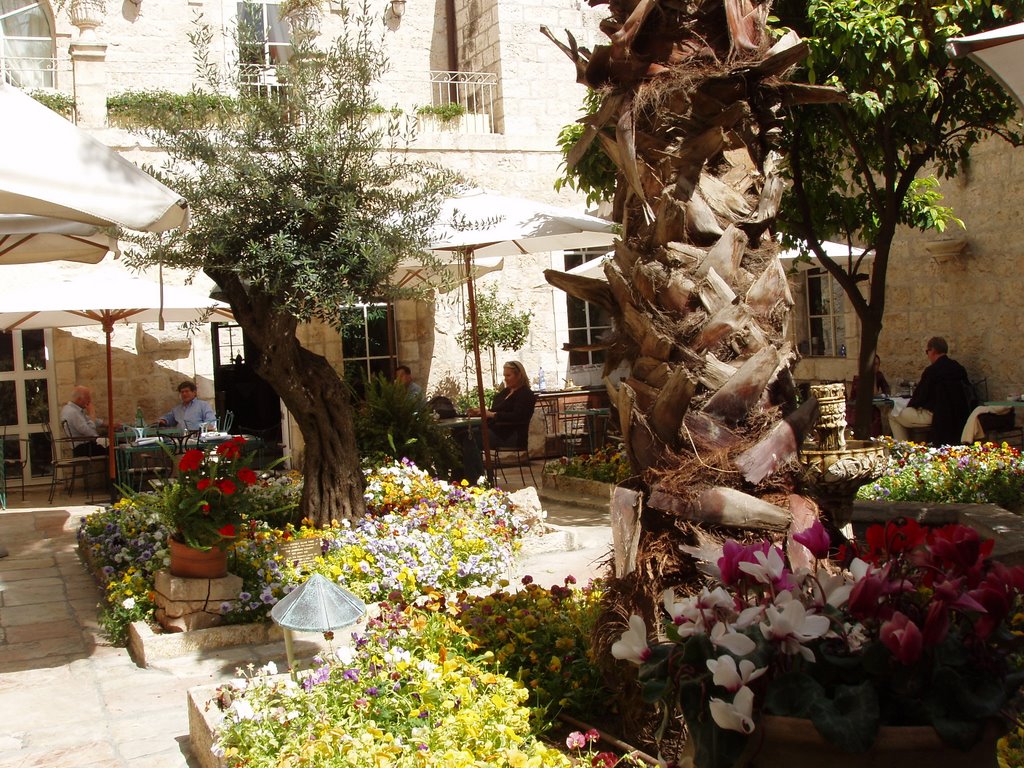
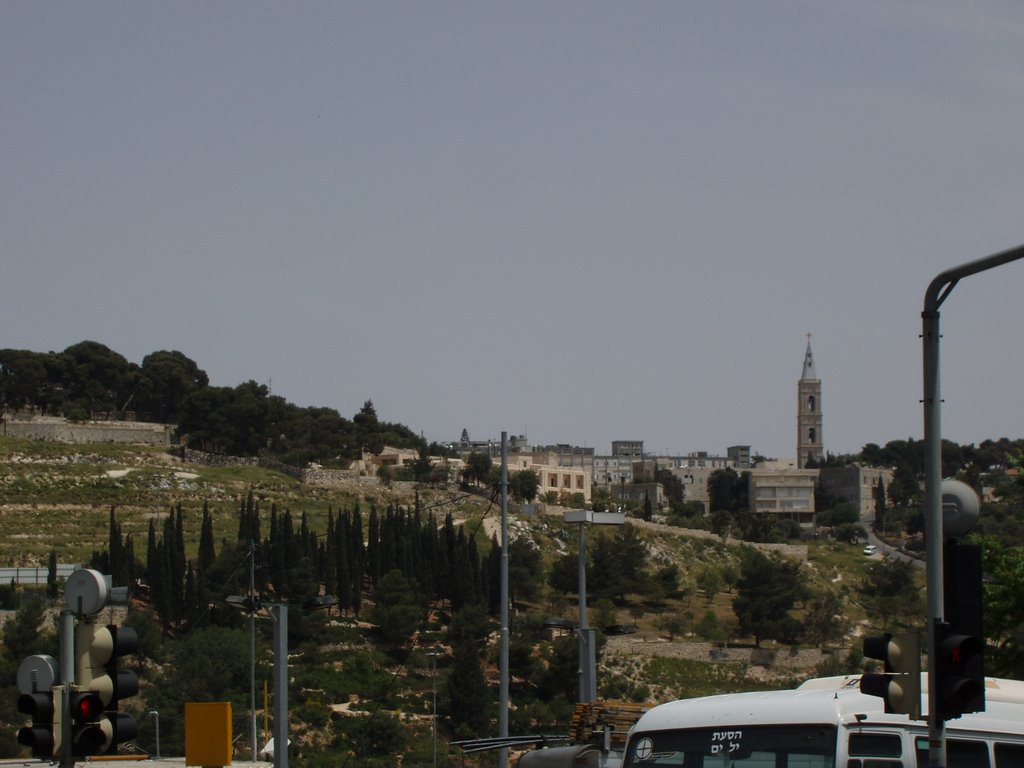
Jerusalem is unbelievably beautiful: very steep hills with all-cream stone buildings. Some genius in city planning outlawed all other forms of building materials. I went to the Israel Museum which is also very wonderful. At the Shrine of the Book, besides the usual Dead Sea Scrolls, they have the Alleppo Codex, a manuscript of the Bible written in the 10th C and still considered the most authoritive of sources. Unfortunately in anti-Jewish riots in 1948 in Alleppo, Syria, the synagogue that had housed it for centuries was destroyed and about half the pages disappeared. Other related artifacts were also in the exhibit.


The museum itself is very rich in art, including archaeology from the ancient Middle East, expecially here, and a wide variety of other things: Buddhist, Impressionist, ultra-modern Japanese, Jewish ethnology, and more. They are about to reconstruct one of the oldest synagogues from the Americas, which is being transported from Surinam (north of Brazil, site of a 17th C. Jewish settlement). They have had the synagogue transported from Cochin, India, for a long time.


Saturday, May 20, 2006

Eretz Israel Museum, Tel Aviv


Museum garden. The museum has many buildings surrounded by gardens. Most buildings display a single type of work: glass, ceramics, copper and other metals, philately, numismatics. The glass pavillion today had a large and very attractive exhibit of Murano glass from 1920-2005.


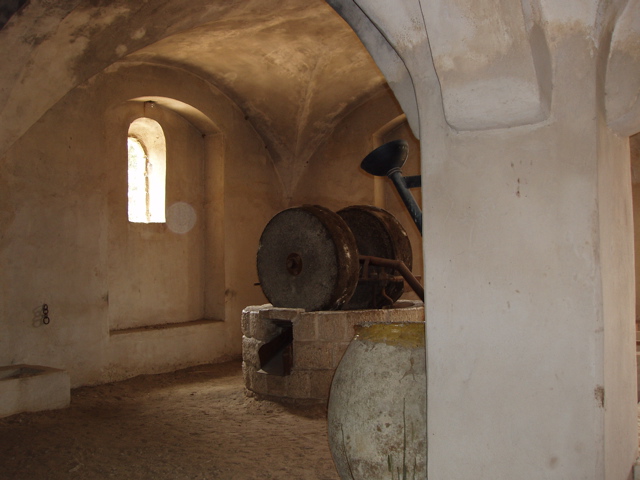
Oil Press: the museum has many displays of ancient practical arts and technologies. They frequently have demonstrations, but none were going on today.


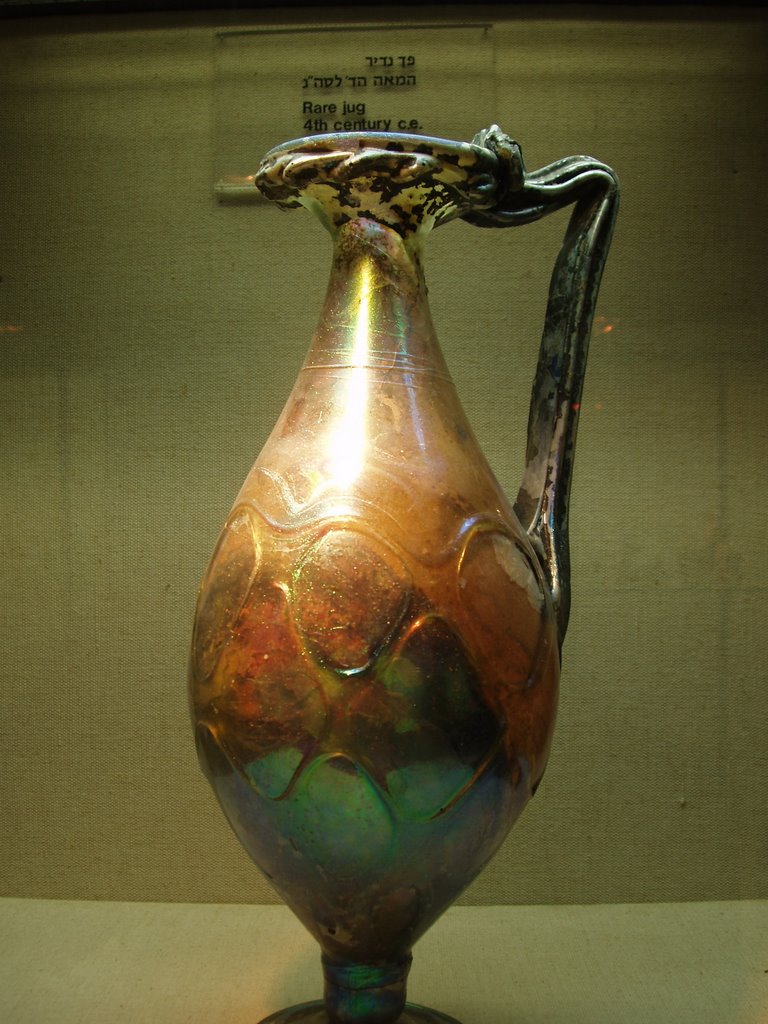
Ancient pottery vessels arranged to show how they were used. Note how the juglets functioned to remove the material from large storage jars.

The German Templars

While we were driving in Tel Aviv, Janet pointed out a construction site where the old German Templar houses are being moved and rennovated. The houses are within a major IDF (Israel Defense Forces) base, and have been used as offices until this historic restoration. They were yellowish stucco with red roofs, and in various states of reconstruction.

Two days later, our guide to the Bet Shearim cemetery in Upper Galilee mentioned that he was doing some research in the archives about the German Templars. Two mentions made me curious, so I googled a bit.

The German Templars were a messianic sect. The founder's name was Christoph Hofmann. His ideas came from 19th century utopian views as well as millenial hopes. He and his followers began to arrive in Palestine in 1868. They built houses in Haifa, in the German Colony in Jerusalem, and also north of Jaffa. The Templars based their neighborhoods on German town plans. The main Tel Aviv community was called Sharona. The Jewish city of Tel Aviv was founded later, not far from their settlement. The Templar neighborhood in Haifa has been preserved, and is a tourist attraction of architectural and historic interest, as of course is the German Colony in Jerusalem.

Because of the interest generated by the restoration of the Templar neighborhood in Tel Aviv, the Eretz Israel Museum in Tel Aviv recently opened an exhibit about them: "The Templars in the Holy Land: Chronicle of a Utopia." Inspired by the articles and also because we wanted to see the rest of the museum, we headed to Tel Aviv this morning, and really enjoyed the exhibit.

The exhibit had photos, water color paintings by visitors, artifacts, diaries, post cards, a household recipe book, school notebooks, and other material, along with detailed historic documentation. Besides the major settlements founded from 1868 to 1878, the Templars also lived in several other areas, including a town, Bethlehem HaGalit, in the area that we visited yesterday.

In addition to the delopment of housing, the German Templars established farms, businesses, European-quality hotels, and transportation for Christian pilgrims. Each settlement had a community center and educational institutions. They also founded hospitals which served the wider community.

Templar businessmen were active in engineering and architecture, and ran businesses such as carriage construction, house-painting, flour mills, bakeries, and a metalworks that employed 100 workers. Eventually they spoke Hebrew as well as German, though most written material on display was in German.

In World War I, after the British conquered Palestine from the Ottomans, the Templars were viewed as enemy aliens, and deported. They came back after the war. In the 1920s, unfortunately, under Nazi influence, some of the Templars joined in the anti-Jewish riots in which Arabs were trying to prevent Jewish settlement under the Balfour declaration. In World War II, the British again began to expel them both to Germany and elsewhere, such as Australia.

The British expelled the last of the community in 1948, just prior to Israeli independence. Templars received restitution for their lost property as part of the post-holocaust agreement between Israel and Germany. The exhibit documented the Templars' Nazi activity, which came at the end of theie time in Israel.

Here is a quote from a letter to Ha'aretz on this subject:

  • Tel Aviv's Yedioth Iriyat newspaper for the Hebrew month of Tevet 1948 reported that some of the Hebrew-speaking Templars, who returned to Germany during the Nazi period, enlisted not in the Wehrmacht, but in the special assassination squads determined to carry out the Final Solution. And don't forget: Adolf Eichmann was a guest in Sharona in the 1930s. At the opening of the exhibit at the Eretz Israel Museum, the German ambassador sorrowfully acknowledged that 30 percent of the Templars were Nazis. (letter to Ha'aretz Yossi Renart, responding to a review of the Tel Aviv exhibit, published May 12, 2006; unfortunately I was not able to locate the review itself which appeared in April.)

Friday, May 19, 2006

Apollonia: New National Park for a Crusader City


Caesarea National Park: A Vast Roman, Byzantine, and Crusader City


Cemeteries, Gardens, and Drama


Bet Shearim burial caves

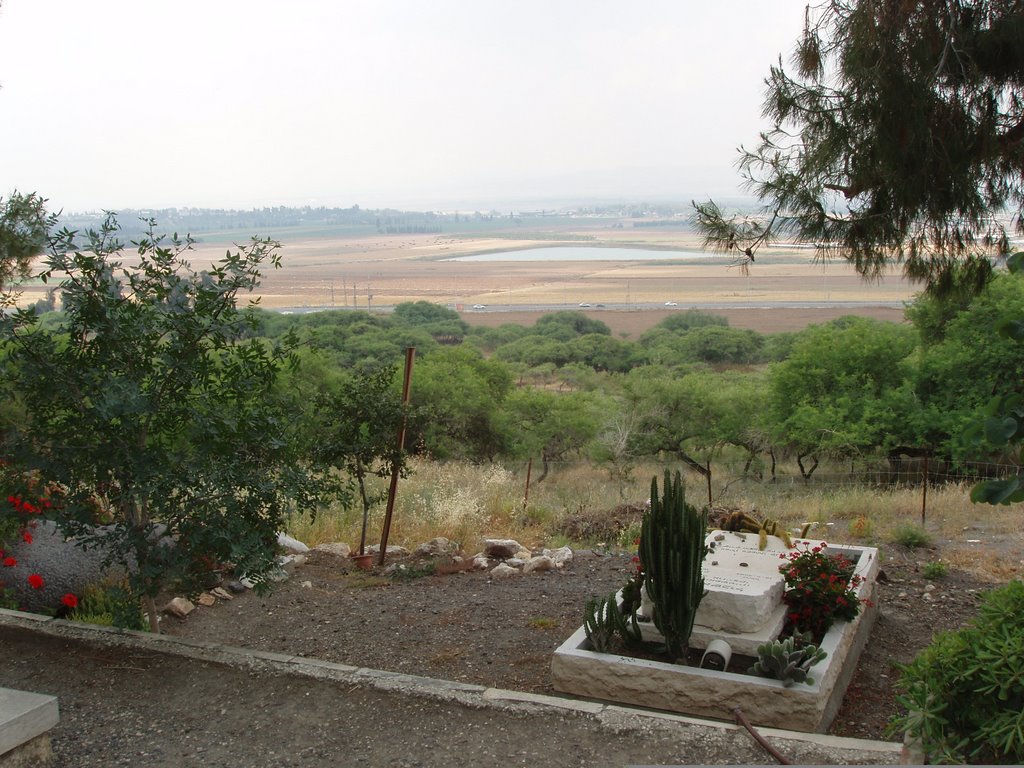
Cemetery of Nahalal with view of Jezreel Valley


Schoolchildren working in the school garden.
Children showing objects that represent their family history.


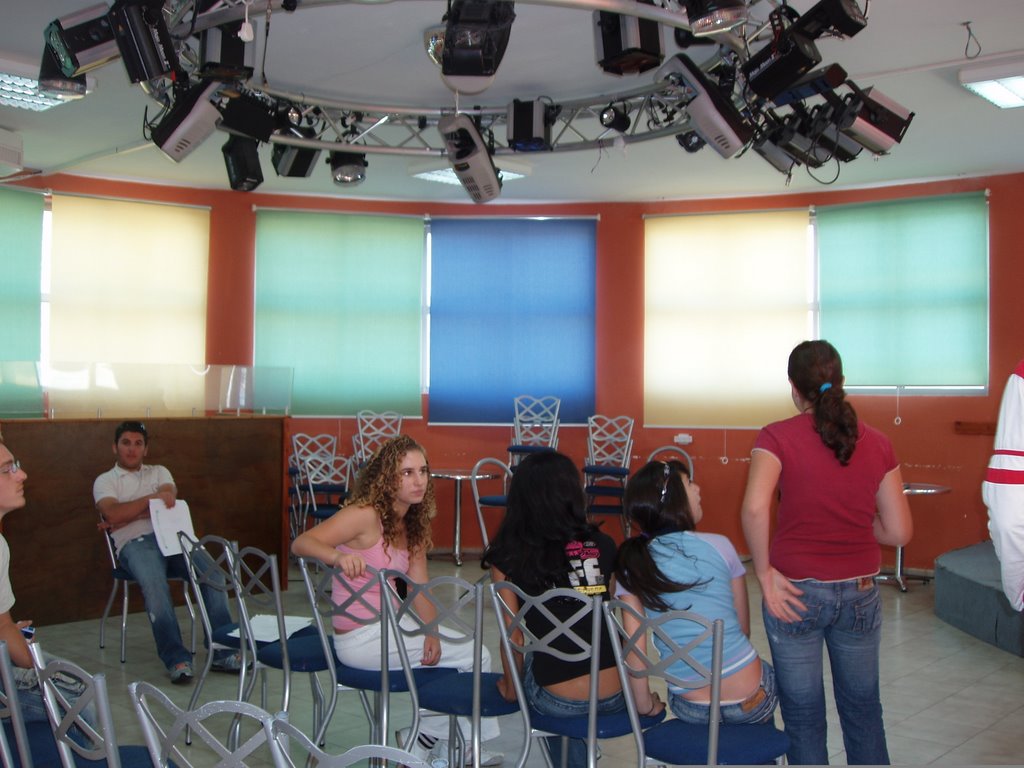
High-school students in the after-school drama program preparing for improvisations.

Visit to Migdal HaEmek, Upper Nazereth, and Nahalal


Yesterday we toured several towns in the Galilee, east of Haifa. We were the guests of an endeavor called Partnership 2000 under the sponsorship of the Jewish Agency for Israel. Ann Arbor, Detroit, and other Michigan cities exchange visits and in partnership with towns in this region do various projects. Our host for the day was Ziva, the coordinator of the Partnership office in the region.

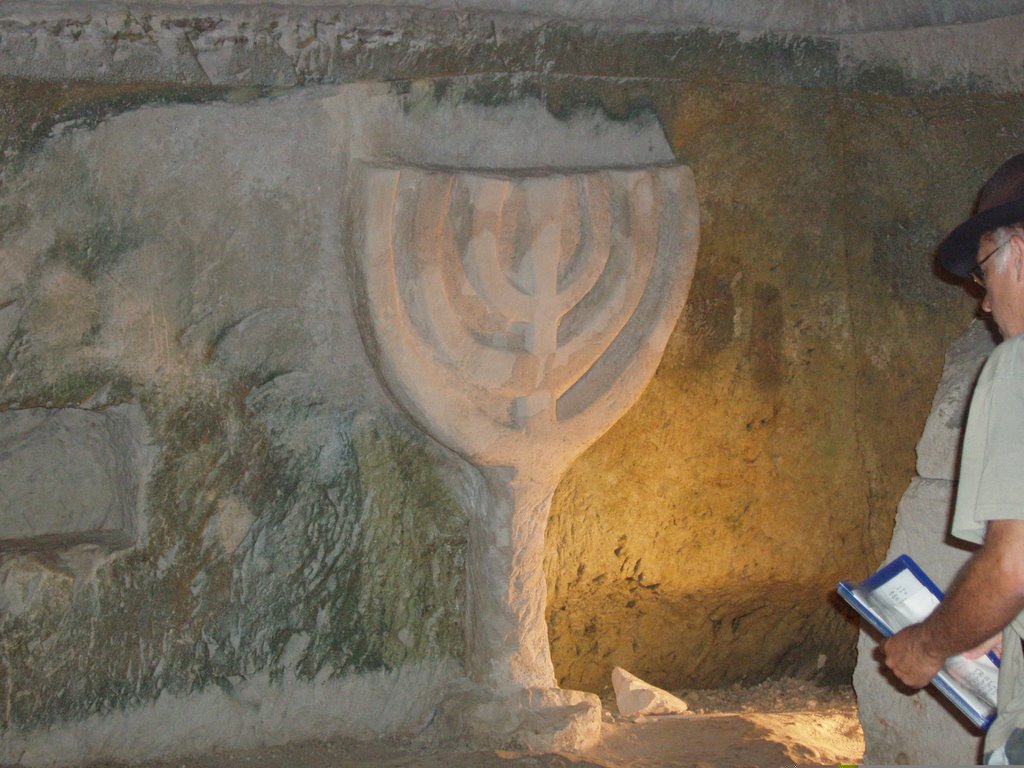
We began with a guided visit to two cemeteries: the 3rd and 4th century cemetery called Bet Shearim, and the 20th century Nahalal cemetery. In the Mishnaic era, inspired by the sage Judah ha-Nasi, many Diaspora Jews had their bodies returned to Bet Shearim for interrment in stone or metal sarcophagi. The caves where burials took place were rediscovered in the 1920s. Inscriptions and carved images on the sarcophagi give insights into the life and attitudes of the dispersed Jews of that era. Many include quite pagan images, such as Nike or Zeus. Without hearing it explicitly, we grasped how Jewish history is very rooted in this area.

The Nahalal cemetery, not far away, reflects the recent Zionist history of the region. Nalalal is a carefully designed town set out in a circle. Houses are in the center and farms radiate outward. The cemetery is on a wooded hill overlooking the stunning green Jezreel valley and the town. Famous residents of the region who are buried there include Moshe Dyan and Ilan Ramon, the astronaut who died in the Challenger disaster.

Our guide -- a local history buff -- also pointed out the graves of the grandparents of writer Meir Shalev, whose book I just bought. When I hear of something for the first time, I always seem to hear of it again right away. The book I'm reading is about the region, and I hadn't even connected these facts.

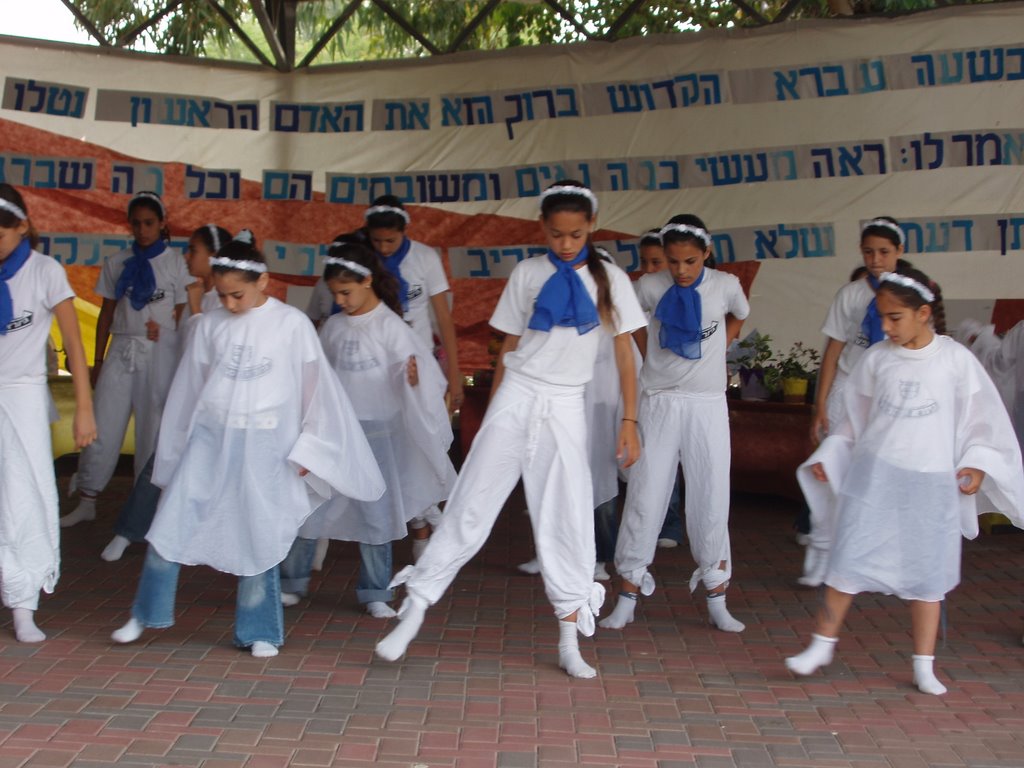
Our tour continued with visits to projects whose funding partially comes from the Ann Arbor Jewish community. We visited an elementary school with a program in Jewish Family education, a women's center with a program for battered women, and an after-school youth drama program. At the school, children performed a dance to a song dating from the 1973 war, about determination to continue in adverse circumstances (see illustration above). All Israelis know this song -- as all our hosts had known the song that's written on Ilan Ramon's grave.

We also heard a PowerPoint presentation entirely in Hebrew, with all-Hebrew slides. Though Ziva translated, circles and boxes don't help slides much if you can't read what's inside. We learned that according to the assembled teachers and administrators, there is no word in Hebrew for accountability. We became much more familiar with the Jewish Family Education program that Ann Arbor's community sponsors. I was delighted to see that the school has several ecology and conservation prograns. In the school garden, even small children cultivate vegetables, which they later eat as part of the lunch program.

For this part of the day, Ziva acted as our guide. We learned a little more about her as well: she lives on an old-fashioned kibbutz, where members turn in their salaries and all receive "what they need." The kibbutz is modern, though, in that it runs a factory and also other non-agricultural endeavors. Although Israel still produces and exports many agricultural products, most kibbutzes have had to expand their investment areas and go beyond orange groves and fields.

As we drove from Migdal HaEmek, site of the school, to Upper Nazereth, site of the women's program, we went through the Arab part of Nazereth. We saw Palestinian flags, though the inhabitants are citizens of Israel. We saw a large green-painted Statue of Liberty with ropes and chains around it. Quite symbolic. I'm beginning to understand the hardening of Israeli attitudes towards the Arab citizens of Israel.

Dinner was at the home of a family who have often visited Ann Arbor and other US cities. I met the couple last fall when they had lunch with the committee that I am on, and now we also met three of their four children. They live on a farm in one of the wedge-shaped areas radiating from the center of Nahalal: we could hear the cows mooing while we were eating. The food was great: fish, potatoes, salad, cakes.

We enjoyed talking to them and to their daughter who's in the army. She answered one question about something I noticed on women soldiers on the train: are hip-hugger pants really part of the regulation uniform? No, the women have them altered, and they can be confined to base as a punishment for wearing them. She serves on an army base adjacent to one of the difficult cities in the territories. The army now has special units for dealing with each city, so that if there is a problem, it can be handled by soldiers who really know the area. Her job is social work: home visits to soliders with problems.

Wednesday, May 17, 2006

What is eating A.B.Yehoshua

In the Israeli papers much attention is directed to A.B.Yehoshua and his insult of American Jews. I have a very contrarian opinion of why he wants to dismiss American Jews. Compare the sales of his books to the books of American Jewish writers (or even of other Israelis).

I checked a few amazon.com sales figures:

A.B.Yehoshua's best selling work today (as far as I looked) is Journey to the End of the Millenium, rank 67,335.
His most recent, The Liberated Bride: 178,460.

Compare:
Amos Oz, Tale of Love & Darkness: 23,915
Philip Roth, Everyman: 13 (#14 on NYT bestseller list)
Bellow: Adventures of Augie March (a really old book): 12,247

See what I mean?

Crowds and Security

150,000 people were on the beach in Tel Aviv to see a 15 minute fireworks display last night. The French embassy employed team of skilled fire-work presenters, known for displays at previous high-profile events. They built a raft in the sea from which to launch the display. The French government is trying for a little rapprochement with the Israelis. (Meanwhile, immigration of French Jews to Israel is up again, but that's another story.)

I had heard about the fireworks in advance: it's the kickoff of a French cultural festival. I don't much like crowds, so it wasn't too attractive to me. But it strikes me that the Israelis love crowds even though security is such an issue. Thinking of the unthinkable, it's strange that they like fireworks with their explosion-like noises. Not to mention that the holiday moments of silence earlier this month that were marked by air raid sirens.

We have seen plenty of evidence of preparation and avoidance of the unthinkable. At shopping centers, guards look in car trunks on the way into the parking lot. One's purse is opened and cursorily checked at entries to grocery stores, restaurants, train stations, and museums. If I were not a grey-haired American, it might be more than cursory.

While we were in Eilat, someone left a beach bag lying on the beach. As a result, we were in a traffic backup while the police got ready to deploy the explosive-handling robot. We caught sight of it in the back of the police truck, in fact. However, they soon announced that the owner of the bag had come forward.

An Israeli -- or tourist -- never forgets the threats and dangers. And enjoys the fireworks and crowds.

Fish Farms

To follow up my conversation with Liza, I did a google search to learn more. The fish farms are in the north part of the Israeli Red-Sea coastline, near the Jordanian border. This is not close to where we snorkeled last week. The farms are considered to be producing toxic wastes, and environmental organizations have urged the government to shut them down. One recommendation was to shut them down almost immediately; another to do so by 2008, then postponed to 2010.

A quote from the Israel Union for Environmental Defense, June 2005:
  • The Government has issued a formal decision approving the new outline plan relating to development and protection of the Red Sea shoreline, after five years of repeated delays. IUED has partnered other enviornmental organizations in campaigning for a speedy resolution to the major stumbling block that has prevented planning authorities from adopting the outline plan: the fate of several offshore fish farms that are a significant source of pollution and degradation of Eilat's unique coral reefs.
  • While IUED welcomes the long-awaited approval of the outline plan, we are disappointed that the government has chosen to ignore the recommendation of the National Planning & Building Committee in December 2004 to remove fish farms from the Red Sea within 14 months. The government has agreed to a three year transition period for the winding down and removal of the mariculture industry from the Red Sea, during which further ecological damage will occur.
Most of the shops in the big and interesting-looking mall around a mile from here turn out to have gone out of business. I walked around before shopping this afternoon. The place is very empty, with glue marks showing the names of the shops that used to occupy the storefronts.

The Stimatzky’s bookstore in this mall has a large and rather forlorn section where English-language remainder books are set out on very uncrowded shelves. However, the front of the store (which faces the parking lot rather than the inner mall) offered a not-bad selection of recent and classic English and American fiction and non-fiction. I bought a few books, including The Blue Mountain by Meir Shalev, recommended by Baruch.

The grocery store in the mall is very big, and has some interesting departments, which I finally took time to explore. One corner is a little spice bazaar, with burlap bags opened to display bulk spices. Admittedly, the burlap bags mainly displayed plastic bags filled with bulk spices and hand-labeled. I requested and bought some Hawaij, a Yemenite spice blend. I feel disloyal to my friend Irit, who told me where to find a real bazaar where a man named Tam has wonderful Hawaij.

Nearby is a meat counter where I couldn’t seem to get a turn to buy chicken. The beef butcher refused to sell chicken, and the chicken butchers were busy with either other customers or things they preferred to do. I bought a packaged (though fresh) chicken.

I had already found the area where they sell grooming products and OTC medications, the side aisle with plastic containers and housewares, and the center aisles of frozen and packaged products. On previous trips to Israel, I am sure I found that the labeling of packaged goods included much more English text than it does now. All in all, grocery shopping always seems too challenging here.

This morning early I did the laundry, and then went to a morning coffee hour for those accompanying Weizmann visiting scientists and post-docs. Guests were from Korea, Hungary, Northern Michigan, Minnesota, and elsewhere. The American wife of a Czech post doc was the hostess -- she will soon accompany him back to his home in Prague.

A few small children and babies were enjoying the snacks that were on the coffee table at their eye-level. Some enjoyed them by nibbling, others by piling them onto their plates. These children seem to respond to any language: English, Hebrew, Korean…

I spoke to several people. Liza told me something interesting: around 4 years ago, a Japanese corporation was running a fish farm and cannery or processing plant near Eilat. She had heard that the fish farm was causing damage to the health of the reef and the fish. I don’t know any more about it, though I’m aware that fish farms produce toxic wastes that are highly polluting.

Tuesday, May 16, 2006

Horse trading at Maggido

This morning I attended another lecture in the English Archaeology Lecture Series at Tel Aviv University. The lecturer was Norma Franklin, who is just completing a doctorate at TAU. Her subject is Iron-Age chronology at Maggido and the city of Sumaria, capital of the country of ancient Sumaria. I found one area of her discussion the most interesting: the function of a large enclosure and pillared building in Maggido.

Franklin agrees with the interpretation (proposed by original excavators in the early twentieth century, but sometimes disputed) that the building was a stable. She has recently worked with the Israel National Park authority to reposition some of the horse troughs to a realistic position. Thus site visitors will be pursuaded of this interpretation. Once the area was called "Solomon's stables" but a variety of evidence now strongly suggests that it dates from somewhat later in the Iron Age.

Several features of the site support the claim that the building was a stables. The stalls appear to be roofed, but the aisles were open, allowing protection from the sun but adequate ventillation for horses kept in a hot climate. The stables are situated near the postern gate, which is the easiest route in or out of the city -- this would provide a reasonable way for horses to enter and for waste products to be removed from the stables. A gate from the enclosure leads into the city, and thus separates it from the city.

The lecture provided a detailed view of the horse in the Iron Age. Egyptian horses were large, and suitable for pulling a war or hunting chariot. Breeding, raising, training, and selling such horses were all important functions. While the Egyptians tried to keep a monopoly on horse breeding, Israel was the site of some breeding and training. Maggido was on the trade route from Egypt, producer of military horses, to Assyria, a major power in the ancient world.

We saw photos of several Assyrian carvings showing a two-horse team pulling a chariot with a driver and an archer, as it would have been used in battle. The endeavor was labor intensive, requiring a groom, trainers, the driver, and three horses so that one would always be resting or in reserve. Iron-age military preparedness required substantial investment in such outfits.

This is Franklin’s conclusion: that the combined enclosure and stables served as the site of a seasonal trade fair. From various parts of the ancient world, people came to trade horses (and also, at other times, sheep and maybe wine and oil). Military buyers would come to procure horses for the troops, while horse dealers and breeders would bring their horses to market. A fair lasted for a set number of days, and then the participants gathered all their goods and returned to their homes.

As I did last week, I met Janet and some others at the lecture, after taking the interurban train from Rehovot to Tel Aviv. After the lecture, Janet, her daughter Abigail, and I went to her favorite shop to buy jewelry. The shop owner is a world traveler as well as a jeweler. She buys beads, silver work, stones, amulets, and other objects old and new, which she refashions into beautiful earrings, necklaces, bracelets, and rings. She also offers beautiful fabrics, scarves, clothing, ceramics, toys, and other objects from the Middle East, southeast Asia, and Africa. Her Roman trade beads from Africa are among the interesting items.

We had lunch in a developing area of Tel Aviv. Up until recently, derelict warehouses and businesses like auto repair occupied the space near the Mediterranean in North Tel Aviv. A beautiful boardwalk now connects a single line of seaside restaurants. Semi-industrial workplaces still stand in the area behind this single line. Parking areas meander about the old areas, easy to use on a weekday, but overwhelmed on weekends.

We ate a very delicious lunch outdoors while enjoying the view of rolling waves and deep blue sea and sky. The coast here is rocky, not sandy, but the board walk is only a few feet above sea level. The air temperature was cool with only a slight breeze, making it a perfect moment for sitting in the sun.

Monday, May 15, 2006

Demo in Gaza from Ha'aretz

Parallel Reality

Today is Nakba Day for the Palestinians in Israel. Some Palestinians use the day by moderately trying to remind Israelis that their villages were destroyed and many people displaced in 1948. Others are militant, and in their celebrations, they clearly express hope that Israel will be destroyed and that the Israelis will be replaced by Palestinians.

Last week, on Israeli Independence Day (called "Land Day" by Palestinans), Arutz Sheva - IsraelNationalNews reported that: "The Land Day march in Lod featured Hamas flags and fiery speeches calling for the destruction of the Jewish state." In response, there was a request that their Nakba Day march, scheduled for today, be prohibited. (I will add any further news of this when I see it.)

In contrast is the "Nakba 60" project, reported in Ha'aretz as "a coalition of five Jewish and Palestinian organizations established a year and half ago." This group was holding a peacful demonstration and giving out brochures to remind people of Palestinian villages once on the site of selected Jerusalem neighborhoods. ("Activists bring Jerusalem's Arab history to life for Nakba Day," Neta Alexander, Haaretz Correspondent)

I am completely unable to figure out where I think justice lies. I have enormous sympathy for the Israeli view that the Palestinians are not loyal citizens. Indisputably, the residents of the territories voted in Hamas, dedicated to destroying Israel, and many Arab Israelis are very sympathetic to their choice. And Arab Israeli citizens enjoy many privileges and economic benefits (they definitely don't want to go and live in the territories!) But also indisputably, there is discrimination that makes me, as an American, uncomfortable.

Indisputably, in the territories, the residents are now suffering a terrible lack of food, medical supplies, fuel, electricity, and basic services because their democratically elected government refuses to recognize Israel or its right to exist. They don't want to take the consequences of their democratic decision. But there must be a way to prevent the extremes of suffering of people who are in some sense caught in the crossfire.

There's always more. The decision yesterday that Arab Israelis' spouses from the territories may not receive permission to live in Israel is one of the hard choices that the Israeli high court has had to make. I talked to Liza about this a little, and she pointed out that other countries generally make decisions about which spouses of citizens should be granted resident privileges, while this ruling allows a generalized denial without a procedure. The court points out that Israel is at war and is being asked to admit individuals from an enemy state. I have a lot of sympathy for that.

Ha'aretz condemns the court decision for the same reason: "There is no country in the Western world that does not limit immigration and set priorities in accordance with its needs at a given time. Immigration laws make it difficult for foreign partners of citizens to receive citizenship, and they combat fictitious marriages. But not one single Western country discriminates against some of its citizens by passing laws that apply only to them, and that impose limits only on their choice of a partner with whom they can live in their homeland." (from "Supreme disgrace," editorial May 15, 2006)

Still, the world seems to pick on Israel. When the UN and Amnesty International condemn them though, one wonders why they pick on a small decision by Israel and say nothing about more dramatic human rights violations elsewhere. They see the deprived refugees and ignore that the money that was donated to help them all went into the pockets of the Palestinian Authority. Liza says in this context: Mrs. Arafat now lives on Avenue Foch!

Sunday, May 14, 2006

Scenes along the way back from Eilat ...

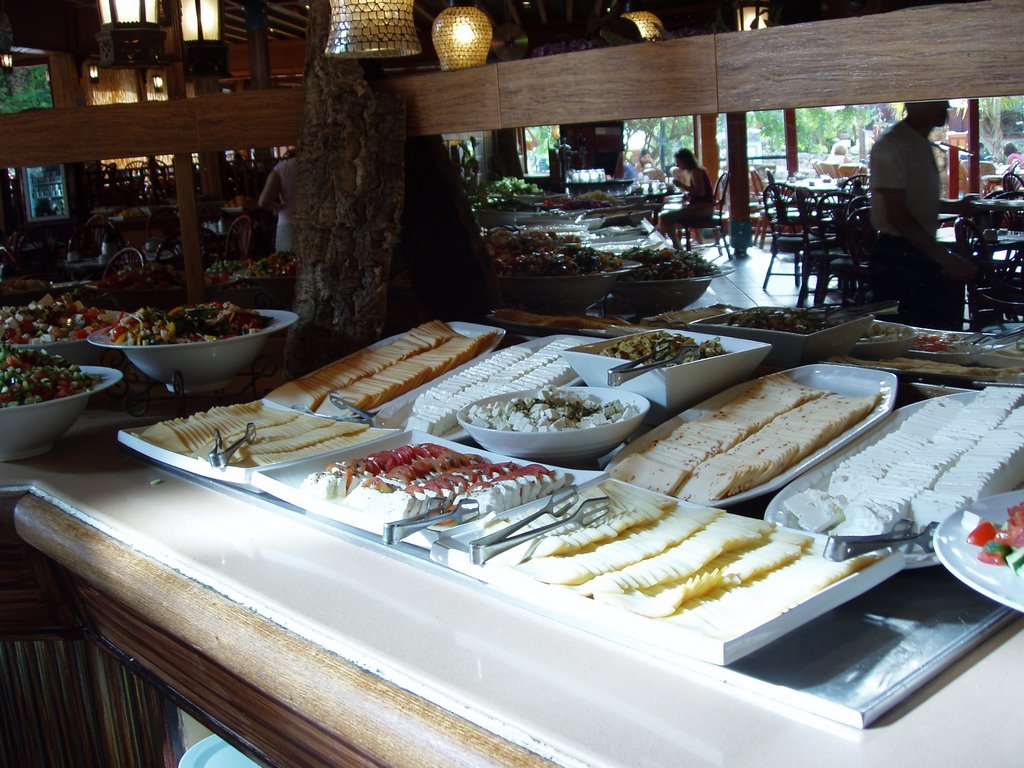
A small area of the vast hotel breakfast buffet:


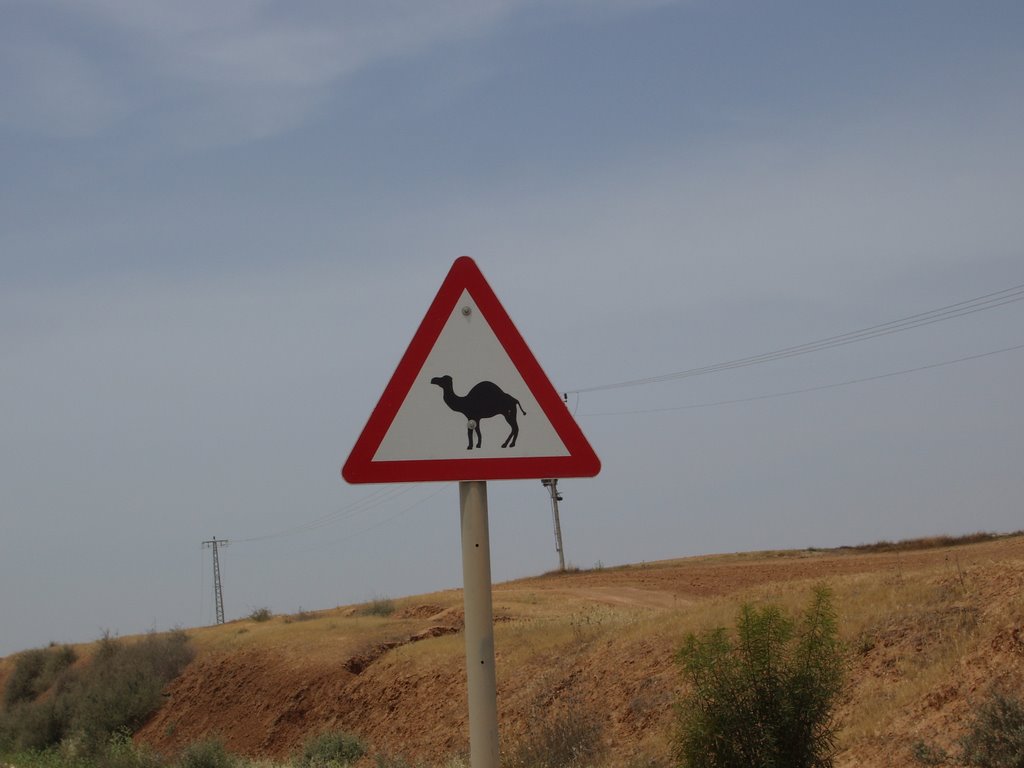
A warning sign along the road:


And, yes, you know MacDonald's is everywhere, but...

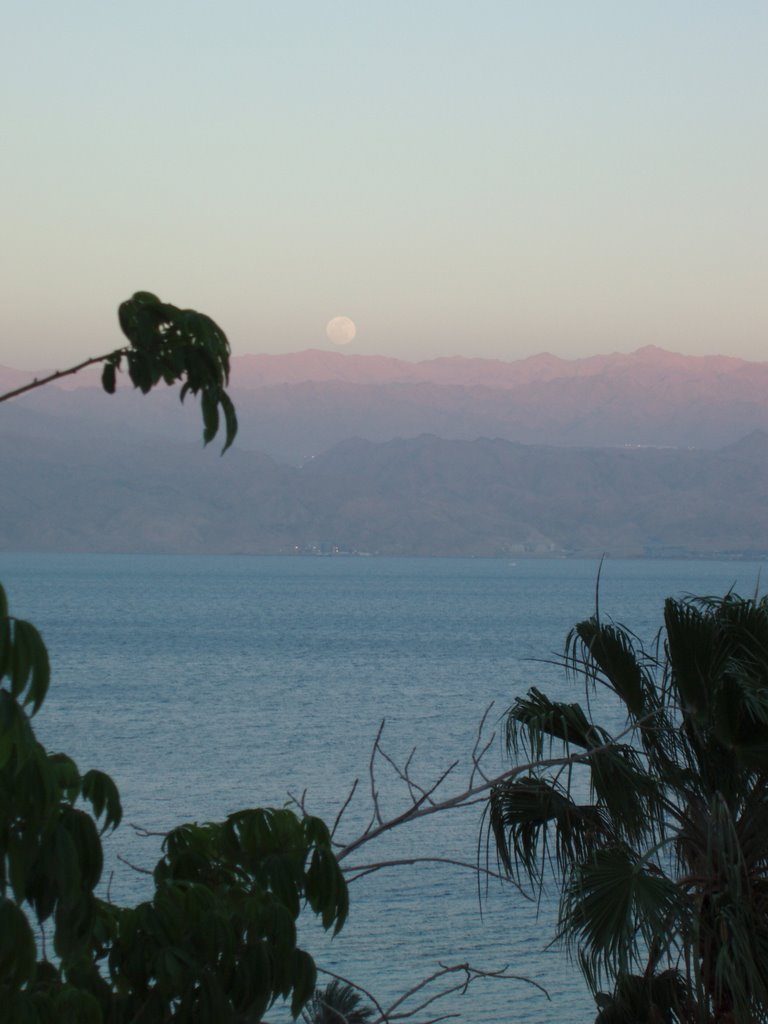
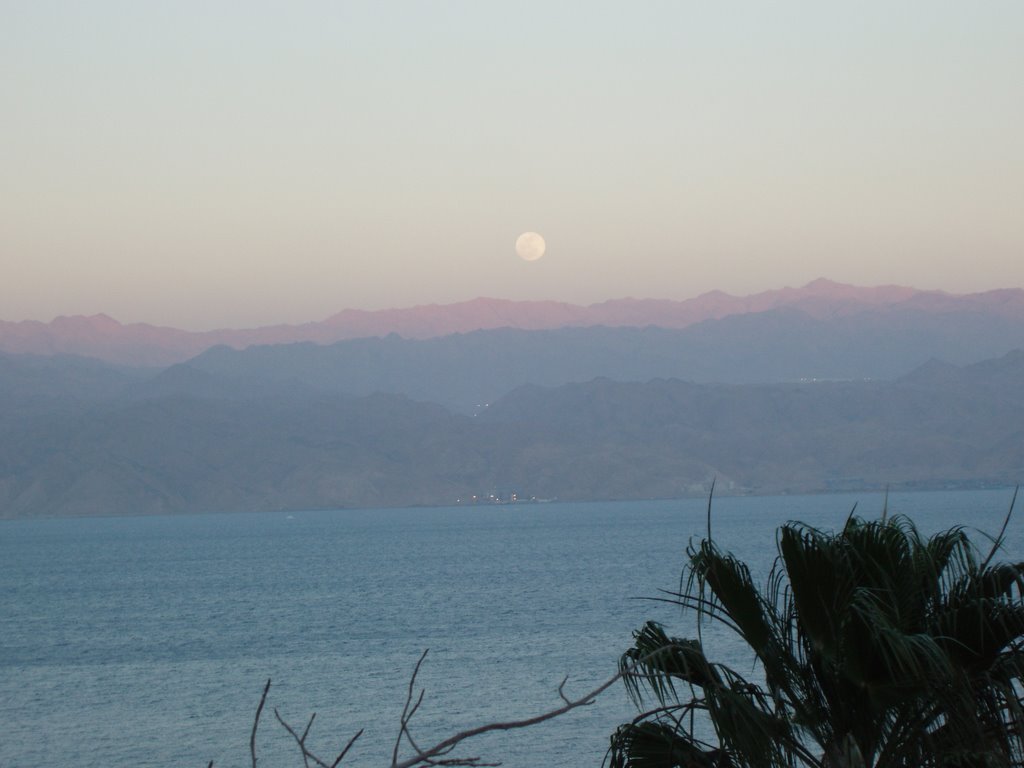
Moonrise from the Orchid Hotel


Weekend in Eilat

Friday we drove to Eilat, a 4-5 hour drive. We stayed for two nights in a suite at the Orchid Hotel, a very beautiful, very full-service establishment. The suite had a very large, high-ceilinged bedroom, a dressing room, and a bath with a large shower and a huge tub. On the deck we had our own private 6-peson jaccuzi -- we were in and out around 6 times. Next to the jaccuzi was a large air mattress with white sheets and pillows for lying in the sun or contemplating the stars and the full moon. Bedroom, bath, and deck had unobstructed views of the Red Sea and the mountains of Jordan on the other side.

At the beach across the street, we both enjoyed snorkeling, and Len went scuba diving, which worked out well. The fish are familiar, resembling those in Hawaii, but everything seems to have been colored with a different pallatte. The trigger fish, which are gaudy and striped in Hawaii, were plain brown. The parrot fish were vivid reddish purple and bright green. The butterfly fish and angel fish are also very bright, novel colors. Hard and soft corals in shallow water are amazingly healthy.

On the drive back we slightly detoured to go past the Dead Sea, though we didn't stop. The drive back up to sea level is steep and winds through salt formations and rocky mountains.

Underwater Eilat


Thursday, May 11, 2006

Meanwhile, back at home...

From the Ann Arbor News:

Jewish celebration picketed

Pro-Palestinian protesters target Israeli Independence Day event
Monday, May 08, 2006
BY LISA ALLMENDINGER
News Special Writer

While about 300 people gathered Sunday at the Jewish Community Center in Ann Arbor to celebrate Israel's independence, about 30 pro-Palestinian rights advocates chanted through bullhorns on the sidewalks outside the center's private property.

Ann Arbor police were called to the Birch Hollow Drive site to ensure a peaceful afternoon for both sides.

"Sadly, we've grown accustomed to their shameful behavior. We don't think that screaming at children is the way Israelis and Palestinians should behave,'' said Jeff Levin, executive director of the Jewish Federation of Washtenaw County.

...

I don't know how long the article will remain online, but here is the URL:
http://www.mlive.com/news/aanews/index.ssf?/base/news-17/1147097440160240.xml&coll=2

The way things work here

Things do function much better now than on our previous trips to Israel. However, we find ourselves in the midst of an ongoing conversion of the pedestrian gates entering the campus, which is surrounded by a high security fence. Gates now require a key for entry. The new method will be turnstiles with an electronically activated mechanism using one's ID card.

Here is my message to my husband about my experiences with the change:
I experimented with a new route to the train station via the back gate on my walk this morning and discovered the following:
  1. My electronic card (so probably yours too) isn't programmed to use the train-station gate. Lucky thing I tested before it was time to take the train! Authorities are aware of the problems -- other people might have a worse day if they actually have a train to catch!
  2. I/we can get the cards properly reactivated starting Sunday. The woman who does it is off today but I can call her Sun or Mon 8-5 and arrange when to fix the card. I'm not sure where this happens, but we can find out when we call. If it's not fixed I'll go the other way out when I want to take the train Tuesday AM.
  3. Work around: one can phone security if one gets stuck by a gate.
  4. Since you don't need to take the train, this is no big deal as that's the only electronic gate operating at the moment.
  5. The Pinsker gate [the most direct access to campus] will be out of service from May 14-26 as it says on the gate. The electronic entry for the Bet Europa gate [next best] isn't supposed to start working yet, so we should be able to use the key-entry gate there during that time.
My conclusion: we shouldn't be in a hurry to get into the campus early next week!

UPDATE: I went to the security office to get permission to use the train-station gate. Reut, the person in charge of the database, updated the file of who can go where so that now we can both use our cards to enter/exit there. And when I came back from my next trip to Tel Aviv on the train, I walked right through the station parking lot and through the gate without a problem. Meanwhile the Pinsker gate is indeed closed as announced, and work is proceeding on the turnstile at the third pedestrian gate.

Paradiso


We had dinner with several friends at the Paradiso restaurant in Jerusalem last night. The restaurant is across a major intersection from the windmill at Yemen Moshe. Before dinner, we had time to walk through the picturesque streets of Yemen Moshe, cross the garden area in front of the Old City Wall, climb the hill, and enter briefy into the Jaffa Gate area of the Old City.

Yemen Moshe is just outside the walls of the city. Built by pioneering Jews, it was a daring place to live in the nineteenth century. The neighborhood was on the dividing line between Israeli and Jordanian-held Jerusalem until 1967, and thus vacant. Houses had to undergo major rennovation after the 6-Day War.

All the houses, walls, pedestrian streets, and stairways in Yemen Moshe are made of the beautiful sand-colored Jerusalem stone. Residents park in lots on the periphery of the neighborhood, so the area has a strangely quiet and almost deserted atmosphere. Flowers bloom everywhere, and all of the stone surfaces are perfectly clean. During our walk, the setting sun gave a increasingly pinkish glow to the stones.

Although called "Italian" Paradiso actually offers several Romanian dishes and Israeli kabobs, as well as pasta. I had a very nice grilled steak with wine sauce, and Romanian sour soup with meatballs and chicken. We drank wine from the Upper Galilee, which was very good. We all enjoyed the food, and we had a very animated conversation about many current topics, including the recent controversial statements from A.B.Yehoshua (see my post "A Dialog of the Deaf" on this issue) and rumors of the fall of the dollar.

Wednesday, May 10, 2006

The Chaim Weizmann House, Rehovot, Israel


Chaim Weizmann was both the first President of Israel and the first president of the Weizmann Institute (later renamed to honor him). Today his house, adjacent to the Weizmann campus, is preserved as a museum, and I toured it this morning.

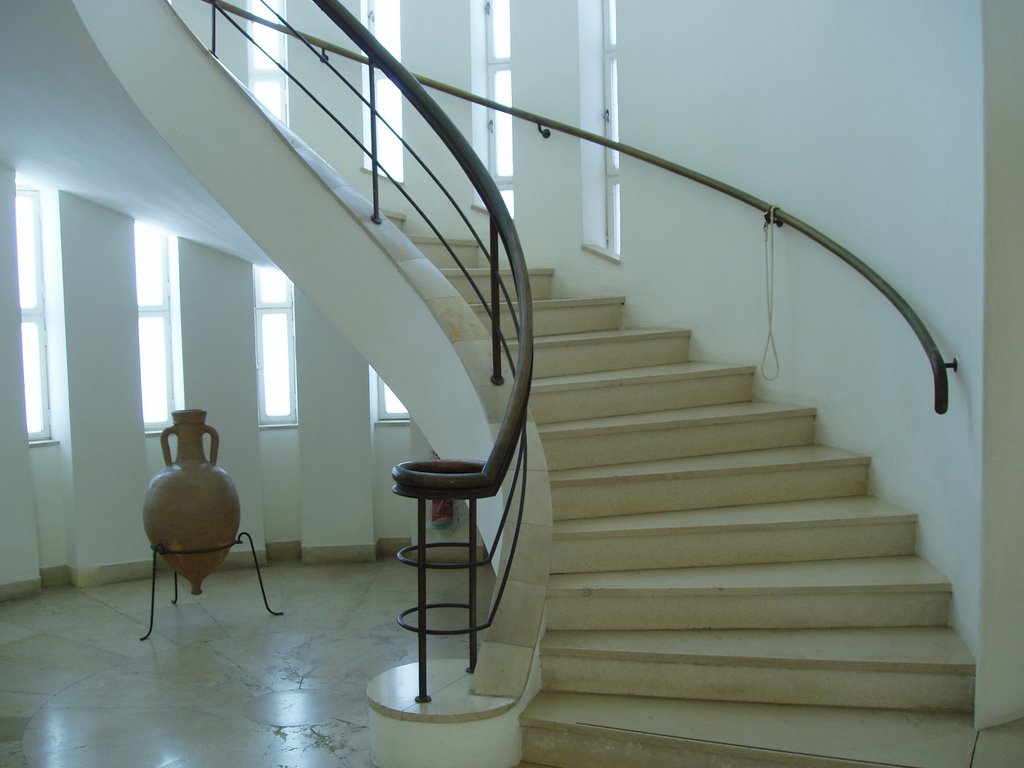
Weizmann and his wife Vera hired the noted German architect Erich Mendelsohn to design the house in the late 1930s. It was very unusual for an Israeli house: a trivial example -- the GE refrigerator still in the kitchen is said to have been the first refrigerator in Israel!

Study, Weizmann House


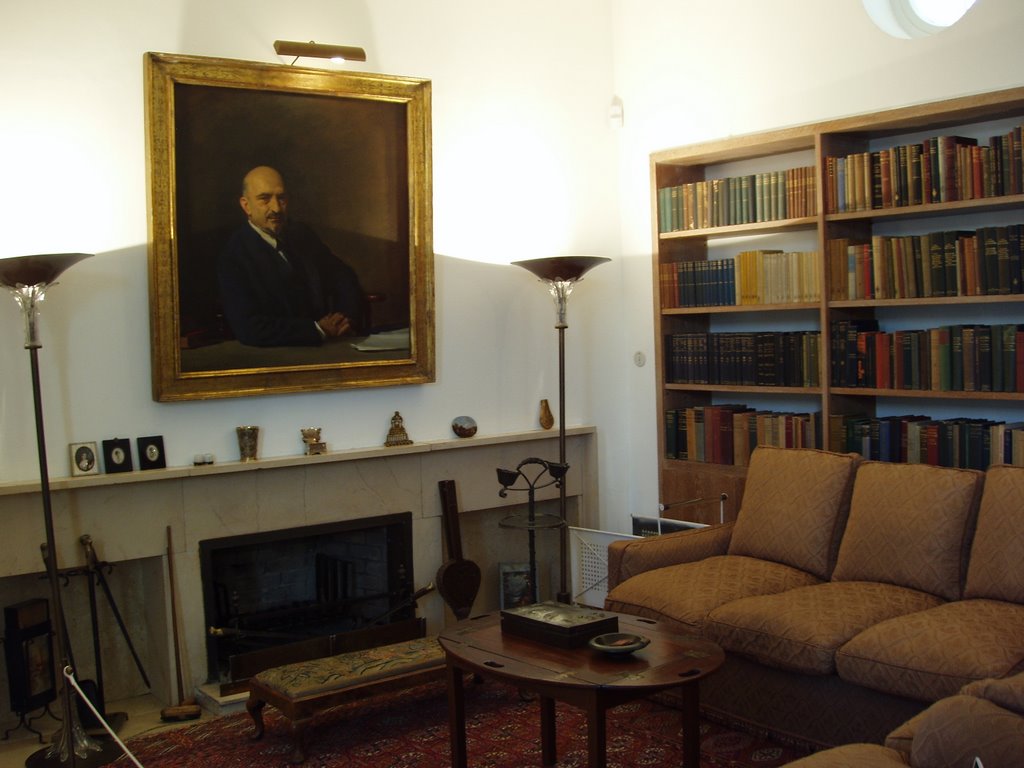
Weizmann's portrait hangs over the fireplace. The room is filled with photos of famous people such as Balfour, Einstein, and the Queen of Belgium, as well as family photos.

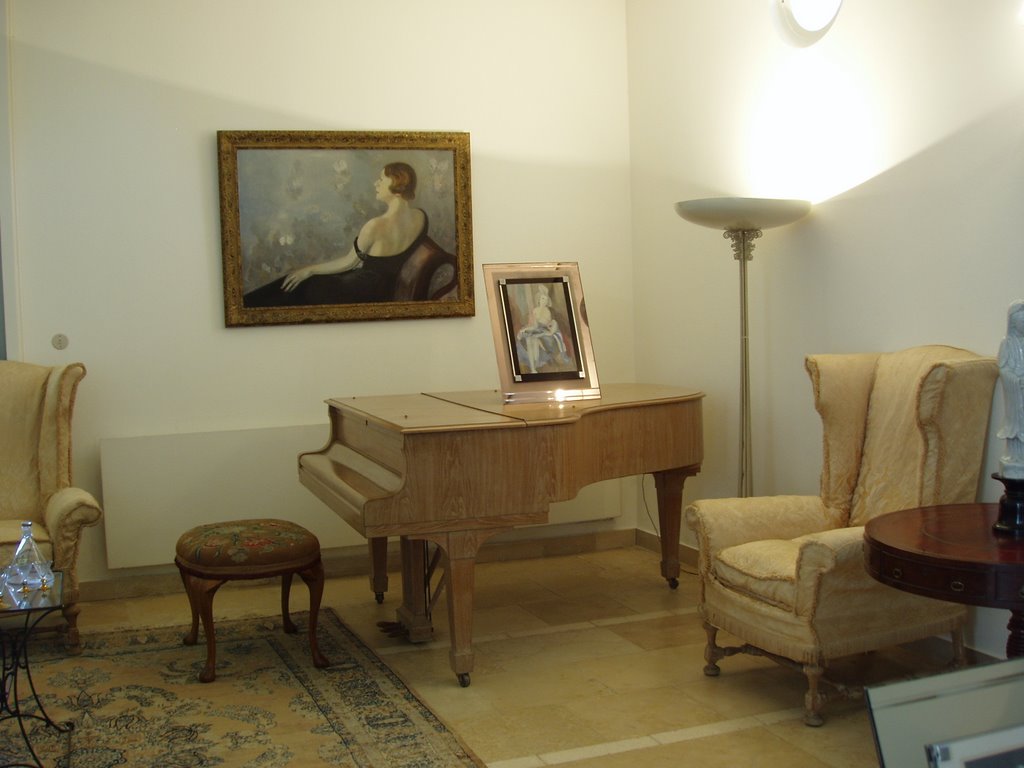
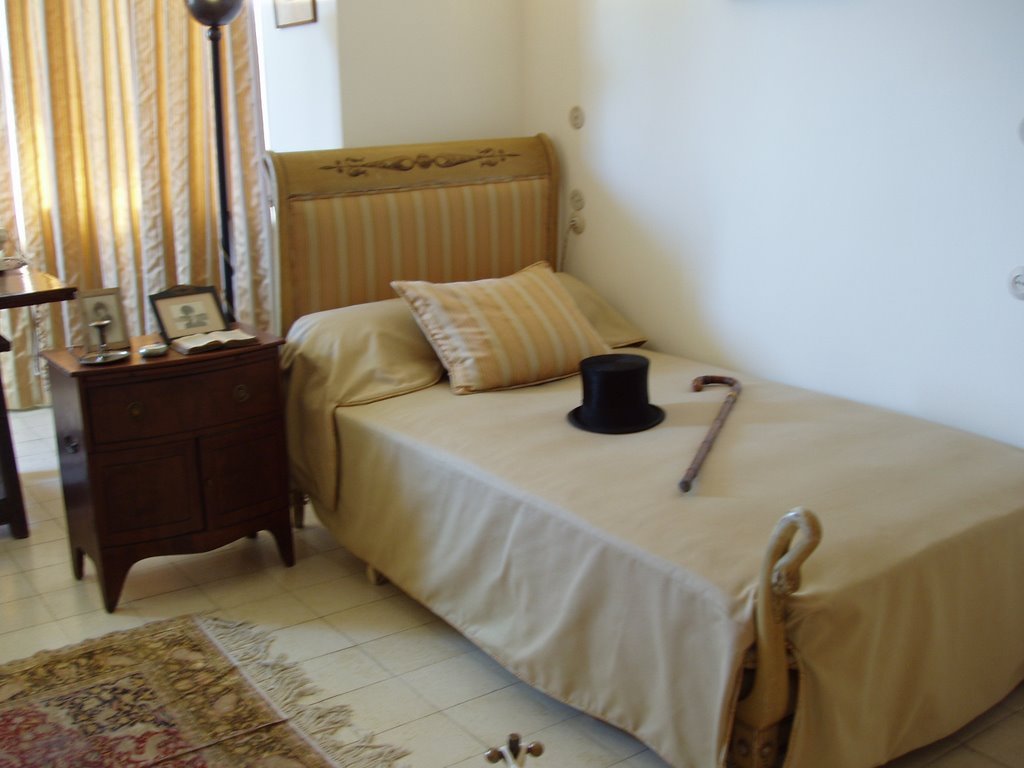
Living Room, Weizmann House


Spiral Staircase, Weizmann House

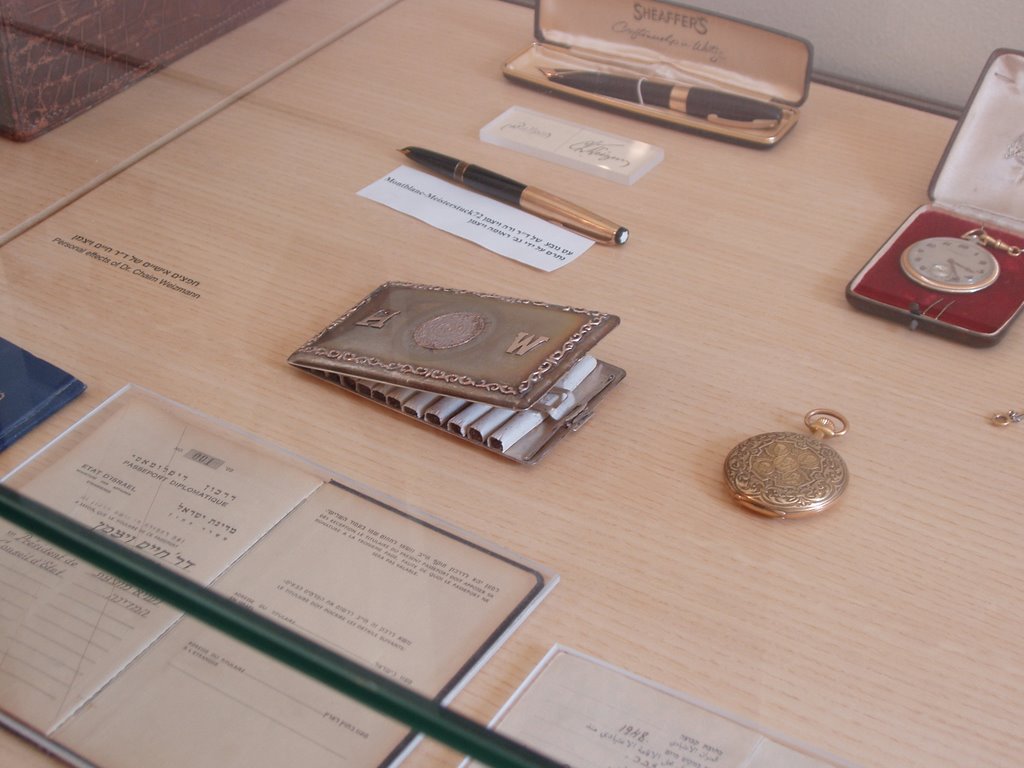
Weizmann: Personal Effects


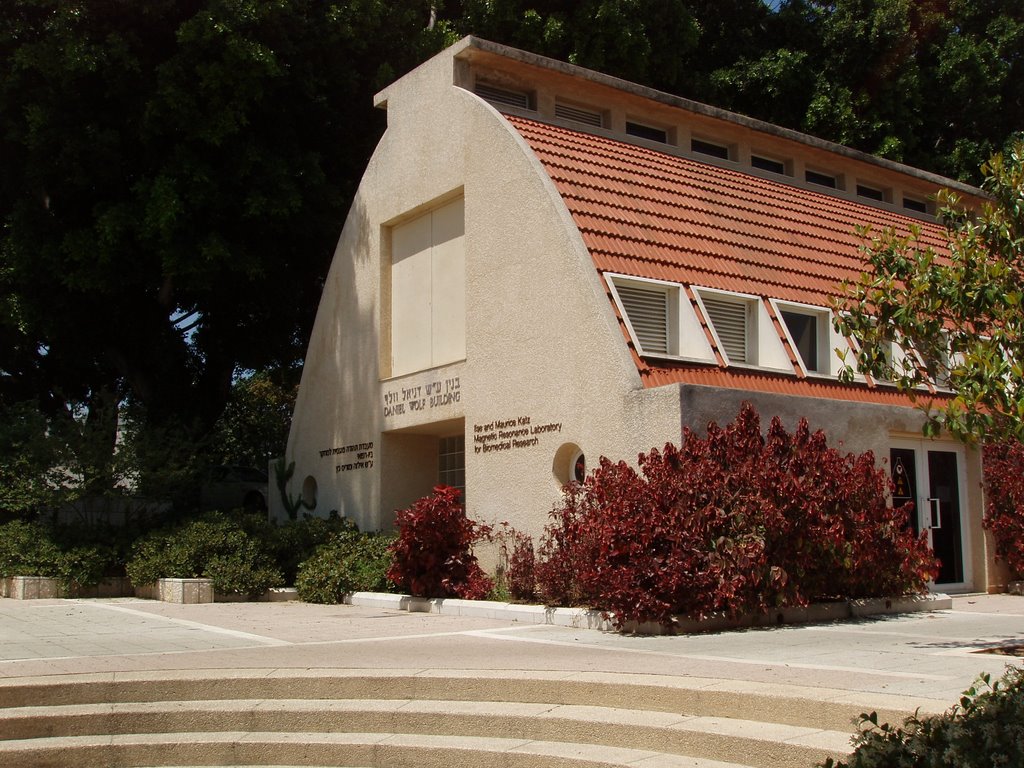
Weizmann Institute, Rehovot, Israel


This building was designed by Erich Mendelsohn, the German architect who also designed the Weizmann house.

Tuesday, May 09, 2006

The Early Bronze Age

Today I attended a lecture at Tel Aviv University called "Maritime Trade and Northern Israel in the Early & Middle Bronze Age." The speaker was Ezra Marcus of the University of Haifa. The sponsor was an organization that Janet belongs to, which puts on a series of English-language archaeology lectures and field trips for non-students.

To get to Tel Aviv University campus, I decided to avoid driving in traffic and take the train. This was a somewhat adventurous undertaking. The 8:00 AM train was very crowded with commuters and young soliders in uniform, some with their uzis slung over their shoulders. The university is not far from the station, but the route involves a walk up around 4 flights of stairs. The train arrives at the bottom of a sort of escarpment and the campus is on top. Security is in evidence, including a search upon entry and sniffer dogs within the station.

In his lecture, Marcus discussed trends in the Eastern Mediterranean from around 3300 until around 175o BCE. He summarized the trade and geographic factors that created a network of shipping and goods exchange. The trading partners were Egypt, Caananites on the coast of Israel, cities of the Levant and Anatolia, Crete, and other places in the Aegean. The coastal ports served traders in paddled boats and later similar sail-equipped boats from Egypt.

Products from the highlands of Israel included olive oil, wine, and timber products -- Egyptians especially valued wood for shipbuilding and resin for many uses. Tin for making bronze came first from Turkey, later from Afghanistan, which also produced lapis lazuli, prized for Egyptian jewelry. Egyptian trade goods included faience beadwork. Pottery vessels were traded and also used to contain agricultural products. Trade in metal weapons and precious metal goods was also important. Northern Israel was at a midpoint of the trade routes, so ports there profited from service to traders as well as from buying and selling products.

The middle of this era saw a drastic decline in the sea trade, as the unified governance of Egypt dissolved and then reformed. The causes, whether due to climate, economy, war, or politics, are not well understood. Before and after this decline, Egyptian and Aegean artisans and colonists seem to have lived in the cities of northern Israel. For example, excavations at the site of Kabri, a port on the Israeli coast, has yielded Levantine, Aegean and Egyptian artifacts such as wet-plaster frescos and pottery.

Marcus supplied many interesting maps of ancient northern Israeli roads and cities, drawings and photos of pottery and other archaeological finds, and diagrams explaining his material. Habitual lecture-goers told me I was lucky to have attended one of the best lectures of the series.

After the lecture we had an enjoyable lunch at the apartment of Janet's friend, who lives in downtown Tel Aviv. As Janet was driving us past the city hall and the famous Rabin Square, I was surprised to see a junk collector driving a horse-drawn wagon full of scrap metal through the heavy traffic.

Monday, May 08, 2006

A Circle

I was talking to Liza, the visitor coordinator here. I went in to ask about some museums that aren't in the guidebook. I began to tell her about some of my past travels, and she began to tell me about her family.

Liza is originally from Algeria. Her family left in 1961, Algerian independence. Someone in her family became interested in geneology and discovered that in the middle ages, their ancestors lived in the Jewish community in the town of Lunel in the south of France, near Montpellier. This was a famous community known as "The Sages of Lunel."

When the Jews were expelled from French territory in the 13th-14th century, the family moved to Cadiz (now in Spain). Liza's maiden name meant "from Cadiz." Jews were expelled from Spain in the 15th century, so the family moved to Morocco. Later they moved to Algiers.

In 1961, the Jews were driven out of Algeria. The family moved to France. Once again they lived in Lunel -- a circle.

Liza herself has lived in Algiers, Paris, Lunel/Monpellier, New Jersey, and Israel.

Sunday, May 07, 2006

Dialogue of the Deaf?

Today seems very hot, and the apartment construction project across the street doesn't seem to be running the noisy compressor. So I'm staying in and catching up on the newspapers online. Ha'aretz has several articles in response to a speech a few days ago by Israeli writer A.B.Yehoshua. He spoke in New York at the 100th anniversary meeting of the American Jewish Committee. Not a low-profile event, the meeting also included speeches by President Bush, German Chancellor Angela Merkel, and UN Secretary General Kofi Annan.

Yehoshua's speech apparently shocked and aggrieved the audience, who wondered if he spoke for all Israelis. Yehoshua said that for him the only Jewish identity was Israeli. "Unless they lived in Israel and took part in the daily decisions, he told the delegates, they did not have a Jewish identity of any significance," said Ha'aretz. The response of David Harris, American Jewish Committee executive director was: "that Yehoshua expressed a 'classic Zionist position' -- a polite way of saying that Yehoshua's position was somewhat outdated and out of touch with the reality of American Jews."

Other than the articles in Ha'aretz, I have been unable to find any coverage of Yehoshua's talk, suggesting that it's not regarded as a big deal by American newspapers (or that coverage hasn't yet been indexed by Google or the NYT search engine). Therefore, I think this is a conversation among a small number of Jews in the US and Israel, which looks important to those few.

So what are they fussing about? Are American/Diaspora Jews inauthentic? Are Israeli Jews ignorant of American Jews' role in forming Israeli policy in the US? (Even if you don't agree with the ultraparanoid view that the Israel lobby caused the Iraq war to advance its own interests, the US position on Israel is no doubt influenced by the American Jewish community.) Needless to say, the reps to the American Jewish Committee are the most committed to Israel of just about any American Jews so their indignation, I would guess, is hightened by a sense of personal insult.

To figure out if Yehoshua has a good point, you can check all kinds of statistics about American Jews beyond the Committee. A recent study says that 1 of 5 American Jews doesn't care about Israel -- extensively discussed elsewhere in Ha'aretz recently. Contributions to Jewish organizations that support Israel declined several years ago (but I think they are on a slight increase now). Americans who go to Israel become much more interested and committed than those who don't, so there's a program for free trips for young American Jews. Mixed marriage decreases support and interest for all things Jewish or Israeli, and it's prevalent. There are many ways to be Jewish in America, from ultra-religious to ultra-unaffiliated, and I don't much like the idea of labeling anyone "inauthentic."

In Israel the facts are in contrast: "Indifference, ignorance and alienation characterize the attitude of the Jewish public in Israel toward the Jews of the U.S. ... The ignorance is shown by the fact that pupils in Israeli schools do not learn anything about the existence of Jews in the world today. The country that had no trouble absorbing billions of dollars from Diaspora Jews does not see fit to devote even a single hour of class time to teach its citizens about the existence of those Jews and the problems troubling them." So wrote Amiram Barkat in an op-ed piece responding to Yehoshua's speech.

Barkat cites a number of Israelis who agree with Yehoshua. For example, philosopher Menachem Brinker, he says, takes the view that "the Arabs of Umm al-Fahm and Lod are part of his nation much more so than the Jews of Manhattan or Chicago - the connection with whom, in his eyes, is a thing of the past."

If the Israelis (at least on some political side) want to have a pluralistic state, American Jews may have varied reactions. I am not the only American Jew who has accepted the American embrace of many ethnicities. Americans debate the details about issues like immigration. But I think most of us share the idealism that we can all live together and govern ourselves justly. I'm comfortable as a member of a minority in a Christian state, despite occasional threats to me or other minorities from various bigots or fanatics.

Some deep American values are uneasy with Israeli Jews' attitudes towards Israeli minorities. I hope Yehoshua and the others mean that Israel should be more idealistic about pluralism. I know they have an unsupportable challenge: members of one Israeli minority are under pressure from a billion of their fellows to hate Jews and to hope to destroy Israel. But if Yehoshua means Israelis should have a more open democracy I think no one heard him. And in turn he didn't hear the 4 out of 5 American Jews who say they support Israel.

Saturday, May 06, 2006

Mount of Olives and American Colony Hotel Restaurant


The olive tree in the courtyard where we ate lunch may already have been there when Mark Twain visited the hotel.

The above photo was taken from the car,in a traffic jam as we looked for the American Colony Hotel.

Museum for Islamic Art, Jerusalem


Tel Aviv and Jerusalem

Last night we had Shabbat dinner at Janet's house near Tel Aviv: only a 30 minute drive when the traffic is minimal. Dinner was great and we enjoyed seeing Janet, Abigail, and Ethan, her son who is in the army.

Ethan was home for the weekend from his job in communications support in the armored vehicle corps. He mentioned (fortunately not while we were eating) that the food in the army is not only terrible, but really filthy. During his time on kitchen duty, he saw food served that had just been cleared of cockroaches, or that had just been picked up from the floor where someone had dropped it.

Today we arranged to meet some friends in Jerusalem, around an hour from here including a stop for gas. So you see how small this country is! Again, we chose a day/hour when traffic is minimal, which makes all the difference.

According to plan, we met at the Museum for Islamic Art, whose purpose is "to promote within the Israeli public an interest, appreciation and understanding of the cultural heritage and artistic achievements of the Islamic peoples." The other museum goers -- including our friends -- all did appear to be Israelis, including some wearing kippas (skull caps, mark of religious Jews). The admission is free on Saturdays, so that a person observing the rule against using money on Shabbat would be able to visit the museum, though I couldn't say whether this was the case of any specific other attendees.

The museum included a special display of artifacts from the Berber peoples of North Africa, including Jewish people. The women of these tribes do all the work: they make their jewelry, weave rugs and clothing, cultivate and harvest crops, and so on. The extensive documentation didn't say what the men do.

The woven rugs, blankets, and shawls on display were stunningly beautiful. Many have typical oriental-rug type diamond and triangle patterns, but others are startlingly modern and abstract looking, with beige backgrounds and a few assymetrical geometric lines or patterns in neutral dark colors. Photographs of women showed the use of the massive jewelry in the display cases: breast plates, chokers of inch-high amber beads, amulets to ward off the evil eye, and headbands with dangling beads or hammered metal work. Most women are tatooed with elaborate designs on their faces hands and bodies.

The permanent collections include ceramic tiles, bowls, pitchers, and chess pieces; glass objects, jewelry, and calligraphy on paper or tile. The documentation about the history of Islam in various regions is very informative.

For lunch we proceeded to the American Colony Hotel. The route from the museum to the hotel passed by the walls of the Old City of Jerusalem, and at one point we could see the Mount of Olives. I was thrilled to see the walls and to see the many people pouring out of the Damascus Gate and Herod's Gate after doing their Saturday morning marketing in the Old City. Plump Arab women in long black gowns with white lace head coverings were carrying new brooms and mops. Adult men with marketing bags, young men in jeans, and teens and children in school uniforms were walking on the sidewalks.

Unfortunately our friend is very uneasy about going to East Jerusalem, of which we were just over the line, and she was very edgy as we drove around looking for the hotel. The fact that we had made a wrong turn and did not exactly know where to go made things worse. Our friends had to inquire, in Hebrew, for directions from several Arab men -- most seemed quite willing to help, though a few were unwilling or unable to answer their questions.

The lunch buffet is extremely nice. A cold buffet has green salad, cheese, ham and roast beef to slice (yes, ham in Jerusalem), smoked and plain salmon, hommos, and every imaginable type of Middle Eastern salad. I especially liked the salmon, the okra in tomato sauce, the potato salad, and the crisp-crusted bread. From a hot buffet I had stuffed grape leaves, rice pilaf, "cigars" (a type of rolled pastry), various meat balls, and some roasted potatoes. I didn't try several casseroles with mushrooms, meat and pasta. I was barely able to taste a few selections from the dessert buffet. We ended with Turkish coffee flavored with cardamom and highly sweetened.

We ate in a beautiful cooling garden with a fountain and an ancient olive tree. A sign on the tree states that it has been there since the hotel was founded over 120 years ago. In the lobby is a list of famous visitors, from Lawrence of Arabia to Bob Dylan, from Ingrid Bergman to Winston Churchill -- politicians, Middle Eastern military adventurers, writers, artists, movie stars.

Thursday, May 04, 2006

Our Apartment Building


The fence around the building is recent: on our visit in 1998, the area was open to the street. The apartments in this modernist building are very spacious, and have recently been refurbished with new kitchen and bathroom fixtures -- a major improvement.

Logos

I always find it interesting how American products are repackaged with recognizeable labels.

Flowers Around the Apartment


Nabatean Ruins in Negev

Wednesday, May 03, 2006

Barbecue for Independence Day


Israeli Independence day began yesterday evening with pageantry and fireworks. It lasts until sunset today. Our friends David and Judith invited us to celebrate with them, their three children, and their friends Audrey and Fred and three of their six children. The children ranged in age from thirteen to early twenties. We joined them in what they say is the most typical Israeli way to spend the day: to visit a National Park, learn about history, and then have a barbecue.

Our friends chose Mamshit National Park in the Negev Desert. The drive begins in the green and productive farming region near Rehovot, and continues towards Be'er Sheva, where the desert becomes drier and drier. Near the town of Dimona are many Bedouin villages. Flocks of sheep and goats graze, and roadside signs warn drivers "Beware of Camels on the Roadside."

While we were driving -- at David's suggestion -- we listened to the Independence Day radio special of Israeli music from the early days. Many of the songs are vaguely familiar, a few we know like "Shoshanna, shoshanna."

The historical interest of this park is the ruins of a Nabatean city, which once served as a stopping point along an important trade route from the East towards the Mediterranean Sea. The city now lies among very arid, scrubby hillsides, but 20 centuries ago was better watered.
The population at that time was around 1000. Low walls made from the local yellowish stone define the buildings that once stood on the site. Most date from the Roman and Byzantine eras, including two fourth-century Christian churches with large mosaic floors and a few surviving architectural details.

Throughout the ruins one sees cisterns. A carefully-engineered
water system stored rainwater. Some dams on a nearby stream, now very dry, also provided a source of water. We walked and climbed to see a watch-tower, two large houses with a variety of arched rooms, two stables where around 20 horses could have lived, a flour mill with black basalt grinding stones, and a Roman bath. Placards located throughout the ruins depict reconstructions of the buildings as they once stood, and show a few of the smaller finds from the site, such as coins and jewelry. The park has no museum, so these articles must be displayed elsewhere.

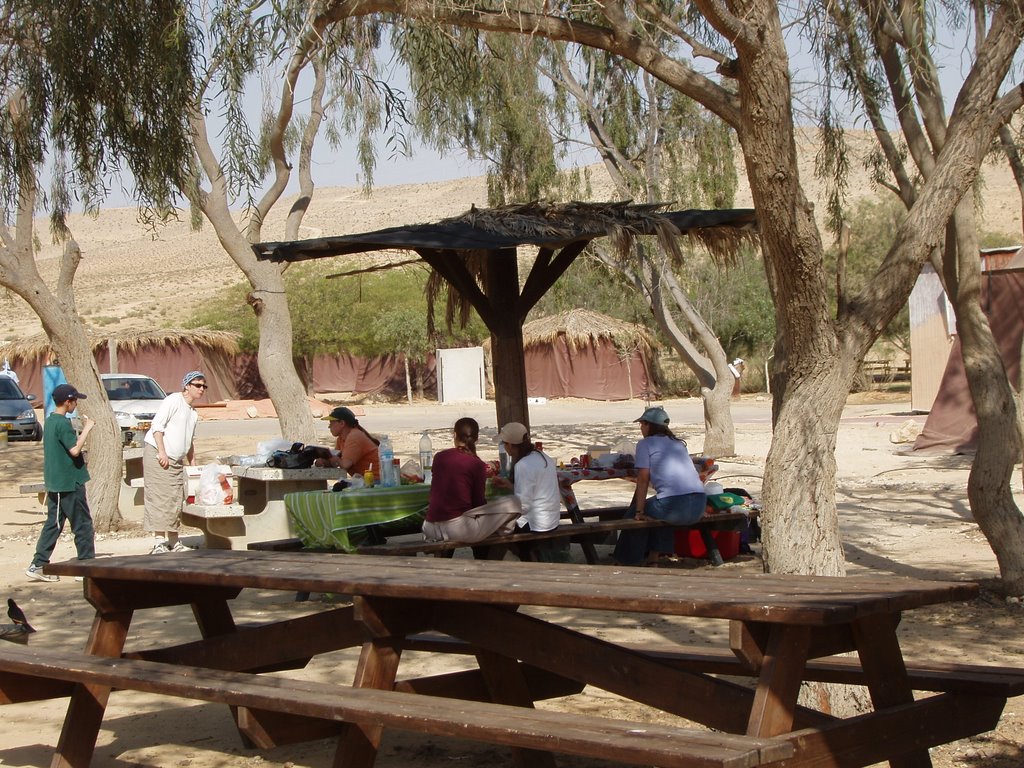
We barbecued in a picnic area with very nice cement tables. Judy and Audrey had brought portable grills, charcoal, and many things to grill: chicken, hamburgers, kabobs, hot dogs, potatoes, garlic, skewers of vegetables, and marshmallows for toasting. They also had prepared salads, vegetables, hot dog buns, pita bread, catsup, mustard, olives, and a few other foods.

As we drove home we saw a number of roadside parks that were mobbed. Families had driven cars onto the grass, set up tables and grills, and were all observing the barbecue tradition.

Israel is a very complicated place. I sincerely rejoice in the existence of a Jewish state, and celebrate her success in 1948. I am very glad that the then small number of committed Israelis avoided
destruction by powerful enemies. I believe that the state of Israel is a legitimate state that should never be annihilated. However, in Ha'aretz today I read a description of the Arab view of this celebration: "More than 2,500 people gathered Wednesday afternoon in the abandoned Galilee village of Umm al-Zinat to commemorate 58 years since Nakba Day, the term used by Arabs to describe their defeat in Israel's 1948 War of Independence." The Israeli Arab view was reflected in the following description of their protest: "Participants carried signs ... rejecting occupation and demanding the right of return for Palestinians, adorned with Palestinian flags and even one Iraqi flag." Another article describes the sentiment about Arab homes in Jerusalem and villages whose names have been changed since 1948. ("Israel marks 58th Independence Day with countrywide celebrations" and "Entrepreneur's dream, historian's nightmare", Ha'aretz May 2, 2006)

Tuesday, May 02, 2006

Getting Settled

We have now started to put food in the kitchen. So we will await the cockroaches, which we remember from earlier visits. Maybe I should be more careful! I got up in midsentence and moved the open cereal and crackers into the refrigerator. Once on a satiric show on Israeli TV I saw cockroach puppets under a sink singing (a parody I assume) to the tune of the old Zionist labor song "all men are brothers." Not just a problem of these apartments.

We saw Batya, secretary of the department we are visiting, this morning. It was very nice to see her after 8 years. We also checked in with Lisa who runs the visitor program. Batya told us how Edna, who used to run the visitor office, had retired. Her son-in-law made a huge fortune with a start-up company and bought apartments in Tel Aviv for all his family.

As well as giving us maps and other information, Lisa called up on our behalf because the car rental company had not yet produced a car as promised. She dropped us off when she had ascertained that a car was finally ready. We had arrived for or 9:00 appointment to be told every 10 minutes that the car would arrive in 5 minutes.

A man in the waiting room assured us that chaos and unpredictibility was what we could expect habitually in Israel. He left the states 30 years ago, he said, and has worked in computers in a large bank. He claims that Israeli habits are chaotic, so they do well at development, but have to partner with Americans and Europeans to do support and real-life implementation in successful technology endeavors. Maybe it's true. We asked how the Israeli partnerships in Europe were doing in view of increasing anti-Israeli sentiment in Europe. He says they are more sympathetic as they have more problems with their own Moslem communities. Maybe it's true.

Fortunately, the Weizmann doesn't work on this basis, so even our TV now works. Though unfortunately our wonderful new cell phone has developed difficulties and we will have to get another one after the holiday.

Janet (a cousin) and Abigail (her daughter) are on the way over here, bringing some food for dinner. We managed to do some grocery shopping before the early closing for Memorial Day today, which means everything is closing some time this afternoon, so we had to rush around. We didn't have time to go to the ceremony on campus, but we heard the sirens at 11:00 this morning and 8:00 last night. Everyone stands still for the 1 minute as sirens sound across the country. (They also use them for air raids.) The sound starts up with distant sirens, gets louder, then dies away as they shut down at slightly different times.

Everything stops in memory of fallen soldiers. I think of the young and not so young people who came out of Europe in time for the 48 war. Since the British didn't allow them in, many came from refugee camps directly to the Israeli struggle against the Arab alliance against the UN-mandated new country. Some of these new Israelis died in battle without anyone even knowing their names. Most Israelis now think of young men they have known and lost recently. We happened to be in the parking lot. One young man stood nearby us, absolutely unmoving.

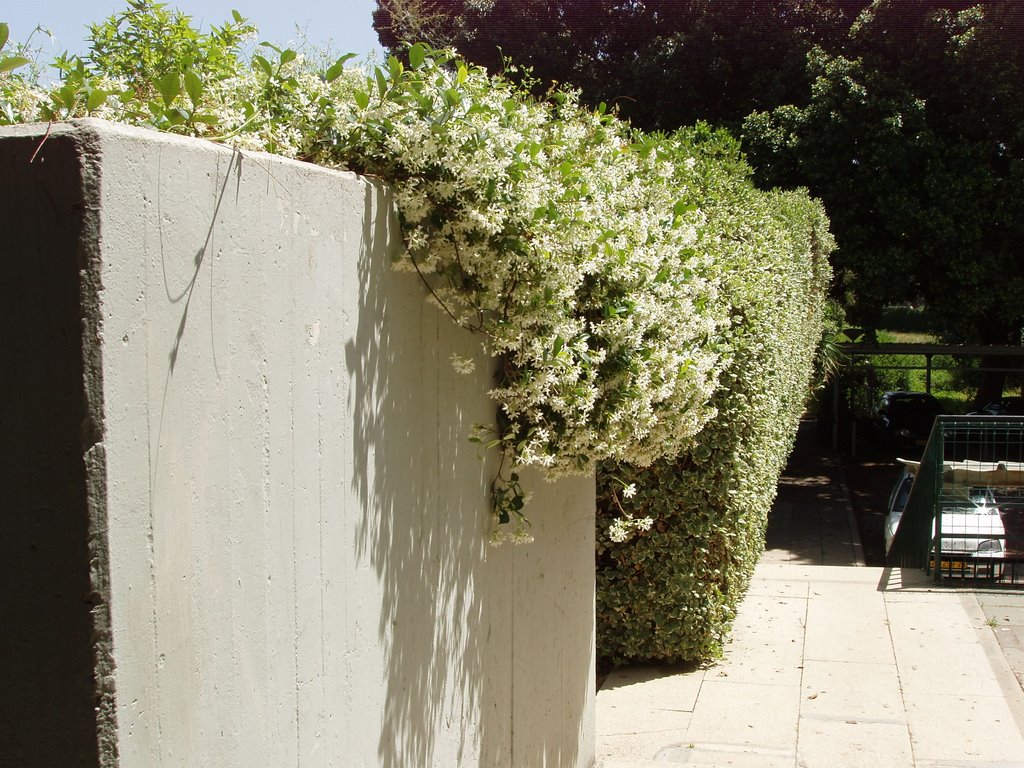
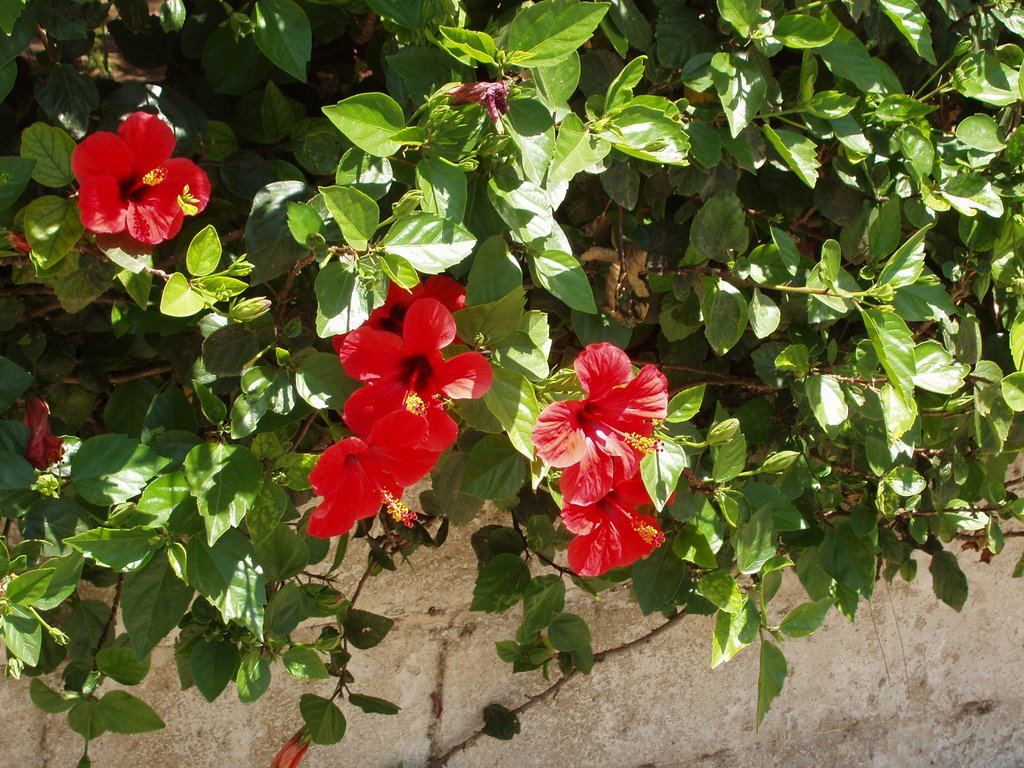
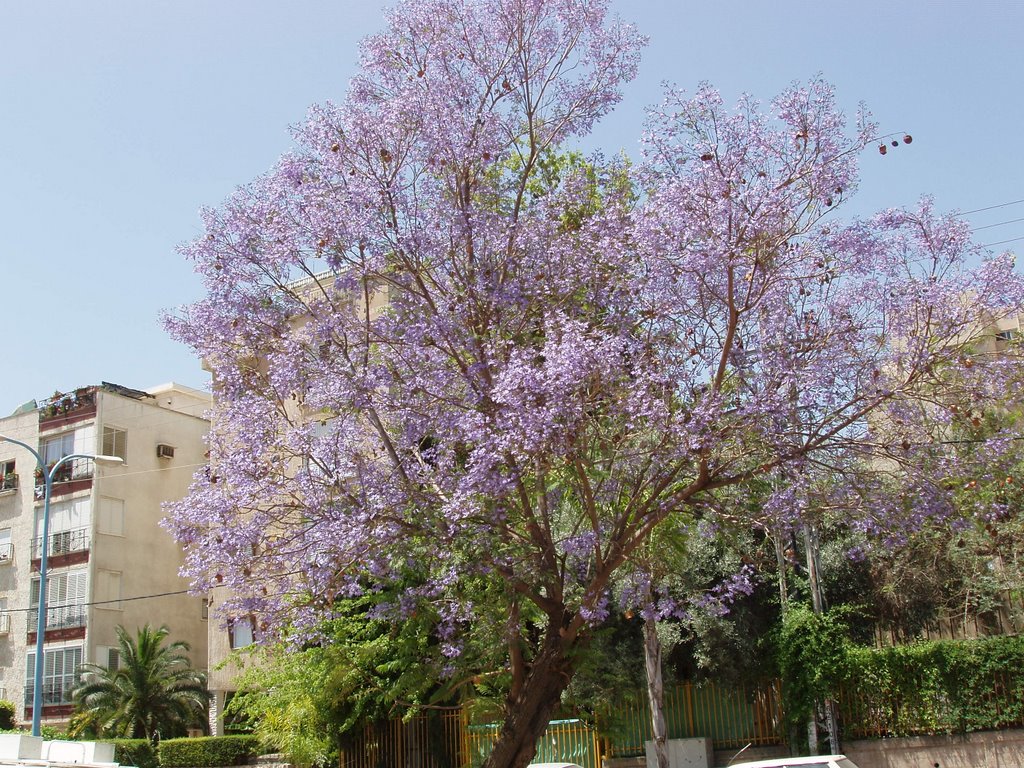
Janet and Abigail arrived around 4:00 with Israeli salads, bread, and goat cheese for dinner. Also home-made cookies which are a spin-off from Janet's commitments as a mother of a soldier (Ethan). Before dinner, we took a walk to the solar energy viewpoint. Bedouin shepherds still tend flocks of sheep on the grassy slope beyond the high-tech experimental field of suncatchers. The Weizmann campus is still gardened with great taste. Tall jacaranda trees massed with purple, fragrant jasmine shrubs, nastertiums, and pansies in rows are all blossoming.

After dinner we watched the national Independence Eve ceremony sponsored by the Knesset. It featured special people chosen this year from the northern regions of the country. They included a Jewish woman from Kurdistan who led pioneer efforts in the Galilee -- she has 55 grandchildren; an entrepreneur who has founded many industrial zones; educators, doctors, and a Holocaust survivor. Each had a special accomplishment. All made a very brief speech (which Abigail and Janet translated for us) and then lit a torch. The torch-lighters included people from Romania, Morocco, Iraq, other countries, and also a Druse women. Marching soldiers, dance troops, and singers also participated in the ceremony, held at Mount Hertzl and televised nationally.

A program about the '48 war, narrated by Martin Gilbert, is now running on the Israeli History channel. From it, I learned that Druse volunteers fought on the Israeli side in the Independence war. It has wonderful contemporary films of the war and just post-war Israeli society.

Monday, May 01, 2006

Our plane trip from Detroit Metro via Newark on Continental went without a single hitch. Even the meal trays at dinner and breakfast were picked up promptly so we didn't have to sit there staring at unwanted food.

About 1/3 of the other passengers seemed to be Haredi -- ultra-orthodox Jews in 18th century clothes. They used up a lot of bin space for their hatboxes: Haredi men wear black felt hats. The young man sitting next to us kept his hat at his feet. He told us he was a seminary student in Jeruslam, originally from LA.

I said "My husband is a visiting scientist at the Weizmann Institute."
He said "What's that?"
I said "A science institute in Rehovot. It's named for Chaim Weizmann."
He said "Who's that?"
We said "He was the first President of Israel, and an important figure in the Zionist movement in the first half of the 20th century. He was also an important chemist who worked in England, so he had lots of contacts there that were important to Zionism."
He said "That's great." We understand that the ultra Orthodox in yeshivas aren't allowed to learn about history, basic mathematics, literature, or any other subject except religion. This really shows how far they go. It's like an American who had never heard of George Washington.

When we got off the plane, the immigration authorities had hardly any questions for us. Our luggage was unloaded promptly. We immediately bought a cell phone, got a cab, and arrived here at our apartment, for which the keys were waiting as promised. What great luck!

And our luck continued. Although it's a holiday evening (tomorrow is soldier's Memorial Day), we got to a grocery store, a restaurant, and a drug store just in time, so we have basic stuff to eat, instant coffee, soap, paper towels,etc.

Just as the little restaurant closed we manged to get in. We had totally Israeli fast food -- chicken skewers, french fries, and chopped salad with creamy (but non dairy no doubt) dressing, all on a puffy pita bread. And coke with the Hebrew logo that is totally recognizeable.

Then we walked around a little bit, with astounding memory for what is new and what isn't. I think the bakery and greengrocer that used to be here are gone, replaced by bars, coffee shops, and restaurants. But a lot has stayed the same.