Saturday, May 18, 2013

The Smell of Beauty

Beauty parlors used to smell of unpleasant chemicals. Now, I've observed, they smell mostly of perfumes with undernotes of chemicals. I wondered about this, so I asked an expert: Kim, the woman who always cuts my hair. Her explanation begins with the fact that permanents have always been the source of the harshest chemical smells in hair products. Kim says that coloring products smell the worst when you mix and prepare them, which doesn't take a lot of time and can be done away from the customers. Acrylic nails also involve stinky chemicals besides the banana smell of nail polish remover, she says.

Childhood memories: this is a Toni Doll
that could be given stinky home permanents
Why doesn't the shop smell like these chemicals? Like the beauty shops I remember from the past?

Permanents, at the moment, are out of style, Kim explains. In the past, a salon would have been giving people permanents all day long. Currently they might do one a day (this morning, she says, they did only one permanent at her shop, which is large, and none this afternoon). Hair styles are more natural now, at least those done in her salon. Along with this natural look for hairstyles, people also are less interested in artificial nails than they were a few years ago. In her view, the natural trend is a main cause of the better smell of beauty salons.

Coloring of all sorts is very popular, now, says Kim, thanks to improvements in the products used: you can choose a more natural-looking hair color. But from the smell perspective, your beautician can choose products with milder chemicals to use when doing the job. She says she has several favorites that don't smell particularly bad -- one she describes as "vegan."

Another specific reason why her salon smells predominantly of the perfume in the many gels, hairsprays, shampoos, lotions, and conditioners is that her salon has confined perms being done with chemicals to a single area of the shop, away from customers who are just getting their hair cut and blow-dried. They are back by the old-fashioned dome dryers, used mainly for these processes. I've never been back there!

I thought the government had regulated salon chemicals to protect the workers, but Kim thinks the smell improvements have arisen mainly from change in demand for artificial products and from the choices of the management, beauticians, and nail techs to use products that smell safer and thus are more pleasing to customers and to themselves.

Note: I recently stuck my nose into a couple of salons in shopping malls and so my aroma observation is not just based on the place where I get my own hair cut, for what that's worth. If there are socioeconomic differences in these trends and choices -- which I'm sure there are -- I'm not in a position to have noticed. I suspect the natural look and smell isn't as popular in other areas as it is in Ann Arbor, but I haven't checked it out.

"A History of the Senses"

Can anything good be learned from a book that takes certified crackpots completely seriously? That's the case with Robert Jütte's book A History of the Senses: From Antiquity to Cyberspace. Among the discredited ideas he finds completely reasonable: the ESP research of the Rhine Institute and other parapsychology research. He's a bit cagy on the subject of aromatherapy and its implications, but a firm believer in homeopathic medicine. (I think he works for a homeopathic training institute.) I'm suspicious about his views on some of the other marginal disciplines too.

My main problem with the book is its diffuseness. It covers all ages, all history, all literature, eastern and western philosophers, and so much more. Of course every sentence isn't untrue: there are lots of insights and quotations that are thought-provoking and worth looking at, and some quite nice historical summaries. But on the whole, I think it's a dubious book.

It did remind me that the five senses are the subject of the fabulous unicorn tapestries in the Cluny Museum in Paris, for which I'm grateful, and I'll have to work on that subject soon.

Cluny Museum:
The Lady and the Unicorn, Sense of Smell (WikiMedia)


Friday, May 17, 2013

"Sensual Relations" -- notes on smell reading, long and rambling!

"Take the case of taste. English has four flavor categories, Japanese has five, the language of the Weyewa of Sumba counts seven flavor terms, while that of the Sereer Ndut of Senegal has only three. When it comes to smell, however, the Sereer Ndut recognize five odor categories, the Weyewa note three, the Japanese discriminate two, and English has no precise olfactory vocabulary. The point here is that there is no single evlutionary pattern to be discerned behind these linguistic facts when categorization in various sensory fields is compared." (p. 9)
This quote is among many interesting facts and observations about smell in the book Sensual Relations: Engaging the Senses in Culture and Social Theory by David Howes. In the follow-up to this text, he suggests that Russians talk about or notice the smells of many more things than Americans -- this is not the same as saying they have more words for smells; it's cultural! He suggests that Arabs are more aware of personal smells, which can lead to cultural awkwardness as they sniff you. And he mentions Arctic tribal trackers who use ALL of the senses, including smell, to follow their prey.

In a long discussion of the senses in the works of various anthropologists, Howes concentrates more on vision and hearing, as one would expect. There are a few interesting smell ideas, though, such as the integration of sight, hearing, and smell in the experience of the Kaluli culture of Papua, New Guinea. In a quote about them, he offers a quote about their experience of "the dense sensuality of evening darkness, with voices overlapping the misting light rains and insects and frogs of the nearby bush... sensually continuous with the smoky aromas that fires or resin torches release into the longhouse and diffuse out into the moist night air." (p. 38)

In fact, he says, the Kaluli have a single verb that means both hearing and smell. Another people, the Temiar of Malaysia, say that people have four souls, including "an odor soul and a shadow soul, which create a kind of bubble around the person." People, animals, plants, and landforms also have a "head soul and a heart soul." These souls play a role in mental actions like dreaming and in sickness. (p. 39)

At one time, anthropologists evidently dismissed smell, taste, and touch as "animalistic" or "exotic" -- but this time is passing, Howes says. Instead of viewing "complex olfactory or tactile codes" as primitive, anthropologists now think that they signal "sophisticate cultural elaboration of a particular sensory domain." (p. 46) Howes suggests that both the different theories and the different metaphorical associations about the senses of different cultures should be respected: "it is not to Western theories and practices of the senses that we should turn, but to the theories and practices developed within the society under study." (p. 54)

Here's an interesting example of an odor with several meanings in different cultures: rot. "The image of abundance in the Massim [Trobriand culture] is that of a village that gives off a rotten stench as a result of all the food that is permitted to rot in its storehouses.... It is not the food cooked for a feast but the food that rots despite a feast -- the conspicuous decay over and above the conspicuous consumption -- that hosts pride themselves on, and that is commemorated in song." (p. 68)

The Kwoma people of New Guinea are the subject of a very long chapter in Sensual Relations. Odor, explains Howes, plays an opposing role to sight in this culture, revealing "identities that visual appearances sometimes mask." My reaction to his examples is that the Kwoma view isn't that different from the view of many people in modern times in the West, but anyway... He offers some myths that show their way of thinking about odors, such as one in which "the human identity of a female flying fox is discovered as a result of the protagonist smelling a breadfruit tree leaf on which the flying fox had urinated. In another myth, a man who used to trick his wives by changing his skin ... has his true identity exposed when the women bring their dogs along with them to the place where they work sago." The dogs immediately know the identity of the disguised man; one can't disguise one's olfactory identity, no matter what appearance one takes.

In real life, says Howes, the Kwoma distinguish many revealing odors about people; they believe that not only other humans but also spirits react to these odors as do "inanimate objects, plants, spears and yams." Odors can be dangerous, or can be enlisted to create strength or defeat enemies, for example among the Kwoma's fifteen varieties of ginger, some can be used to stun the enemy in a raid or for other warlike purposes. (p. 146-149)

In a section titled "The Decline of Smell in the West" Howes has a very jargon-filled description of odors in recent history, as Pasteur and Freud variously redefined smells and their relation to disease. "The net result of these developments was the destruction of the elaborate olfactory semiotics of premodernity and its replacement by an olfactory hedonics -- a simple calculus of relatively pleasing and displeasing aromas and stenches," he wrote. "A significant by-product of this shift was the way in which the nose came to be conceived of completely independently of its function as the smell organ and exclusively in terms of its visual shape in the 'scientific' classifications or races promulgated by Freud's contemporaries." (p. 200-201)

Howes is a co-author of the book Aroma: The Cultural History of Smell (on which my notes appear here). In Chapter 3, "Universes of Odour," there is a great deal more about tribal views of smell -- the "osmology" of each culture. The Andaman islanders and their calendar of smells is one of the most interesting (I was so interested that I read the source material, noted here). Besides the Andaman islanders, Classen cites the Dassanetch of Ethiopia, whose calendar contrasts "the smells of burning and decay characteristic of the dry season ... with the fresh smells of new plant growth that arise during the rainy season." (p. 96)

Classen also cites examples of people who smell the scent trails of prey or of other people in the woods. The Umeda of New Guinea can detect a trace of smoke from a campfire far from them in the forest, or can locate a pungent-smelling posssum called a cuscus hiding there. (p. 98)

The Desana of the Amazon believe that "tribal territory is marked out by the scent trails laid down by the people who live there. Each tribe is deemed to emit a unique odour." Their name for themselves is wira which means "people who smell." They also associate distinct smells or "wind threads" with various animals that live in the deep forest or in the open, and can follow their scent trails; they can follow the scent of plants and fruit. They believe that smells are perceived by the whole body, not just the nose. They have elaborate categories of odors that group smells that are related by their location and also "on the basis of their moral significance." (p. 98-100) They have two general categories: good smells and bad smells. (p. 111)

A number of other tribal societies similarly assign names and groupings to sets of aromas that join several types of entities. For example, the Suya of Brazil have a category called "strong-smelling" which includes "adult women, children, carnivorous mammals and birds, harmful plants." Their other categories are parallel. (p. 101) The Serer Ndut of Senegal have five categories that include what we would find incongruous members; for example the category "acidic" includes "spiritual beings, donkeys, tomatoes, certain trees and roots." The spiritual beings belong to this category because of the acrid smoke used in rituals where snakes, associated with them, are chased away. Europeans belong to the category "urinous," while the members of the tribe belong to "fragrant." (p. 103-104) The Kapiski of Cameroon have fourteen classes of smells, though not total agreement among themselves about which items belong to each class, with variations depending on the social status and gender of the person doing the classification. (p. 110-111)

Now I'm even more ready to return my books to the library -- one more to make notes on!

Aroma Image for Today

Lillies of the Valley make my whole front yard smell wonderful this week

Thursday, May 16, 2013

"Aroma: The Cultural History of Smell"

Aroma: The Cultural History of Smell by Constance Classen, David Howes and Anthony Synnot covers several key topics in smell reading. It begins historical data that summarize how smell appeared in ancient times through the Dark Ages up through recently. It includes a survey of anthropological observations, and a summary of some of the commercialization of smell in modern times. First published in 1994, the book is a very useful introduction to topics that have recurred in the small but possibly growing literature exploring a variety of aroma topics.

Classen notes the many uses of perfumes, fragrant unguents, incense and other burned aromatics, spices, beds of rose petals, and many other odor conditioners of the Romans. While modern people see distinctions between perfumes, incense, products rubbed on the body, and spice or flavorings added to food, the Romans often used the same products as incense, food additives, drugs, and perfumes; that is, in a sense, they ate or drank perfume, used incense or perfume as medicine, and otherwise blurred the lines as we see them.

The role of aromatics in Romans' lives contrasted with the many unpleasant smells of their cities and industries -- such as the use of urine in tanneries and even laundries. A fascinating observation: that the shellfish used to dye garments the well-known royal purple color left a fishy odor on the cloth that had to be masked by various fragrant smokes or powders put on clothing.

The early chapters of Aroma particularly stress the role that aromatics like incense and the smoke from animal sacrifices played in ancient religions and early Christianity. Specifically, the Roman gods loved incense -- like many ancient Mediterranean gods they ate nectar and ambrosia, a cross between incense and food. Spicy, exotic aromas were associated with religious experience. The early Christians at first rejected this, wanting to make their new and more reserved faith different from the old religion. The Church, however, eventually added incense back into the sanctuary and added the concept of a holy odor that distinguished saints even after death -- the odor of sanctity. Only the devil stank.

While the Romans loved bathing extended with lots of perfumes, unguents, etc. later people virtually gave up bathing and used perfumes to cover the rather appalling odors of their bodies, feet, breath. The puritans purified things by opposing the use of perfume.

In the chapter on medieval through modern times, I enjoyed her description of a medieval kitchen. Its odors not only included the smoking hearth but also refuse, spoiling food, sweating cooks and servants, dogs turning the spits on the fire, and animals waiting to be slaughtered or actually being killed prior to cooking them. Pungent sauces or vinegar served to mask putrid meat; their odors blended with those of spices, herbs, garlic, onions, wine, meat, cheese -- nothing refrigerated. Such were the smells of the medieval kitchen.

Classen's chapter on anthropological observations inspired me to read about the Andaman islanders, which I wrote up here: The Spirits Can Smell You. Her observations are interesting, and  have been expanded by later writers.

She describes how the Victorians defined the senses -- sight was for men like explorers and scientists while smell was feminine and associated with women, savages, animals. Smell symbolized intuition, irrationality, and sentiment. Her discussion of how modern advertising of beauty aids and personal care products has driven current western attitudes to odors is interesting, but I have read more penetrating analyses of this area.

I am getting ready to return all the books I have from the library, so I hope to make a quick set of brief notes on some of them before they are out of my hands.

Sunday, May 12, 2013

Who smells better: a man or a dog?

Agriculture-sniffing dog
One rarely-disputed belief about smell is that humans have a less-developed or weaker ability to detect odors than many animals, especially dogs. Both Freud and Darwin suspected that evolution had weakened the human sense of smell while being quite kind to dogs. Recent research has changed the way science views the difference. Dogs don't necessarily smell better, they just smell differently.

Drug-sniffing dog
Let's begin with the term "trained bloodhound," which of course refers to a dog breed that can smell with incredible, almost uncanny accuracy. Give them a tiny whiff of a person's scent and -- noses to the ground -- these dogs can find their quarry. At least since the Middle Ages, bloodhounds have been trained and used to track down criminals or victims. And dogs seem to have helped human hunters to track prey animals for around 16,000 years, or at least lived with humans that long, making them the first domestic animals.

Boston Police dogs in hunt for fleeing
Marathon Bomber
The terror of being hunted down by baying sniffer-dogs plays a role in a variety of melodramas depicting an innocent accused person, a runaway slave seeking freedom in a hostile wilderness or a dangerous criminal attempting to escape in urban confusion. In stories, comic books, and movies (once they were invented) the bloodhound chase has become a cliche along with a near-mystic belief in dogs' ability to sense the quarry.

More recently, many breeds of dogs work in the customs halls of America's international airports, as you may have seen while returning from a trip abroad. Drug-sniffing dogs wear badges that say "US Customs and Border Protection" and Agriculture Department sniffing dogs wear little green coats that say "Protecting American Agriculture" while working with their handlers. Bomb squads have trained explosive-sniffing dogs. A few weeks ago, the Supreme Court ruled that "using a drug-sniffing police dog on a suspect’s property without a warrant violates the Fourth Amendment’s protection against unreasonable searches." (NY Times, March 29, 2013)

Major news coverage has also described success training dogs to recognize the odors of various diseases such as bladder cancer smells in patients' urine and other diseases on patients' breath. However, the success rate isn't good enough to create squads of disease-sniffing dogs like the law-enforcement dogs.

Could humans accomplish anything like dogs? Of course no humans would be able to make their way through the woods on their bellies, sniffing a trail of scent. Not even if their noses would pick up the traces that the dogs would find. And although in the Middle Ages, doctors sniffed their patients' urine as a diagnostic test, I suspect that most medical professionals today would rather forget that smell has diagnostic value. Leave those things to the dogs!

But is the human olfactory sense really deficient compared to dogs? The book What the Nose Knows by Avery Gilbert suggests that the common awe for what dogs can smell is unfair to humans, who aren't tested or trained to do similar acts of sniffing. "If the human nose received the same gee-whiz treatment given to animal stories, we would sound as impressive as any dog. Here's an example: Just by smelling some ice cream that once had a wooden popsicle stick in it, regular folks can tell whether the stick came from Wisconsin, Maine, British Columbia, or China. Amazing, no?"

Gilbert describes the popsicle-stick experiment and several others in which humans demonstrated feats of smell prowess that compare to those that give dogs their reputation. A human can pick out a T-shirt that belongs to his or her spouse or partner from among a number of shirts. A human mother knows her own babies smell from that of other babies. In his autobiography, physicist Richard Feynman described several smelling feats he had mastered, including following a scent trail on the ground or identifying people by the smell of their hands. (Gilbert calls some of these "stupid human tricks.")  And in an experiment at Berkeley, human subjects on hands and knees could "follow a 10-meter-long chocolate-scented trail using only their noses." Training improved their performance -- after a few days of practice, their speed doubled and they stayed on the trail better.

"Dog lovers ... may also be surprised to learn that drug dogs and humans have almost identical sensitivity to methyl benzoate, the smell used to track cocaine. Dogs have great noses, but it's time to stop the trash talk and give ourselves more credit," writes Gilbert. (quotes from What the Nose Knows, pp. 62-64; Kindle locations 1018-1034)

On the more technical side, in the book Neurogastronomy: How the Brain Creates Flavor and Why It Matters, author Gordon Shepherd describes the comparative anatomy and neurobiology of the human and canine sensory organs.

Shepherd describes the length, placement, and form of the nasal tract; how the nasal tract attaches to the mouth; the form of the nostrils, the configuration of the location of the molecular sensors that connect by neurons to the brain, the olfactory bulb that processes the responses, the cognitive apparatus for sensing, recognizing, and remembering odors, and the overall measurable results. Both dogs and humans have the olfactory bulb at the base of the brain just above the smell receptors in the upper chamber of the nose, as do other mammals.

Dog nostrils have several specialized structures for scooping up air and effectively delivering smells to the smell sensors in the upper part of the snout (sniffing through the nose is called orthonasal smelling). The dog's snout and nostrils very effectively pull in smells from the ground or the air surrounding their snouts. Human noses aren't as good at sniffing, but humans make better use of retronasal smelling: that is, pressing scent-laden air across chewed food in the mouth and wafting it onto the sensors in the upper nasal passages. Such retronasal smelling combines odor sense with all the senses in the mouth (taste buds, pressure and temperature sensors, etc.) In retronasal smelling, the senses of smell and taste integrate in the brain to make flavor. Dogs' noses, says Shepherd, are "engineered for orthonasal smell, and the human nose is engineered mainly for retronasal smell." (p. 19)

In the past, generalizations about human versus dog ability to smell have not considered these structural differences. For example, simple counting of the number of olfactory sensors oversimplifies the comparison of smell ability. Indeed, humans are outranked by rodents with 1000 types of smell receptors and dogs with 800 -- humans have only 350. "However, the greater complexity of the human brain in analyzing the images becomes a critical factor," says Shepherd. He elaborates this complexity a great deal in the remainder of the book. (p. 89)

Detection of molecules is only the beginning of a process. Humans perceive flavors and create "smell images" by using the complete set of structures in the mouth, nose, and brain. The human sense of flavor thus discriminates between many foods -- the aromas of boiled or fried foods, fermented foods, and spiced foods. The brain also has intricate ways of creating smell memories, as well as selective ways of reacting to flavors, depending on the context in which one smells, including how hungry one is and on the appearance, especially the color of a smelled object. (p. 97, 137)

The role of evolution in creating the human or canine senses is mainly speculative, according to Shepherd. Details of the adaptation and evolution of the structures of the human and canine snouts and brains are not well understood, nor about the relationship of humans and dogs.

Other writers do speculate about how dogs and humans got together. One theory is quoted by Richard Wrangham in the book Catching Fire: How Cooking Made Us Human -- wolves began to hang around human settlements because of the great garbage they could find nearby. The calmer members of the wolf packs were able to get closer to human camps; over time these calmer members of the species self-domesticated into dogs and were accepted as part of human society. (p. 184)  Another theory says that once wolves did become part of the human family, dogs and humans evolved together to improve their ability to track prey and score lots of meat for both species. The dogs' role included helping to frighten away predators or human enemies, as well as participating in the hunt and eating the garbage.

The idea that dogs have an incomprehensibly evolved sense of smell beyond our imagining is probably just wrong. The concepts that human use of smell is part of a broader cognitive grasp of flavor and that it's an often unnoticed human way of perceiving the environment are fascinating. I have learned from my recent reading that human olfactory activity is far more complex than I thought. We can do away with the simple-minded idea that if we aren't able to replicate the action of a trained bloodhound we aren't very good at smelling.

So next time you hear that people don't smell well, you could mention this: dog owners in a carefully controlled test could smell which of two blankets belonged to their dog and which belonged to an unfamiliar dog 89% of the time. (Gilbert p. 61) On the other hand, if you hear that people don't smell good, you're on your own.

Saturday, May 11, 2013

A Scratch-and-Sniff Story

"Responsible thing: An energy company sending out scratch-and-sniff cards that smell like natural gas so customers can learn to identify the smell in case of a leak. Unfortunate thing: An entire box of said cards compressed in a garbage truck that then travels through town and makes residents think there’s a widespread gas leak." -- from The Consumerist, 5/8/13
 A gas company employee in Great Falls, Montana, threw away the scratch-and-sniffs because they were expired, but when the garbage truck's compressor processed them, it was like "turning the compressor into a giant finger that scratched all those smelly cards."

"Gas on all floors" -- Paris sign that inspired Marcel Duchamp
See this blog post for details
What people really smelled was a harmless but smelly gas called mercaptan, which gas companies for a long time have added to harmful but odorless natural gas to make sure people can smell it when it leaks.  (The practice started after a build-up of the undetectable gas caused a tragic school explosion in 1937.)

Whether they had been educated by one of the scratch-and-sniffs or otherwise learned to recognize a gas leak, the people in Great Falls recognized the smell so -- "Emergency crews responded to reports of gas smells and evacuated at least six downtown buildings," according to the Great Falls Tribune.

I was surprised that anyone thought it was necessary to ensure that people could recognize the smell of natural gas. I thought the smell was absolutely universal in America where so many homes have a gas line, and occasional bits of odor escape from time to time without consequences -- other than maybe a call to the gas company to check for leaks.  When a person totally loses the sense of smell, a condition called anosmia, the fear of missing a gas leak is one of many terrible reactions to the loss.

My own false alarms about a gas smell have resulted when my hands have absorbed the stinky aroma of garlic during food preparation. Sometimes the odor stays on my hands until the middle of the night, when it's made me think of mercaptan, a thiol (organo-sulfide) with a garlic-like odor. I've talked to other garlic-loving cooks who have experienced this.

A lot of stinky organic chemicals can cause a similar odor. For example, it can also result from algae in seaside ponds. Last May in Santa Barbara I wondered why the beautiful ponds of the Andree Clark Wildlife Refuge near the downtown beaches were absolutely rank-smelling. The rotten-egg-like odor, according to the Santa Barbara Independent, came from an unnatural algae bloom, which arises from time to time in the artificial pond which replaced a natural wetland.

I imagine that everyone has a memory of a gas-leak smell that wasn't a gas leak, but I guess Great Falls is the champion!

Sunday, May 05, 2013

Garlic Smells


"Can I smell the pickles?" I used to ask when I was a small child and my father took me to a delicatessan. I only vaguely remember the deli, which we must have walked to (no car), but I remember the wooden pickle barrel, which was almost as tall as I was. The deli man would take off the barrel's lid, and I would put my nose near but not too near to the curing cucumbers and green tomatoes in greenish brine, and sniff -- garlic, dill, vinegar.

My father would ask for a half-sour pickle or pickled tomato and buy half a pound of corned beef, if my memory is right. The deli man knew which pickles had been in the barrel just the right amount of time. I think he and my father knew each other from some other time or place, but my memories are vague, except for the delicious smell from the pickles. Kosher-garlic-pickle smell is still noticeable in the blend of smells in a deli, along with the garlic from the pastrami.

Smell-resistant American culture in the past, like proper British culture, classified garlic as foreign and offensive, but Americans slowly got used to garlic as group after group of immigrants enjoyed it and then popularized it along with their cuisines. I guess garlic came in by a back door near the famous "golden door." Americans looked down on Italians at first, but soon learned to love pizza, spaghetti, and garlic bread, getting used to the cheesy, yeasty, herbal and garlicy aroma of Italian restaurants in the early 20th century.

Chinese restaurants became trendy in America several times, beginning, surprisingly, as early as the mid-19th century. Fresh garlic and ginger sauteed in hot oil are the now-familiar start of many stir-fried Chinese dishes, so the smell of garlic is definitely a component of the characteristic Chinese-restaurant aroma. Korean restaurants, which also use lots of garlic in strong-flavored dishes like kim chee, are growing in popularity now. Though I've never tried any of the famous foods from a Korean taco truck, I imagine a powerful aroma that's partly garlic and fermented cabbage and partly tortillas, maybe with a whiff of hot lard for frying as I would expect in a taqueria.

"The first thing you smell at the Huy Fong Foods factory in suburban Los Angeles is the overwhelming aroma of garlic, a key ingredient in the company’s signature product: Sriracha Hot Chili Sauce," wrote Caleb Hannan in "Sriracha Hot Sauce Catches Fire, Yet 'There's Only One Rooster,'" in Bloomberg Business week recently. "Last year, the company sold 20 million bottles." Originally part of Thai cuisine, sriracha sauce in America has become synonymous with the Huy Fong LA version and its rooster logo. The popularity of garlic-heavy Thai food and above all sriracha sauce is a recent thing in America.

Japanese cooking isn't known for garlic, but a Japanese friend told me that families there use garlic in cooking only on Friday and Saturday night to avoid offensive garlic breath when they go to work or to school on weekdays. Though not a traditional flavor in the type of sushi that's very popular here, garlic is used in raw beef dishes in Japan and in a few other foods. Similarly, garlic isn't a dominant flavor in the Indian food that Americans are accustomed to, but has its place in some regions. Maybe the garlic-flavored preparations from these cultures will reach American diners some day.

French cuisine dominated fine dining in America in the 19th and much of the 20th century. Garlic was a pretty muted element in French haute cuisine, and I suspect that even chefs who trained in France tended to avoid garlic aromas when adapting their cuisine to America or England. But maybe not completely -- consider this:
 "La Cuisine Pratique [a recipe collection from 1902 used at the cooking classes held at the Cordon Bleu school in Paris] occasionally contains stories about chefs. One, 'Le Secret de Francatelli,' discusses the salads he prepared during his tenure at the Reform Club in London. A customer commented on the wonderful aroma that wafted from the salad when it arrived at the table. The secret? Garlic, crushed in the chef's teeth while he tossed the salad. The smell of his breath helped create that indefinable aroma. The piece ends by saying that the customer thanked Francatelli profusely, but remarked that perhaps he would not admire the salads as much in the future." (from Haute Cuisine: How the French Invented the Culinary Profession by Amy B. Trubek, p. 28)
The smell of garlic has a complicated reputation. If you eat garlic, some people believe, mosquitos will avoid you; maybe this works. Italian mothers once burdened their children with necklaces of garlic. This made the children unpopular, but the mothers insisted because they thought the smell prevented colds or other diseases. In Eastern European folklore, garlic cloves and garlic breath or body odor functioned not only as an effective vampire repellant, but also as a charm against the evil eye and other malicious spirits or devils. (The Andaman Islanders that I wrote about aren't the only ones whose spirits can smell you. For lots more garlic superstitions and history, check this American Folklore page.)

Garlic can be loved or hated. If your mother ate garlic before you were born, you probably like it better than if she did not: garlic, in a prenatal diet, can be detected in the amniotic fluid, as can other types of flavor/aroma. The presence of garlic has an influence on "after-birth preference lasting into childhood. ... the neural system for the basic hedonic responses to taste, in terms of attraction or repulsion, is in the brain stem and is active in the newborn. The learning of these preferences in utero and their emotional expression are therefore incorporated into this hardwired system." (from Neurogastronomy: How the Brain Creates Flavor and Why it Matters by Gordon M. Shepherd,  p. 234)

Photo from Wikimedia commons.

Saturday, May 04, 2013

The Spirits Can Smell You

Illustration from Radcliffe-Brown's
The Andaman Islanders
Andaman islanders around 100 years ago lived in tropical forests and on the shore. They located their camps seasonally, according to what food was available: prey like turtles, wild pigs, and dugongs, and plants like yams and taro. In the forests, they believed, lived various spirits; some of these were what remained of dead people, and some were the controllers of natural phenomena like lightening, storms, earthquakes.

Between 1906 and 1908, anthropologist A.R. Radcliffe-Brown lived in the Andaman Islands which at the time belonged to British India. He reported his observations and interpretations of Andaman culture in the book The Andaman Islanders, published originally in 1922, and reissued several times since then. It's a fascinating classic study from what I believe to be the early days of anthropology, and I loved reading it. I was especially searching for information on aromas and odors and what they meant to the islanders -- a topic for which this book is noted. This blog post is based on my reading.

Forest spirits, like the islanders themselves, were extremely responsive to odors, and the islanders were very careful not to allow inappropriate odors to anger the spirits. In addition to being conscious of odors, the islanders were also highly aware of the colors of flowers and fish and of the changes in light and darkness at night and in the forest.

Radcliffe-Brown recorded many stories that illustrated the spirits' reactions to odors. One story concerned Pulaga, a spirit of wind, who caused violent storms that came from the sea. Pulaga hated the smell of burning wax from beehives where the islanders gathered honey. The smell or sight of burning wax could cause cyclones so violent that jungle trees could be uprooted for miles, destroying paths and hunting grounds. At times islanders also used techniques for burning wax to placate Pulaga and stop a storm. The season for gathering and burning wax was just before cyclone season, so Pulaga's behavior was somewhat predictable. (p. 153-157, 357)

Radcliffe-Brown writes of the ferocity of these storms:
"The wind is sometimes so violent as to tear every leaf from the trees in its path. While the storm lasts there is danger to the lives of the natives. An old man recounted to me how on the occasion of a violent cyclone he and the others of his village took refuge in the sea and on the open shore from the danger of falling trees, and remained there till the violence of the storm had abated. ... If a storm lasts for any length of time the natives, who are unable or afraid to go out hunting, have to do without food until it is over." (p. 352)
In early times, a spirit named Bilika had smelled the mouths of the islanders' ancestors to see if they had been eating his food. If he discovered the smell of his food he slit their throats. Another spirit named Nila could smell a human being who came near his tree and would come out and kill him with his knife. Smells were always associated with danger, magic, ancestors, and spirits. The smell of a certain red paint could cure disease, so a sick person would paint his upper lip in order to inhale the aroma. (pp. 200, 163, 268, 179)

Some spirits were especially sensitive to the smell of a particular green plant. A person who handled the plant or prepared it by scraping it while it was in contact with his thigh acquired its smell. This smell could cause him to get rheumatism. Also, a person who wanted to hunt sea turtles would avoid this plant as the turtles would be frightened by the smell. Other trees had helpful smells: one small tree's leaves could be used as a bed for a sick person; in inhaling the aromas of these leaves he would be cured. (p. 180-182, 268)

Spirits also reacted to cooking odors and body odors. Jungle spirits hated the smell of roasting pork, but didn't mind the smell of boiling pork. They could detect the odor of a person who had eaten either turtle or pork -- the smell was, in their view, a heated smell, and could be disguised or made unrecognizable by certain techniques of body painting with a special white clay that cooled off the person who had eaten the offensive food. (Radcliffe-Brown himself said he couldn't detect the difference in body odor of people who had eaten different meats.) (p. 161, 312)

The odor of the body was connected to the "virtue or energy of the person" and with manifestations of the food being eaten -- thus was a source of danger. Foods conveyed a variety of dangers to those who ate them; the most dangerous foods were dugong, a particular fish, certain snakes, and fats from several animals. Pork, turtle and turtle eggs and a few others were less dangerous. Vegetables were safest. (p. 312, 269)

The islanders were aware of many sensory variations in the seasons, which included hot seasons, a rainy season, and a season of cyclones. They named the seasons for the trees and plants that flower at that time. (p. 119)
"In the jungles of the Andamans it is possible to recognize a distinct succession of odours during a considerable part of the year as one after another the commoner trees and lianas come into flower. when, for example, the species of Sterculia called ... jeru comes into blossom it is almost impossible to get away from the smell of it except on the seashore when the wind is from the sea. Moreover these various flowers give their scent to the honey that is made from them, so that there is also a succession of differently flavoured kinds of honey. The Andamanese have therefore adopted an original method of marking the different periods of the year by means of the different odoriferous flowers that are in bloom at different times. Their calendar is a calendar of scents." (p. 311-312) 
Each season offered different foods, which contributed to the overall sensory perception of the seasons. When "important roots and some of the most prized fruits" were in season, during the cool season and the following hot time, the natives did not consider lizards, snakes and civet-cats to be in season; the pigs were breeding and thus also not eaten. Honey was abundant in the hot season. Jungle animals and fish were more plentiful in the rainy season when vegetables and honey were scarcer. Certain spirits were associated with these seasons, during which the winds blew predominantly from a particular direction. All these factors affected the way the islanders categorize and named their seasons. (p. 353)

Cultural variation in categories of aromas and perception of them are a topic of most writers who explore the topic of smells. Radcliffe-Brown gave a fascinating account of the aromatic and sensory world of the Andaman Islands and the people who lived there.

Wednesday, May 01, 2013

Reading about aromas, smells, odors, and how we perceive them

I have mentioned my recent reading project about the senses, with an emphasis on the sense of smell. I've read an explanation of neurogastronomy (how the brain works with the senses of taste and smell),  anthropological studies of the role of smells in other cultures, historical studies of attitudes and theories about odors and aromas, and various works describing subjective feelings about smells and their meanings. I've been reading but not writing much, but I want to change that. So first, here's my recent reading list (some of which I've mentioned before):

  • Neurogastronomy​: How the Brain Creates Flavor and Why It Matters by Gordon M. Shepherd
  • Aroma: The Cultural History of Smell by Constance Classen
  • A Natural History of the Senses by Diane Ackerman
  • A History of the Senses: From Antiquity to Cyberspace by Robert Jütte
  • Sensual Relations: Engaging the Senses in Culture and Social Theory by David Howes
  • The Foul and the Fragrant: Odor and the French Social Imagination by Alain Corbin
  • Andaman Islanders by A. Radcliffe-Brown

Saturday, April 20, 2013

Sunday, April 14, 2013

Sunday at the Detroit Institute of Arts


This morning we decided to go to the DIA. A great museum!

First, we viewed the special exhibit of work by Iranian-American artist Shirin Neshat. Featured works included several fascinating and evocative videos. My favorite of these, titled "Passage," which has an original score by Philip Glass. Visually I loved the stark and exotic landscapes and costumed villagers filmed in Morocco. Neshat's video art seems to me to have superior production values compared to the video art that I am accustomed to seeing in museums. Besides her videos the exhibit displayed many photographs, which the artist enhances by use of calligraphy and pen drawings.

We next enjoyed a small exhibit of Van Gogh works, a few from the museum, and one on loan from Musee D'Orsay in Paris. On loan is the painting of Van Gogh's bedroom at Arles -- we've seen it there, but it's interesting to see it isolated from the vast richness of Paris. The DIA has several other Van Goghs in its collection. I was amusing myself taking extreme close-ups: here is one from "Bank of the Oise...":


Other closeups:
Boar Hunting detail, from 15th century stained glass roundel
Lace collar from portrait of William Fitzwilliam by Cornelius Jonson
Ancient Babylonia Snake Dragon's head

As we browsed, we briefly listened to a jazz concert in the Diego Rivera hall:


Friday, April 12, 2013

Aromas

D.C. Tidal Basin Cherry Blossoms, 2007

Irises in St.Louis -- my parents' house had rows and rows of them.
They smelled like April!

Earth wet by spring rain, new flower shoots
(my yard this morning)

San Diego Zoo Flamingos -- a fishy smelling bird (2009)

Talcum Powder

Comet: a clean but sharp aroma

Minty Mouthwash

Baby smells
Spices
Campfire Smoke (and how it stays on your hair and clothing)

I am reading about the history, anthropology, sociology, and physiology of smells and smelling. I have already talked about The Foul and the Fragrant: Odor and the French Social Imagination by Alain Corbin here. I have also read Aroma: The Cultural History of Smell by Constance Classen and  the relevant chapters from A Natural History of the Senses by Diane Ackerman.

I have found a wide variety of new ideas in these books, which inspired me to find the images that call up so many aromas from my life. I'm fascinated that some tribal societies love smells like onion and cow dung, while other societies find them gross. I also loved descriptions of the language of smell and the distinctions that reflect very different views of what smells to focus on. For example -- a word that means the odor of fish or milk, because the speakers live in a hot climate where both smells are associated with spoilage.

Sunday, April 07, 2013

Festifools


A few images of the small parade in downtown Ann Arbor today.

Sunday, March 10, 2013

What Stinks?

First scene of "Zazie dans le Metro"


“What stinks?” Or in the original French, “Doukipudonktan” (d'où qu'ils puent donc tant) is the famous first word of Zazie dans le Metro, both in the book and the film. Yes, I remember the stinks of Paris in the 1960s and also later. Rebreathed garlic and cheap wine, sweaty bodies in overheated spaces, stale smoke from Gitanes cigarettes, and some undefined decay that came up from the Metro. Well, the Metro was on strike for Zazie’s zany weekend in Paris, but anyway…

The Foul and the Fragrant by Alain Corbin is a classic academic French study* of the history of aromas and stinks and what people thought about them in the 18th and 19th century, mostly in Paris. It couldn’t be more different from the madcap irreverent work of Queneau, author of Zazie! I just happened to watch the film in the middle of reading the book this week.

There’s even a word for Corbin’s topic -- osphresiology: the study of odors and the sense of smell. He makes a case that scientific interest in smells, and especially interest in the danger of dreadful stinks, was higher in the earlier days before Pasteur discovered micro-organisms and explained previously mysterious processes putrefaction, plague, and pestilential odors.

Corbin dwells on the horrific odors from cesspools, streams and streets full of excrement and garbage; smoke from heating, industry, and cooking; odors that arise from the ground like miasmas and mephistis (another addition to my vocabulary from this book), unwashed bodies, overused bed linens, rarely-changed clothing, plaster walls permeated by oily fumes, and other joys of life back then. He discusses views of health associated with the odors; most surprising was a view held at one time that sewer gases counteracted the danger of plagues.

Dangerous fumes and odors, Corbin points out, were symptomatic of many industries like tanning and chemical production. Workers became accustomed to the smells of their jobs and to the dangers they presented, and didn’t object unless the harm was immediate and obvious. Further, the struggle to keep such industries out of central cities and residential areas was a long and troubling one. Before intervening, experts on committees responsible for public health and safety “waited till public opinion showed itself through complaints or petitions. They acted more as arbitrators than as inspectors.” (p. 132). Maybe this hesitation was like the current disconnect between measurable climate change and what we are continuing to do to increase it. 

From time to time, Corbin mentions attitudes towards perfume, particularly changing taste. In the 18th century, people preferred earthy scents like musk from deer intestines, civet from cat intestines, and ambergris from whale intestines. Later, these became less popular, mainly replaced by floral aromas. Attitudes also changed towards the smell of tobacco smoke – at first, smokers were expected to hide the smell. Later, towards the end of the historic era discussed in the book, it became associated with masculinity . (Obviously it’s gone through a few more changes in the subsequent 150 years, and I guess views are more or less back where they started.)

Perfume was not only for enhanced attractiveness; it was also thought to repel plague. From a summary of such practices written in 1800:
“For people who are not in a position to afford odoriferous balls or perfume-pans, the best authors recommend sachets of rue, melissa, marjoram, mint,  sage, rosemary, orange blossom, basil, thyme, serpolet, lavender, bay leaves, orange and lemon bark, and quince rind; they recommend that these always be present in apartments at time of plague.” (p. 64)
A subject that I expected to find in The Foul and the Fragrant was the attribution of bad personal smells to marginalized groups and minorities. Corbin has one or two references to this sociological or psychological topic, but very little discussion. He did mention two competing attitudes of middle and upper classes and also literary types in France to perceived smells of peasants and the poor.

“Country smells were often the objects of attack… like swamps, villages engendered miasma,” he wrote. Peasants themselves were also thought to possess bad personal odors. Such negative attitudes towards the dangerous smells of the countryside contrasted to the views expressed by Jean-Jacques Rousseau. He “exalted” the countryside, “a sweet-scented area, free of stenches from the village and its assembled peasants, wafted by nothing but the breath of spring flowers.” (p. 154-155)

As I read I thought of Marcel Duchamp, who said America’s two artistic contributions were plumbing and bridges. I’m grateful for the plumbing since it so completely saves us from the cesspools, latrines, polluted rivers, and piles of refuse I’ve been reading about – compared to France in Duchamp’s lifetime, maybe that’s one of the things he was thinking about.

Corbin never quoted Shakespeare, who was English and too early for his time frame, but I think Shakespeare offers a bit of the smell picture, for example with Caliban’s ancient and fish-like smell (Tempest, II ii). Shakespeare’s smell images are not as graphic, but it didn’t sound too good. I’m glad our “rabblement” don’t hoot and clap their chopped hands and throw up their sweaty nightcaps and utter such a deal of stinking breath that a person could have “swounded and fell down at it.” (Julius Caesar, I, ii)

Obviously, smells in our lives are vastly less dominant than they used to be. That’s not the only difference highlighted by Corbin, though. Modern science has a very different approach to smells. Consider  the book Neurogastronomy: How the Brain Creates Flavor and Why it Matters by Gordon M. Shepherd. Rather than concern for the smells per se, it studies how the brain handles the combined sense of taste and smell. Human beings, says this author, have an incredibly powerful sense of smell, which is created by both biology and environment. Interesting implications for studies like Corbin’s. Also an interesting contrast with the early scientific osphresiologists.

*Corbin, writing in the 1980s, is such a purist about historic writing that he summarizes the 18th and 19th century scientific theories without judgement or explanation of the twentieth century views – this is probably fine with literary types who don’t care about science. Or maybe with deconstructionists who were dominating academic thought when he wrote in the 1980s. It kind of creeped me out.

Sunday, March 03, 2013

Hawaii Wrap-up

Click on map to see enlarged version

We drove all around the island. Up to the north tip and the Pololu Valley at the end of the only road north. South to Manuka State Park and, another day, around to Volcano and back through Hilo. Up the mountain and a little way on the saddle road (below, extra photo that didn't make it onto the map). We saw volcanic features, petroglyphs, waterfalls, sunsets, and rainbows. Never a sunrise, because we stayed on the west side of the mountain.

Hawaii Saddle Road near Sunset

Tuesday, February 26, 2013

Goodbye, Hawaii

Kona Airport, February 25, 2013
Goodbye, sunsets. Goodbye beaches. And hello home where dismal grey skies make mid-afternoon look like twilight, and freezing rain is mixing with sleet and covering tree branches and sidewalks. Happily, after we left the Kona Airport all our connections went perfectly.

Saturday, February 23, 2013

Fish, Whales, Dolphins, Turtles

macro_2_23 6

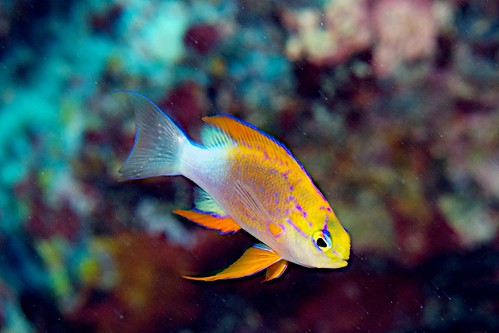
This photo shows a longfin anthias, a fairly rare fish which Len has been hoping to see for several days. The very accommodating diveshop, Kona Diving Company, made sure that they had one dive this morning where they found him, enabling Len to take this photo and also quite a few more -- all wonderful, in my opinion.

The entire boat trip today was unusually wonderful, as I already wrote to a few relatives. Before we were even much outside of the harbor we saw spinner dolphins on the surface, probably sleeping; then a big bottle-nose dolphin swam past us and went under the boat. Later we saw a pod of around 3 humpback whales jumping, breaching, and lifting their pectoral fins out of the water. They were around us for around the next 2 hours. We were unusually close to them, though outside the legal 100 foot distance. Better than many whale-watching trips, though they are supposed to be really good here at this time of year, when whales are migrating past the islands.

Diving and snorkeling -- which was what the boat trip was supposed to be for -- were both great. I snorkeled with a turtle and watched a school of fish swim under an archway in the coral and come out on the other side. Lenny saw a lot of stuff underwater, and took great photos, as I mentioned. I had my little camera with us, but the dolphins and whales weren't close enough for that type of photography. It was very sunny on the water, while at the same time, up on the mountain there was thunder and hail. (The captain's brother texted him about hail at 1500 feet).

So it was a nice end to our boat trips this time -- we don't have any scheduled for tomorrow, and our plane out is Monday. We hope the weather will cooperate with our scheduled planes coming back.

PS From the sea-facing terrace of the restaurant where we ate dinner, we saw a beautiful sunset with a real, though slightly anemic, green flash!

Tuesday, February 19, 2013

Tulgey Wood


As you walk from the parking lot at Honokohau Harbor to the nearby beach at the national historical park, you go through a very small wooded area which seems rather magical and tulgey! The parking lot is really ugly, so the woods seem very secluded and mysterious, like many of the dreamy sequences in Alice in Wonderland. Also, as you emerge from the woods the beach is dramatic, a cove surrounding the ruins of an ancient fish trap.

I've posted photos of the beach many times -- here are a couple of them from a few days ago showing the thatched shelter which I think would have originally been a place to store canoes, and showing the fish trap:

culturalfest2054
Honokohau Historical Park


culturalfest2044
Ancient Fish Trap and Two-Hulled Canoe at Honokouhau

Sunday, February 17, 2013

Hula Dances

volcano2272
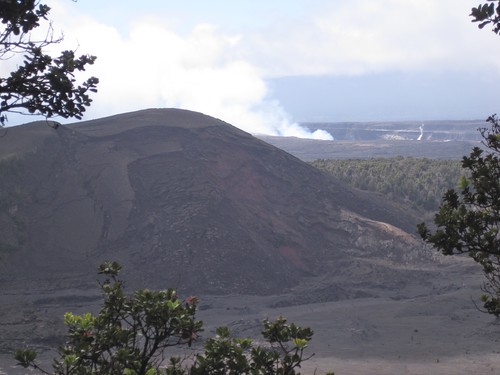
Fumes rising from the crater at Volcano National Park
Yesterday we drove to Volcano National Park, around 100 miles from Kona where we are staying. It was not very good weather most of the day, but we enjoyed the scenery anyway. Behind the outcropping of lava in the photo above, you can see the fumes and steam rising from the most active part of the crater, where there is currently a lava lake. Viewing the lake isn't possible because of the sulphur fumes.

When we first arrived, it was really raining hard, and a scheduled hula performance, which was supposed to take place in view of the crater, had been moved inside to the visitor center auditorium, usually used to show movies (so I couldn't get any good photos). The leader was an older man who chanted traditional song-stories in the Hawaiian language about the gods and kings of old Hawaii. A woman read a translation of the songs with some background information.

volcano2261
Hula dancer, Volcano National Park
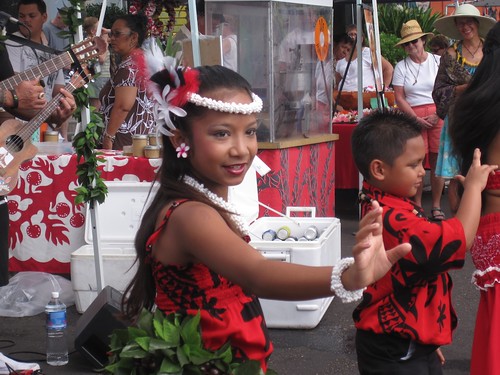
The most enthusiastic dancer -- though perhaps not the one who knew the dances best -- was this little girl, who posed for a photo on the visitor center porch after the performance.

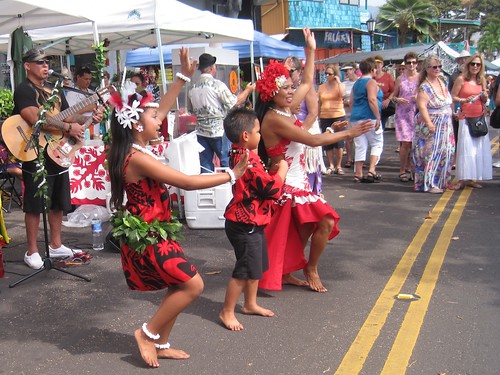
Today we saw a quite different hula performance at the monthly crafts market that occupies the main shopping street of downtown Kona. These dancers were very skilled, though the traditional song accompanying their dance may be a bit more recent -- "Little Grass Shack in Kealakekua, Hawaiʻi" -- written in 1933 in English with a few Hawaiian words. Traditions being what they are, the Hawaiian-language chants we heard yesterday could actually have been written more recently for the revival of pre-contact Hawaiian arts, but I don't really know. Everything about local history here is perplexing.

konasunday2296
Hula Dancers, Kona Sunday Craft Market

konasunday2292
Hula Dancers, Kona


konasunday2287
The market stalls, under their awnings, line the road along the waterfront
In case you are wondering, this cove is where the Iron Man triathlon begins and ends. Like many seaside hotels here, the hotel in the background of the photo is on the site of a royal palace, which would also have been a religious place. It's named the King Kamehameha hotel, in honor of the beloved king who united the islands -- he's celebrated by the chants of the Volcano hula dancers as well as by having a hotel named for him. Perplexed history.